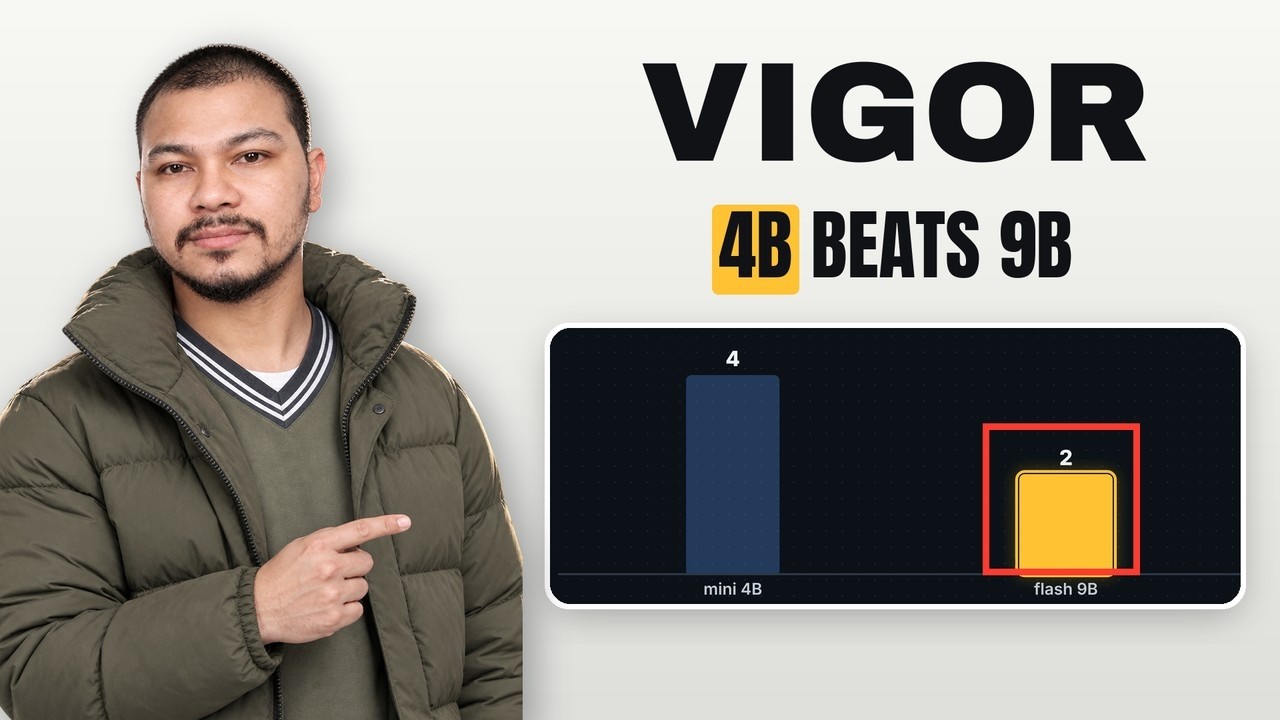
The video explores VIGOR, a new family of vision safety AI models designed to classify images as safe or not safe using strict JSON outputs. The presenter tests the 4 billion parameter “Mini” model and the 9 billion parameter “Flash” model on a laptop with an 8 GB RTX 4060 GPU, running 27 real-world images through them. VIGOR models are community fine-tuned versions built on Qwen 3.5, with a strict zero-tolerance prompt that flags nudity and suggestive content. The models output detailed JSON including scene descriptions, safety flags, reasons, and confidence scores, aiming to provide local, private content moderation without uploading sensitive images.
Regarding hardware compatibility, the 4 billion Mini model comfortably fits within the 8 GB GPU memory, using about 4 GB, while the 9 billion Flash model fits just barely at around 6.5 GB. The largest 27 billion parameter model is too large to run on this hardware. Memory usage includes the model weights, image processing, and context window tokens, with the Mini model leaving ample room for other tasks. This makes Mini a practical choice for local deployment on mid-range laptops, while Flash is more demanding and slower.
In testing with 27 images categorized as harmless, ambiguous, drawn/painted, and a trap image, Mini flagged four out of six risky images correctly with no false positives, achieving 100% precision and 67% recall. It accurately flagged nudity in classical art and statues but missed two borderline cases due to reasoning errors rather than vision errors. Flash, despite being larger, caught only two risky images and was more forgiving, applying its own judgment rather than strictly following the zero-tolerance prompt. Both models handled harmless images well and resisted a trap image designed to trick them by adding a “safe” banner.
Speed-wise, Mini processed images in about 4.2 seconds on average, faster than Flash’s 7.3 seconds, making Mini more suitable for quick, local filtering of personal or sensitive photo collections. The models spend most of their time generating detailed textual descriptions rather than image analysis, limiting throughput to roughly 14 images per minute. The presenter notes that the models’ strictness and behavior depend on the use case: parental controls benefit from Mini’s blunt approach, while creative platforms might prefer Flash’s nuanced judgment.
The video concludes with recommendations to start with the Mini 4-bit model for local safety filtering, emphasizing that it should be used as a first-pass filter with human review of flagged images. The presenter advises caution, noting the experimental nature of the models, the limited test set, and the need to test on one’s own images before trusting the system. Future tests could explore other quantization levels, the larger model on more powerful hardware, and comparisons with other vision safety models. Links and scripts are offered for viewers interested in further experimentation.
Useful Links