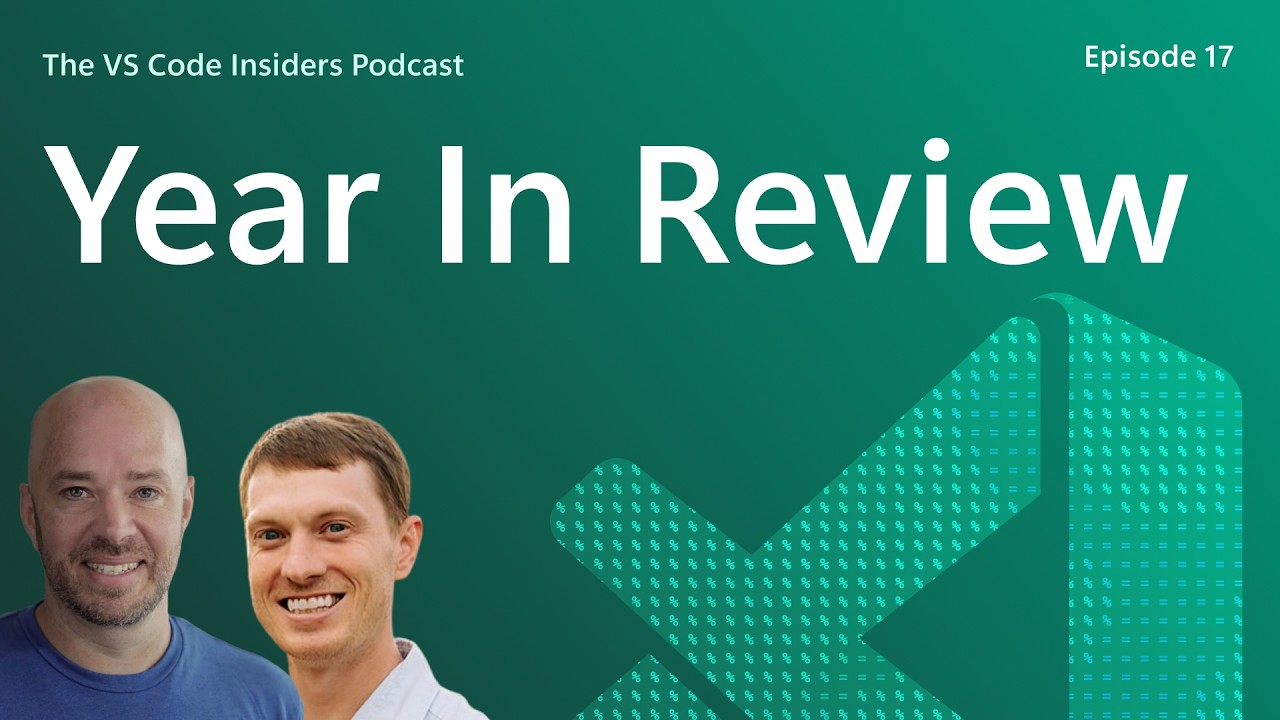
Certainly! Here’s a five-paragraph summary of the “VS Code - 2025 Wrapped with Burke Holland and Pierce Boggan” video, with spelling and grammar errors corrected:
Burke Holland and Pierce Boggan, both members of the Visual Studio Code (VS Code) team, reflect on a transformative year for VS Code, GitHub Copilot, and AI integration in developer workflows. They begin by recalling the pivotal release of Copilot Free in December of the previous year, which marked a significant acceleration in AI-powered development tools. This release, along with support for multiple AI model providers like Anthropic and Gemini, set the stage for a year of rapid innovation and feature rollouts.
Early in the year, the team shipped major updates such as Copilot Edits (General Availability) and Next Edit Suggestions. These features represented a shift in how developers interact with code—moving from manual code writing to prompting AI for code generation and edits. The introduction of agent mode in February was particularly significant, allowing AI agents to autonomously perform complex tasks across entire codebases using a set of tools, further evolving the developer’s partnership with AI.
March and April saw the launch of key customization and extensibility features. The team introduced MCP (Multi-Command Plugins), enabling users to bring their own tools and integrate them into the agent workflow. The “Bring Your Own Key” feature allowed developers to use their own AI models, including open-source and domain-specific models, within Copilot. Additional enhancements included custom instructions, chat modes (now called custom agents), notebook editing for data science workflows, and reusable prompt files (slash commands), all aimed at making AI assistance more flexible and team-friendly.
Throughout the summer and fall, the team focused on improving collaboration, security, and scalability. Notable releases included multi-window support for chat, improved tool management, cloud agent integration for background tasks, and open-sourcing Copilot Chat. Features like auto-approving terminal commands (with safety measures), worktree support, chat checkpoints, virtual tool sets, and sub-agents addressed the growing complexity of AI-driven development. The MCP Gallery and integration with OpenAI’s CodeX agent further expanded the ecosystem, allowing developers to experiment with multiple agents and tools seamlessly.
The year concluded with the introduction of background agents, a unified agents view, agent skills (formerly Claude skills), and ongoing support for the latest AI models from partners like OpenAI, Anthropic, and Google. Burke and Pierce emphasized the immense effort from the engineering team and the importance of community feedback in driving these advancements. They expressed gratitude to users for their engagement and support, acknowledging that the pace of change in AI and developer tools is only accelerating. Looking ahead, they anticipate even more groundbreaking developments in the coming year, building on the strong foundation laid in 2025.