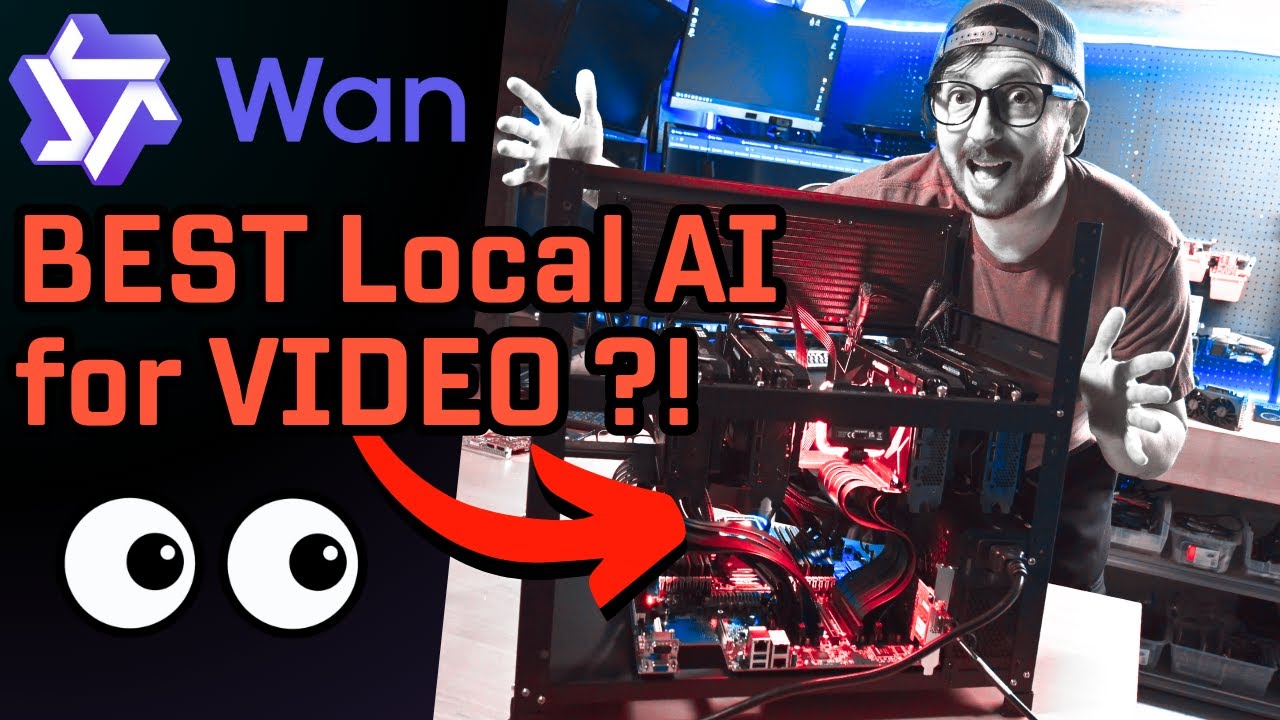
The video reviews WAN 2.1, a local AI video generator from Alibaba that allows users to create videos on their personal desktops, showcasing its capabilities in image-to-video and text-to-video generation. The presenter experiments with various prompts, discusses the model’s performance and output quality, and invites viewers to suggest future prompts while expressing a desire to improve their skills with the tool.
In the video, the presenter explores WAN 2.1, a local AI video generation model developed by the Alibaba Group. Unlike many video generation models that operate in the cloud, WAN 2.1 can be run on a personal desktop, making it accessible for users who prefer local processing. The presenter highlights the model’s capabilities, including image-to-video and text-to-video generation, and discusses the hardware requirements, specifically mentioning the use of a quad 3090 GPU rig. The video aims to demonstrate the quality of video generated by this model while also providing insights into its performance metrics.
The presenter begins by setting up the video generation process, using a prompt that describes two cats in boxing gear fighting on a stage. They note some initial challenges with the setup, particularly regarding the model’s VRAM requirements and the limitations of the smaller 1.3 billion parameter version being used. The video generation process is shown to take around eight minutes for a five-second video at a resolution of 480p, with the presenter expressing excitement about the potential quality of the output. They also mention the possibility of using larger models for better results.
As the video generation progresses, the presenter shares their observations about the output quality. They critique the generated video of the cats, noting that while it is decent, it could be improved. The presenter also discusses the differences in performance between the 3090 and the more powerful 4090 GPUs, emphasizing that the latter can handle video generation tasks more efficiently. They express interest in testing various GPU combinations to optimize performance and explore the capabilities of the WAN 2.1 model further.
The presenter continues to experiment with different prompts, including one featuring a calico kitten playing with a ball of yarn. They provide feedback on the generated video, highlighting both strengths and weaknesses in the animation quality and realism. The presenter notes that while the kitten’s appearance is satisfactory, the motion of the yarn is unrealistic. They also attempt to generate a video featuring a giant monster attacking a city, which yields mixed results, indicating that the model may require longer processing times for more complex scenes.
Throughout the video, the presenter encourages viewer interaction by inviting them to suggest prompts for future video generations. They acknowledge the learning curve associated with using the WAN 2.1 model and express a desire to improve their skills and settings for better results. The video concludes with a call to action for viewers to like, subscribe, and share their prompt ideas, as the presenter plans to continue exploring the capabilities of this local AI video generator.