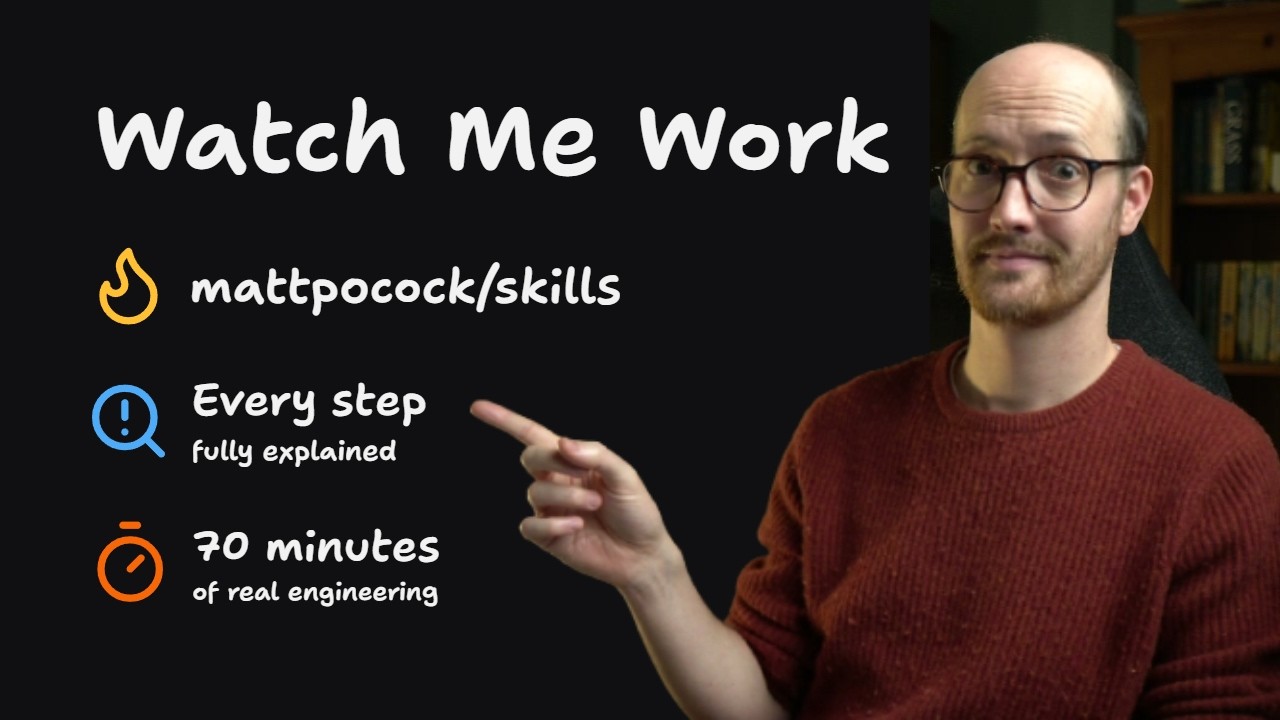
In this detailed walkthrough, the creator demonstrates their development process by building a substantial new feature—a thumbnail editor integrated with diagram editing—using their highly starred skills repository. The focus is on two key skills: “grill with docs,” which emphasizes domain modeling and clarifying the language and concepts of the application before coding, and the “retro” skill, which reviews completed work to identify improvements. The feature aims to streamline the creation of video thumbnails by allowing users to edit diagrams directly alongside a cutout of their face, addressing frustrations with the existing manual and fragmented workflow.
The process begins with a thorough grilling session using an AI agent to explore the problem space, ask clarifying questions, and define precise terminology for the new feature. This includes debating whether the thumbnail diagram should be treated as a full diagram, a snapshot, or a new concept altogether, and how it fits into the existing data model and glossary. The grilling phase helps align the developer’s understanding and the AI’s approach, ensuring that the feature’s design is well-grounded in the project’s language and architecture before any code is written.
Following the conceptual alignment, the creator works with the AI to prototype multiple UI variants of the thumbnail editor, iterating based on usability feedback. This prototyping phase is crucial for reducing ambiguity and decision space for the AI during implementation. Once a preferred design is chosen, the AI generates a detailed specification and breaks down the work into manageable tickets, enabling parallel development. The implement spec skill then runs autonomously to produce a large pull request containing over 21,000 lines of code, which the creator reviews carefully.
The human review phase involves scrutinizing the generated code for quality, maintainability, and adherence to coding standards. The creator identifies issues such as excessive comments, problematic TypeScript patterns, and opportunities for better API design. These findings lead to the creation of new linting rules and coding standards to improve the codebase over time. The large PR is further broken down into smaller, reviewable chunks with feature flags to minimize risk during deployment, reflecting best practices for shipping complex features in production environments.
Finally, the retro skill analyzes the entire development process, including the AI sessions and human review comments, to generate a prioritized list of improvements for the development environment and agent workflows. This retrospective highlights systemic issues like outdated documentation, prototype code reuse, and review limitations, prompting the creation of new issues to enhance the skills repository and tooling. The creator emphasizes the value of early alignment and final review phases in maximizing their impact, showcasing a sophisticated, AI-assisted development workflow that balances automation with human expertise.
Useful Links