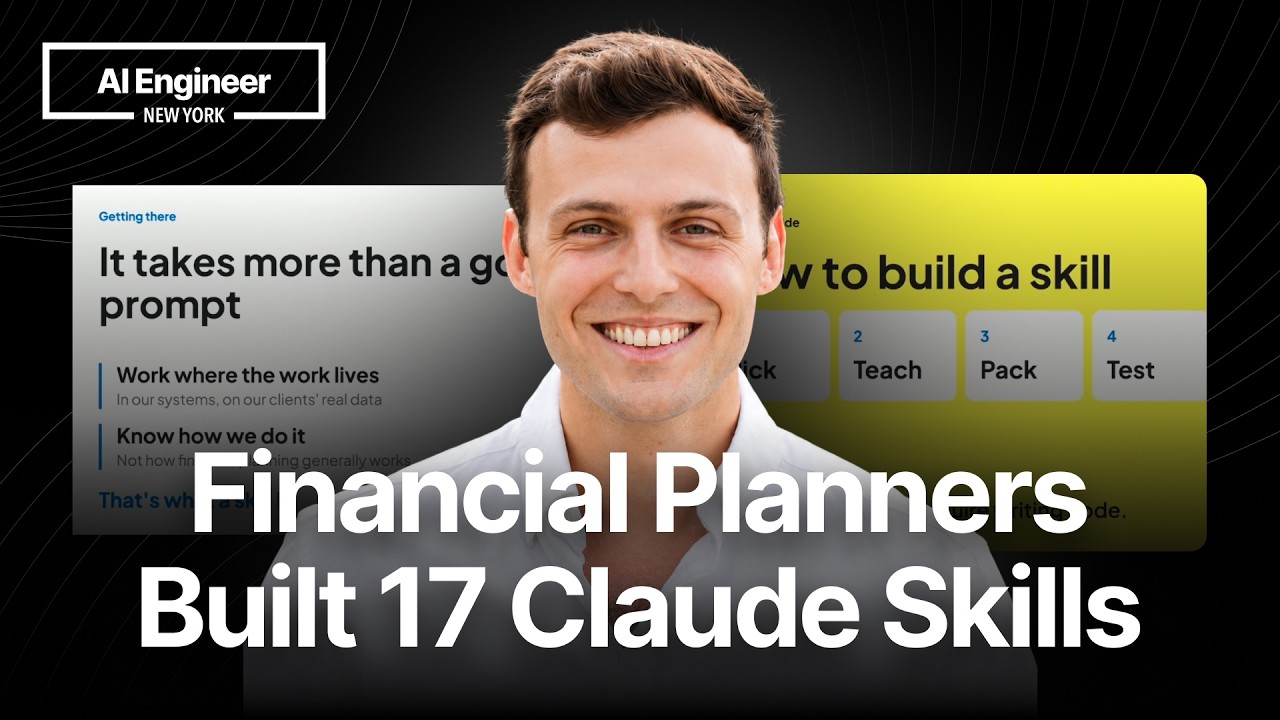
Matt Ragone, a financial planner at Range, shares how his team of financial planners, none of whom write code, successfully developed AI agents to assist with their daily work. Unlike typical AI talks from engineers, Matt approaches the topic from the perspective of end users in a regulated financial advisory environment, emphasizing that every AI-generated recommendation is reviewed by a planner before reaching clients. Initially, AI was used as a chatbot to speed up tasks like rewriting messages, but the real breakthrough came when agents began drafting complex analyses independently, allowing planners to focus on reviewing and refining rather than creating from scratch.
The key insight was recognizing that planners’ main limitation isn’t typing speed but their inability to multitask across clients simultaneously. By having AI agents draft analyses such as cash flow or insurance reviews while planners are engaged elsewhere, the team could increase efficiency without compromising quality. However, for this to work, the AI needed to operate within the planners’ existing workflows and understand the specific methods and language used at Range, rather than generic financial advice. This led to the creation of “skills,” which are detailed, firm-specific instructions that guide the AI in performing particular tasks.
Matt outlines a five-step process for building these skills without coding: picking a frequently repeated and manageable workflow, teaching the AI through real case examples with narrated judgment, packaging the process into a skill that includes necessary questions and strict limits, rigorously testing the skill on multiple cases to catch errors and edge cases, and finally shipping it with designated owners and reviewers to maintain accuracy and accountability over time. This method ensures that the AI’s output is trustworthy and aligned with the firm’s standards.
After six months, Range has developed 24 skills across various departments, with 17 in financial planning alone. The initiative organically spread beyond planning to sales, product, and marketing teams, all created and maintained by subject matter experts rather than engineers. This approach has led to more specialized and reliable AI agents, with peer review processes mirroring those used for client plans, fostering a culture of continuous improvement and shared responsibility.
Matt concludes by highlighting that the challenge is no longer whether AI can perform tasks like drafting financial analyses, but rather who documents the firm-specific processes, tests the AI’s output, and takes ownership as these tools become widely used. His experience at Range offers a practical framework for other organizations looking to integrate AI agents into their workflows while maintaining control and quality in regulated environments.
Useful Links