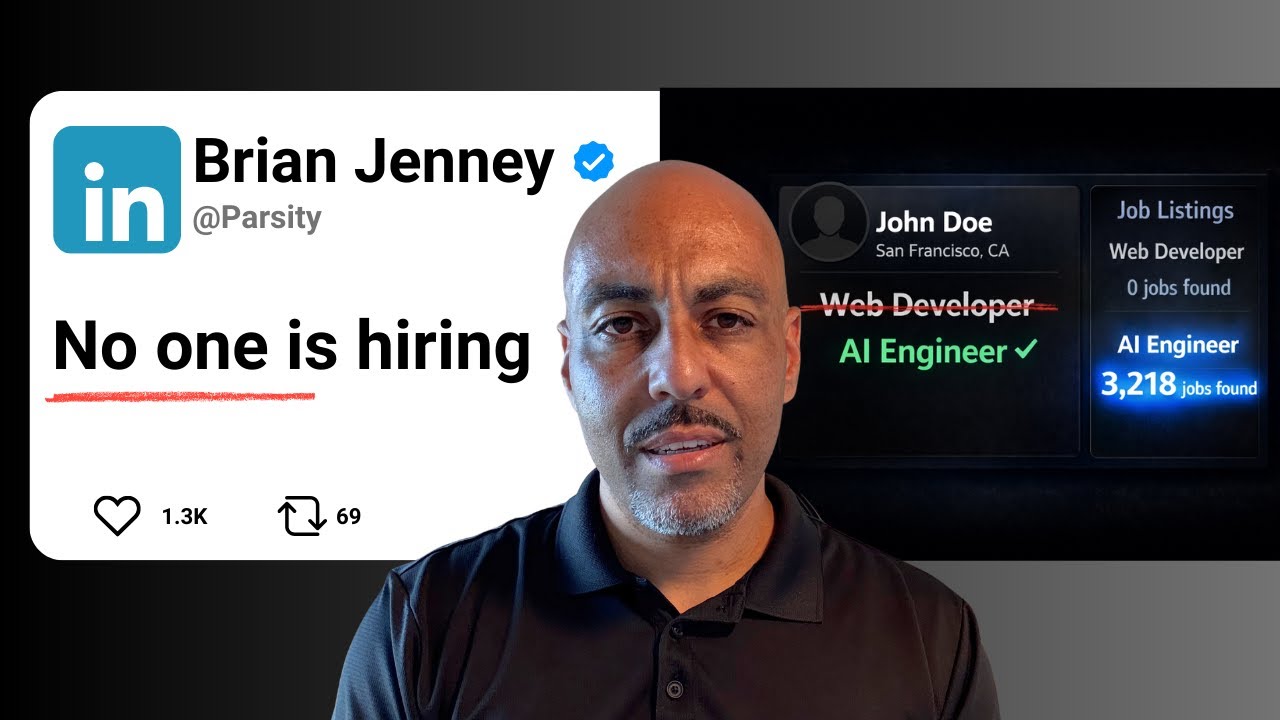
The video addresses concerns about the future of software engineering in the age of AI, emphasizing that instead of worrying about job security, developers should focus on acquiring the skills that are actually in demand for AI engineering roles. The speaker highlights that the term “AI engineer” is still evolving and somewhat ambiguous, but there are clear patterns in the skills companies are seeking, especially in the San Francisco Bay Area. The video aims to clarify what employers are really looking for, based on real job listings, rather than relying on online speculation or outdated advice.
A review of several AI engineering job postings reveals that most companies prioritize hands-on experience with AI and machine learning-powered systems, particularly those involving large language models (LLMs), rather than traditional data science or academic credentials. Skills such as proficiency in Python, building APIs, writing high-leverage design documents, and mentoring other engineers are commonly requested. Notably, there is little emphasis on degrees or certificates; practical experience and the ability to build and deploy AI systems are far more important.
Many of the roles examined focus on building agentic workflows, retrieval-augmented generation (RAG) architectures, and multi-agent orchestration. Familiarity with frameworks like LangChain, LangGraph, Crew AI, and Autogen, as well as experience with vector databases such as Pinecone and Weaviate, are frequently mentioned. The ability to work with LLMs in production, develop data ingestion pipelines, and optimize search quality are also highly valued. Salaries for these positions are often well into six figures, contradicting the narrative that tech jobs are disappearing.
The speaker stresses that the technical requirements for these roles are accessible and can be learned relatively quickly, especially through practical projects. Building and deploying non-trivial AI agents, implementing RAG systems, and integrating monitoring tools can make candidates stand out, even if they only have a few years of experience. The current scarcity of professionals with hands-on experience in these areas presents a unique opportunity for motivated developers to break into AI engineering.
In conclusion, while some AI roles may still require data science or machine learning expertise, the majority are looking for full-stack engineers who can build, deploy, and maintain AI-powered applications. The speaker encourages viewers to focus on acquiring practical skills—such as working with LLMs, agent frameworks, and vector databases—rather than worrying about formal qualifications or industry hype. By doing so, developers can position themselves at the forefront of the AI wave and take advantage of the significant opportunities available in this rapidly growing field.