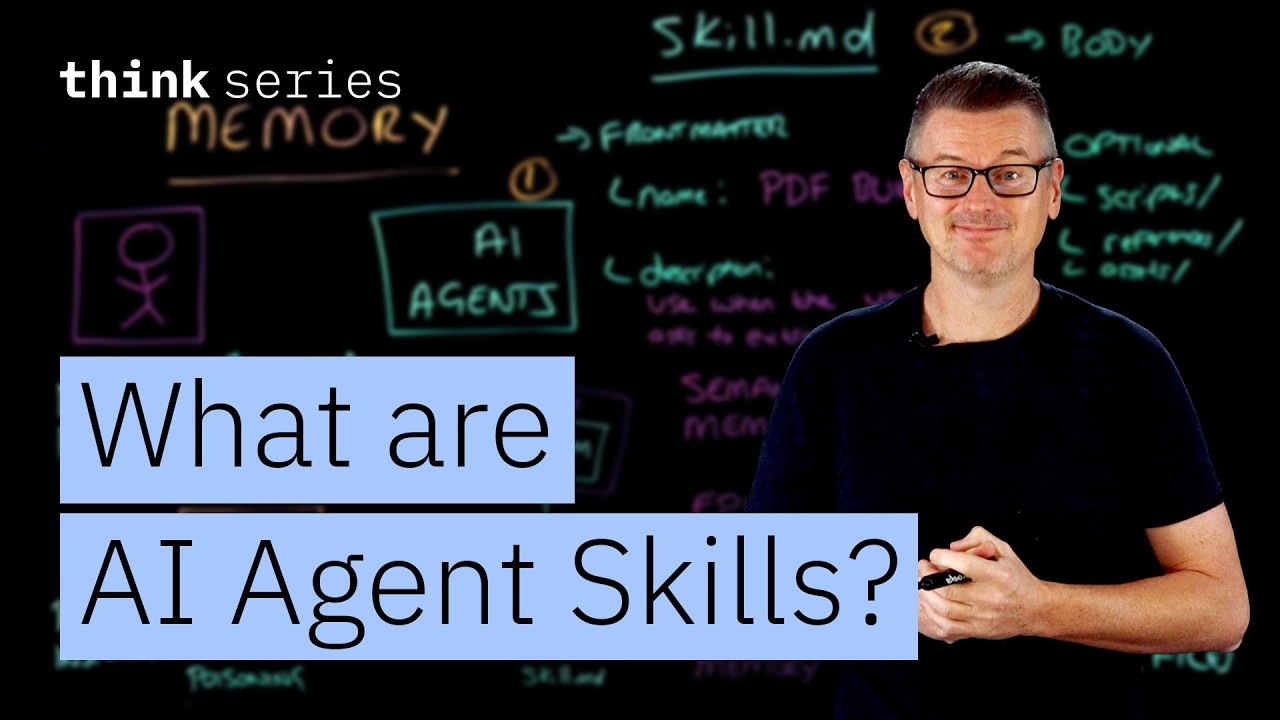
AI agent skills are specialized procedural knowledge modules that teach AI agents how to perform specific tasks step-by-step, addressing a key limitation of large language models (LLMs) which, while rich in factual knowledge, lack detailed procedural understanding. These skills are defined simply in a skill.md markdown file containing essential metadata like name and description, along with detailed instructions, examples, and optional resources such as scripts, references, and assets. This modular approach allows agents to handle complex workflows, such as generating a multi-step financial report, without needing exhaustive prompting for every step.
To manage potentially hundreds of skills without overwhelming the AI’s context window, skills use a method called progressive disclosure. This involves three tiers: initially loading only metadata (name and description) as a lightweight index, then loading full instructions when a task matches a skill’s trigger condition, and finally loading optional resources like scripts or templates only when specifically needed. This efficient loading strategy ensures that agents remain responsive and scalable while leveraging a broad range of procedural knowledge.
Skills complement other knowledge integration methods used in AI agents, such as Model Context Protocol (MCP) for tool access, Retrieval Augmented Generation (RAG) for factual knowledge retrieval, and fine-tuning for embedding knowledge directly into model weights. Unlike these, skills focus specifically on procedural memory—how to do things in the right order with appropriate judgment. They are easy to update, version control, and transfer across platforms, often incorporating other knowledge types like MCP to execute external actions when necessary.
The skill.md format is an open standard under the Apache 2.0 license, widely adopted by major AI platforms including Claude, OpenAI Codex, and others. This cross-platform compatibility means a skill created for one system can work on any other supporting the standard. Conceptually, skills align with cognitive science’s idea of procedural memory, complementing semantic memory (facts) and episodic memory (experiences) that AI agents also emulate through retrieval systems and conversation logs, respectively.
While skills empower agents with powerful capabilities, including running executable scripts with access to local systems and APIs, they also introduce security risks such as prompt injection, tool poisoning, and malware. Therefore, users must treat skill installation with the same caution as any software dependency—carefully reviewing and understanding skills before use. Overall, AI agent skills provide a structured, efficient, and open way to extend AI agents’ abilities to perform repeatable, complex tasks beyond mere factual recall.