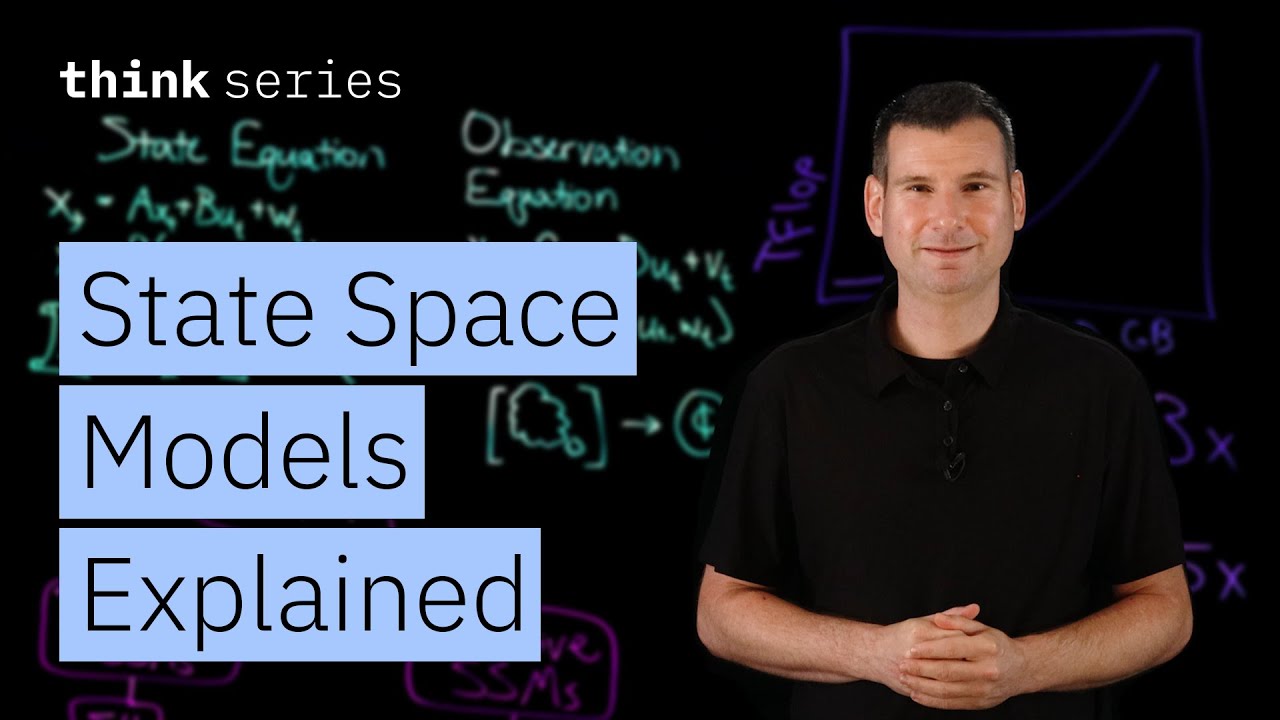
State Space Models (SSMs) are a powerful mathematical framework that is transforming artificial intelligence and machine learning, especially in handling sequential data like text, speech, and time series. Unlike traditional models, SSMs act as memory layers, learning how information evolves over time. They are designed to remember past events, update their memory as new patterns emerge, and make predictions based on this evolving state. This makes them particularly effective for tasks where understanding the progression of data is crucial.
At the core of SSMs are two main equations: the state equation and the observation equation. The state equation models how a hidden state changes over time, incorporating inputs and random variability (which can even contribute to creativity in generative AI). The observation equation maps this hidden state to the actual output, accounting for measurement errors. In generative AI, these equations help determine the next token in a sequence, allowing the model to generate coherent and contextually relevant outputs.
SSMs have roots in robotics, where they were used for tasks like position estimation in noisy environments. Today, they have been adapted for AI and machine learning, offering significant advantages over traditional transformer architectures. Transformers, while powerful, are memory-intensive and inefficient during inference, often bottlenecked by GPU memory bandwidth. SSMs, on the other hand, process long sequences more efficiently, using implicit memory structures that store only essential information rather than every past token.
Recent architectural breakthroughs, such as the Structured State Space Sequence model (S4), have further enhanced the capabilities of SSMs. S4 is designed to handle very long sequences efficiently, overcoming the scaling limitations of transformers. It models memory dynamics with a continually updated state vector, allowing it to remember important information from far back in a sequence without the computational overhead of transformers. This makes SSM-based models faster, more memory-efficient, and better suited for real-time applications.
Building on S4, the Mamba family of models introduces selectivity, enabling the model to focus on relevant information much like attention mechanisms in transformers, but with greater efficiency. Mamba models dynamically update their memory based on input, ignoring unimportant tokens and optimizing for modern hardware. These innovations have led to the development of small, high-performing models that can run on consumer devices, marking a shift from simply building larger models to creating ones that remember and process information more intelligently. SSMs, together with new architectures and hardware advances, are redefining the future of AI by enabling faster, smarter, and more efficient learning systems.