The video reveals a hidden energy crisis fueling the AI revolution in the United States, where major tech companies like Microsoft are securing vast amounts of nuclear power to train advanced AI models. This surge in demand has caused electricity prices to skyrocket, with data centers responsible for about 63% of the increase. As corporations lock up the cheapest and most reliable power, ordinary consumers face higher bills and a strained public grid struggling to maintain stability. The privatization of energy resources for AI workloads is quietly reshaping the electricity market, leaving households to bear the financial burden.
Contrary to popular belief in a clean energy boom, the U.S. is witnessing a complex energy landscape where nuclear plants are being restarted primarily to serve corporate data centers, while older fossil fuel plants are kept running longer to balance the grid. Deals like Microsoft’s 20-year agreement to power a restarted Three Mile Island reactor illustrate how clean energy credits are effectively reserved for private use, despite the electricity physically flowing through the shared grid. This bifurcation creates a two-tier system: firm, carbon-free nuclear power for hyperscalers and intermittent renewables plus fossil fuels for the general public.
The high reliability demands of AI data centers—requiring 99.999% uptime—make renewable energy insufficient on its own due to its intermittent nature. AI servers also generate immense heat, necessitating advanced cooling solutions that further increase power consumption. As a result, hyperscale data centers increasingly rely on nuclear power for consistent, carbon-free electricity. Meanwhile, the public grid absorbs the instability and costs of balancing intermittent renewables, leading to delayed retirements of polluting plants and escalating infrastructure investments, such as massive new transmission lines to serve data center clusters.
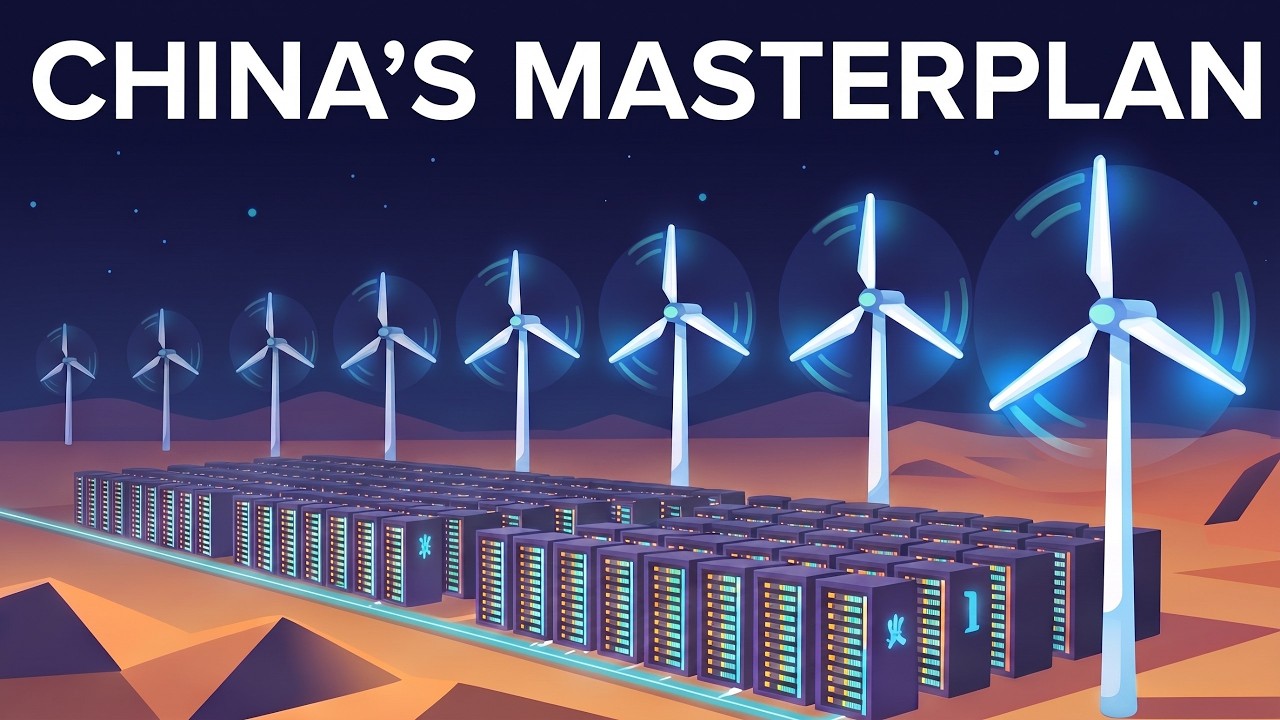
In contrast, China is implementing a coordinated national strategy called the East Data, West Computing initiative, relocating data centers to inland regions rich in renewable energy resources. This approach aligns computing demand with abundant, cheap power, reducing transmission bottlenecks and latency issues. By integrating energy policy, industrial planning, and infrastructure development under a unified state-led plan, China is rapidly building a scalable and efficient AI energy ecosystem. This contrasts sharply with the fragmented and privatized American system, where corporate interests dominate and public benefits are limited.
Finally, the video highlights the emergence of private nuclear microgrids in the U.S., where tech giants invest in small modular reactors (SMRs) dedicated exclusively to powering their data centers through private lines, bypassing traditional utilities and regulatory oversight. This creates a parallel energy system that deepens inequality, as the public grid deteriorates and consumers face rising costs without access to these new energy assets. The AI energy race is thus not just about technology but about control over critical infrastructure, with China’s integrated approach positioning it ahead, while the U.S. grapples with a divided and costly energy future.