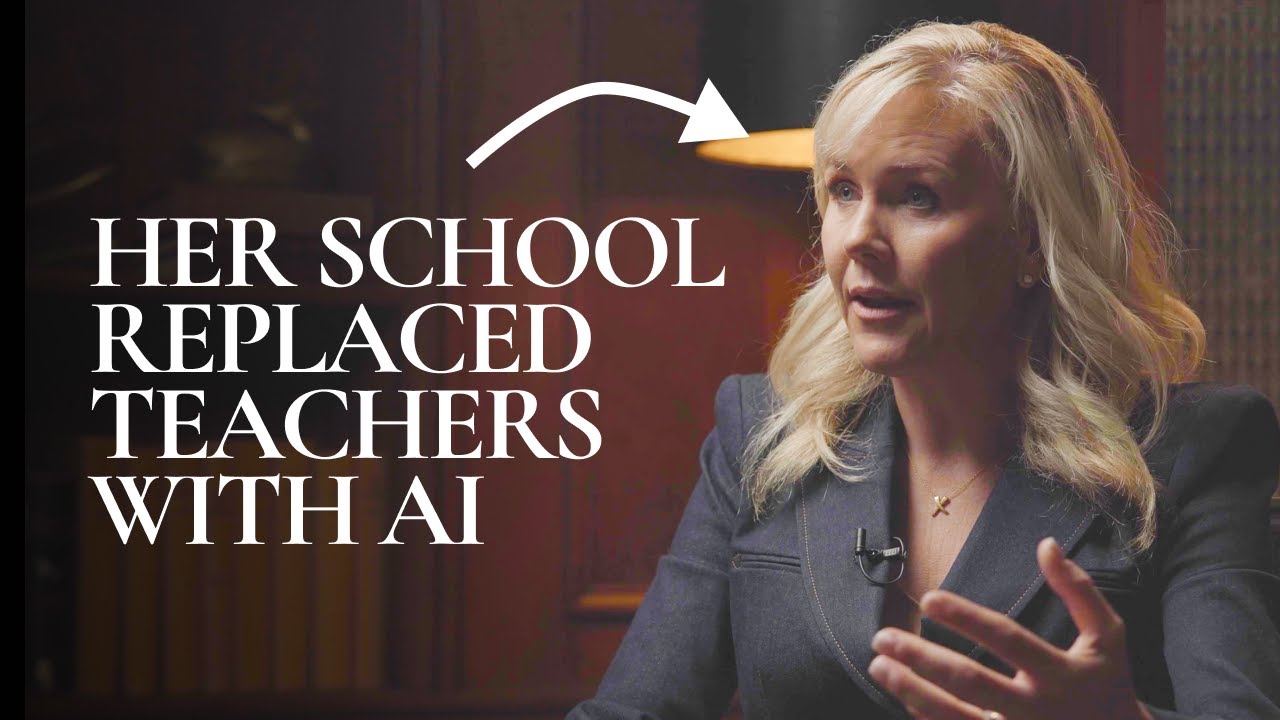
The video features an in-depth interview with Mackenzie Price, co-founder of Alpha, a K-12 school whose entire academic curriculum is delivered by AI. Price discusses the historical roots of modern education, tracing it back to the Prussian model designed to create compliant factory workers, and contrasts this with the personalized, mastery-based tutoring of the ancient Greek elite. She argues that the traditional classroom model, with a teacher lecturing to a group, is outdated and fails to meet the needs of individual students, often leading to disengagement and poor academic outcomes. Alpha’s approach leverages AI to provide each student with a personalized learning path, allowing them to master material at their own pace and fill in knowledge gaps, resulting in students consistently scoring in the 99th percentile on standardized tests while spending only two to three hours per day on academics.
A key innovation at Alpha is the use of AI not as a chatbot or robot teacher, but as an adaptive platform that analyzes each student’s progress, identifies their strengths and weaknesses, and delivers tailored lessons. This system enables efficient mastery of core academic content, freeing up the rest of the school day for project-based learning, life skills, and personal interests. The AI tracks student engagement and cognitive load, ensuring that each child is challenged at the right level without being overwhelmed or bored. Unlike traditional schools, where falling behind can lead to a cascade of academic struggles, Alpha’s model ensures that students achieve true mastery before moving on, preventing the accumulation of learning gaps.
Motivation is identified as the critical factor in student success, accounting for 90% of the outcome according to Price. Alpha employs a variety of extrinsic motivators, such as a school currency system, rewards, and team-based incentives, to encourage students to meet their goals. Over time, these external motivators are designed to foster intrinsic motivation as students gain confidence and competence. Teachers, rebranded as “guides,” focus on providing emotional and motivational support rather than direct instruction, building strong relationships with students and helping them discover their passions and strengths.
The interview also explores philosophical questions about education, such as whether virtue and agency can be taught, and the balance between nature and nurture. Price asserts that while cognitive abilities like IQ influence the pace of learning, all students can achieve mastery of core academics given the right environment and support. The Alpha model aims to cultivate a growth mindset, where students attribute success to effort and strategy rather than innate ability, fundamentally changing their self-perception and resilience. The system also leverages social status and peer recognition as powerful motivators, with public tracking of progress and opportunities for students to set and raise their own standards.
Finally, the discussion addresses concerns about scalability and equity. While Alpha currently operates as a high-end private school with extensive resources, Price argues that the core AI-driven personalized learning model is infinitely scalable and can be adapted for use in under-resourced settings, such as refugee camps, with appropriate motivational structures. The ultimate vision is to democratize access to high-quality, individualized education, freeing up time for students to pursue meaningful projects, develop life skills, and discover intrinsic motivation—preparing them not just for academic success, but for agency and fulfillment in the AI age.