In the video, Cameron, an experienced software developer and business owner, explores the paradoxical idea that AI, while automating much of the coding work, might actually increase the overall workload in software development projects. He begins by reflecting on how people’s responses to “How are you?” have evolved over the years—from simple answers to prideful busyness, and now to a bewildered sense of being overwhelmed. This shift, he suggests, mirrors a broader change in how work is experienced today, especially in tech fields where the pace and complexity of projects have intensified.
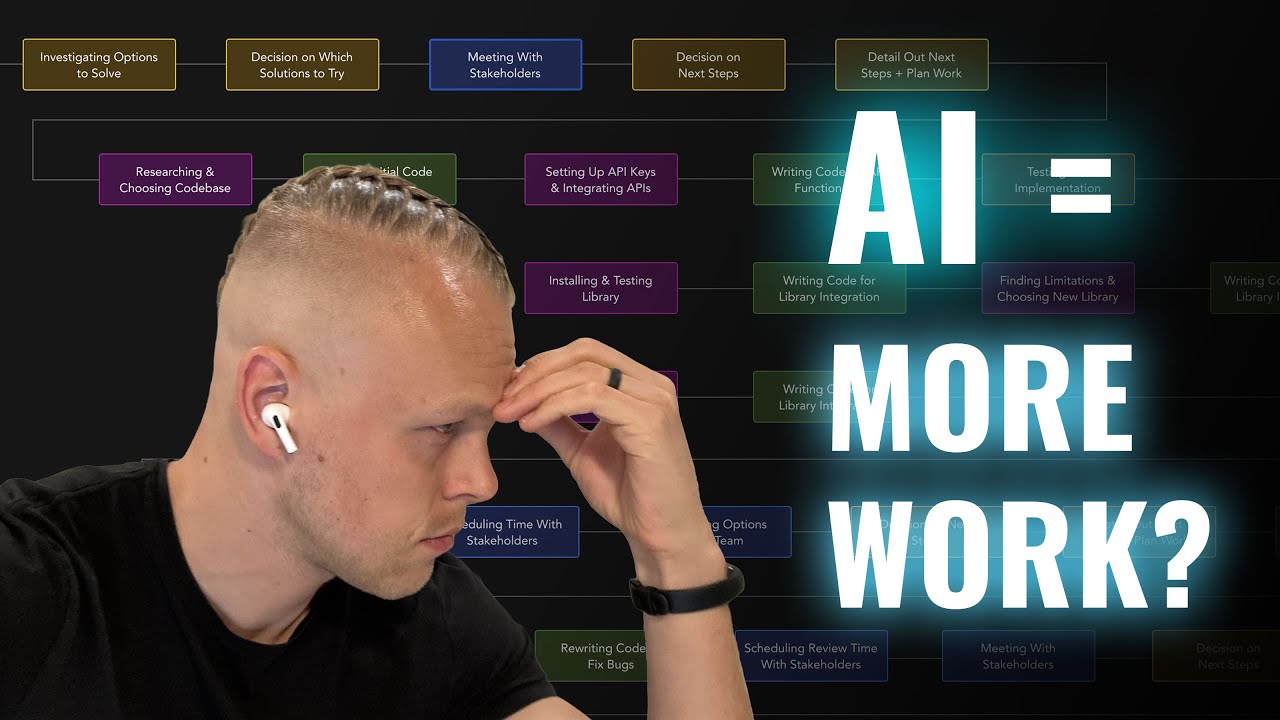
Cameron presents a detailed flowchart illustrating the many stages involved in a typical software project, emphasizing that coding is only a small part of the entire process. The workflow includes problem identification, research, planning, meetings, coding, testing, revisions, and stakeholder communications. He highlights that much of the project’s complexity lies outside of writing code, involving continuous decision-making, coordination, and quality assurance. This complexity often goes unrecognized by clients, who tend to focus solely on the coding aspect when commissioning work.
As AI increasingly takes over coding tasks, Cameron argues that the non-coding parts of projects—planning, communication, testing, and iteration—become even more demanding. The speed at which projects move has accelerated, requiring developers and teams to respond faster to stakeholder feedback and changing requirements. This rapid pace can lead to a feeling of constant busyness and overwhelm, as workers struggle to keep up with the flow of inputs and outputs, making work feel more intense despite AI handling more of the coding.
Despite these challenges, Cameron sees positive aspects in this new work dynamic. AI enables faster testing, deployment, and iteration of software, allowing more ideas to be realized and refined in the real world. This shift empowers problem solvers and broadens the scope of what can be achieved, even if it demands a different mindset and skill set—one focused more on integration, communication, and rapid adaptation than on traditional coding alone. He envisions a future where roles evolve into “digital solutions engineers” who manage complex workflows rather than just write code.
In conclusion, Cameron acknowledges that while AI may reduce the value of pure coding work, it simultaneously creates new opportunities for value creation in other areas of software development. He draws a parallel to historical technological advances that promised more free time but instead introduced new forms of work and communication challenges. Ultimately, he encourages embracing this evolving landscape with openness, recognizing that the nature of work is changing rather than disappearing, and invites viewers to engage with his ideas through comments and discussion.