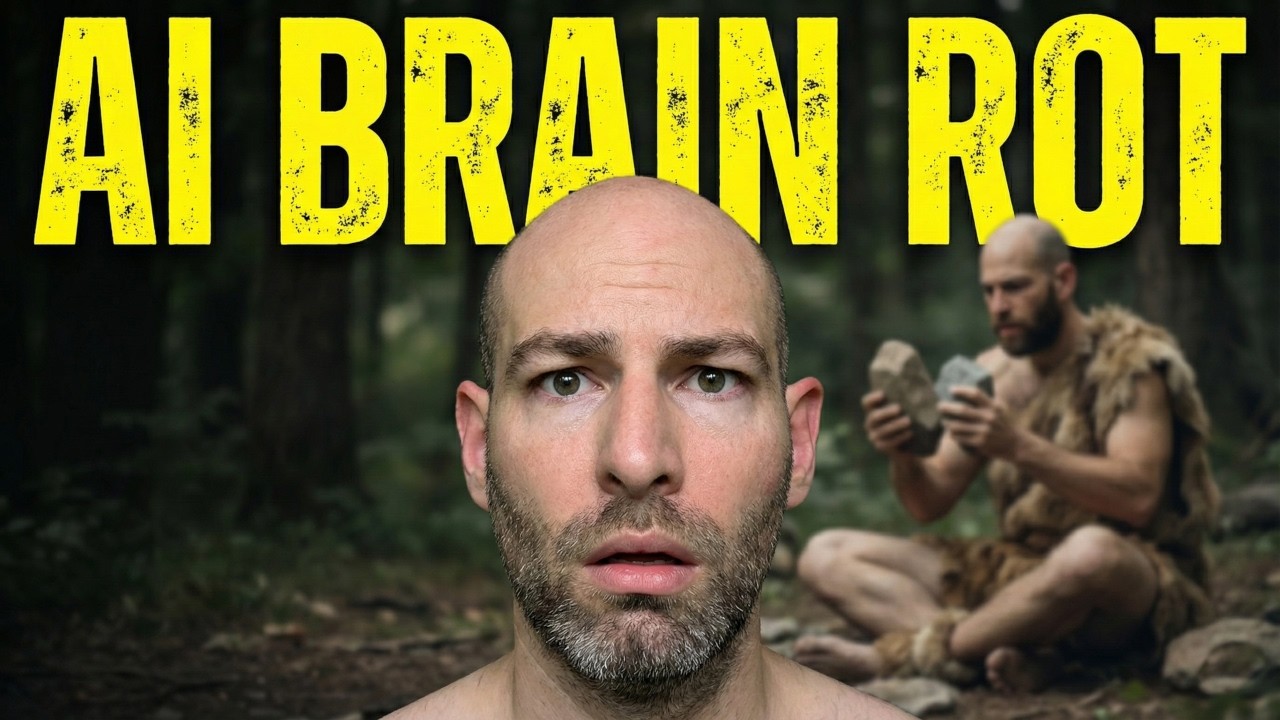
The video explores the concern that artificial intelligence (AI) might be making us intellectually lazier or “dumber.” The creator references a well-known MIT study that found reduced brain activity when students used AI tools like ChatGPT to write essays, but clarifies that the study’s design intentionally maximized cognitive offloading. Rather than debating the evidence for or against AI-induced “brain rot,” the speaker assumes for argument’s sake that some cognitive decay is happening and reflects on their own reliance on AI tools, such as Notebook LM, for research and content creation. They note that while AI-generated materials can be polished and efficient, they lack the cognitive challenge and performance aspect of extemporaneous speaking or riffing, which is a skill in itself.
Drawing a historical parallel, the speaker discusses Socrates’ skepticism toward writing, as Socrates believed that externalizing memory would weaken the mind. However, the speaker points out that writing and books ultimately enabled the growth of civilization by allowing knowledge to be shared and preserved. They argue that every new cognitive technology—from books to the internet to AI—raises similar concerns about offloading mental effort, but each also brings transformative benefits. The unique affordances of AI, such as compressing vast human knowledge into an interactive, accessible format, are described as “magic technology,” fundamentally different from previous tools.
The creator shares personal strategies to avoid over-reliance on AI, such as deliberately not saving chat threads and practicing the recall and explanation of concepts without external aids. They emphasize the importance of cognitive friction—struggling to synthesize, recall, and debate ideas—as essential “exercise” for the brain, akin to physical exercise for the body. Engaging critically with AI, debating its responses, and even pitting different chatbots against each other are presented as ways to keep one’s mind sharp and avoid passive consumption of AI-generated content.
From a societal perspective, the speaker considers whether widespread use of AI as a “cognitive prosthesis” could lead to collective intellectual decline. They note that while some people may blindly trust AI outputs, others will use these tools to fact-check, research, and develop more nuanced opinions. The speaker references research on information spread and “epistemic phase changes,” suggesting that if a critical minority uses AI thoughtfully, it could have positive ripple effects on society’s overall knowledge and reasoning standards.
Ultimately, the video concludes that while humans are naturally inclined to seek shortcuts and offload effort, the key is to remain mindful of how we use AI. The speaker warns that if AI becomes so advanced that it anticipates our needs without requiring us to articulate or think through our intentions, we risk losing essential cognitive skills. The actionable advice is to treat AI as a powerful tool or crutch—useful but not a replacement for active thinking and learning. Practicing old-school methods of reasoning and synthesis, alongside AI, is recommended to maintain and develop intellectual abilities.