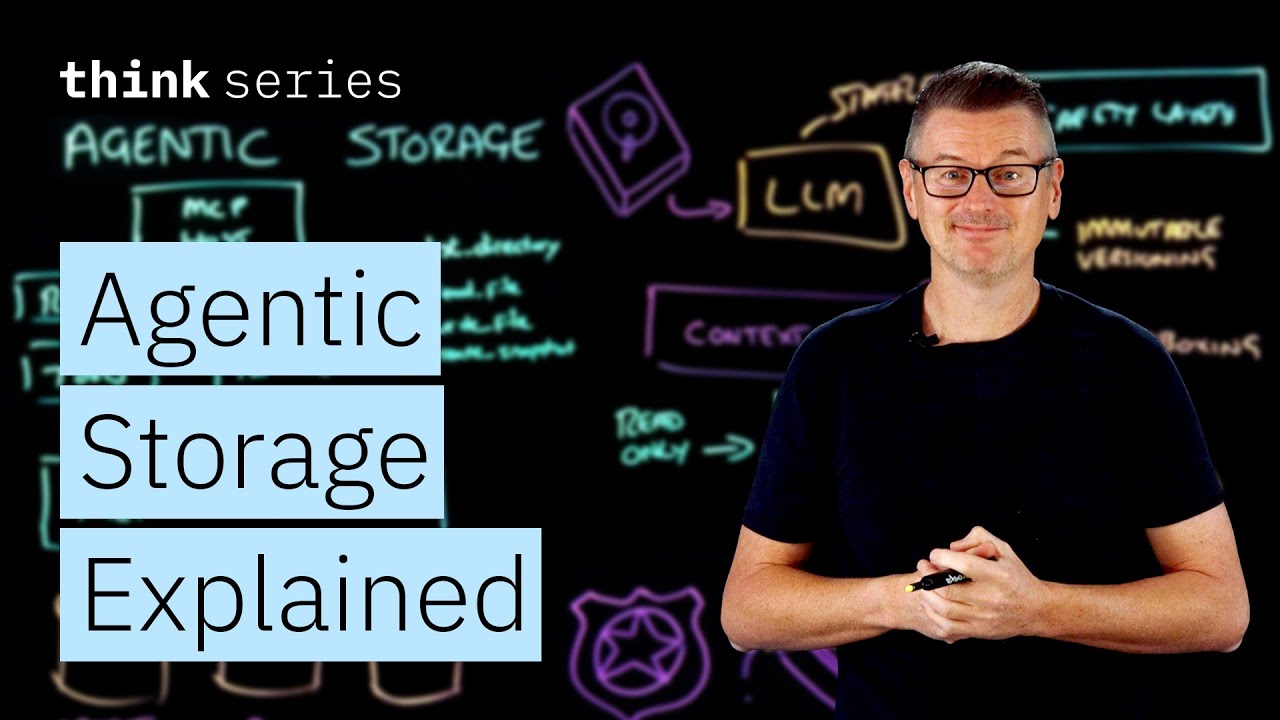
Agentic storage is a new approach that gives autonomous AI agents persistent, secure memory for their outputs and actions, overcoming the stateless limitations of large language models and the read-only nature of traditional retrieval systems. By using the Model Context Protocol (MCP), agentic storage standardizes how agents interact with various storage systems while incorporating safety features like versioning, sandboxing, and intent validation to ensure secure and auditable operations.
Agentic storage is a new concept designed to address the limitations of current AI systems powered by large language models (LLMs). Unlike traditional chatbots, agentic AI systems are autonomous and capable of performing complex tasks such as writing code or remediating incidents. However, LLMs are inherently stateless, meaning their memory is limited to the temporary context window—similar to a computer’s RAM. Once the session ends or the context window is full, the agent forgets its previous actions, which poses a significant challenge for persistent, autonomous work.
Retrieval Augmented Generation (RAG) partially addresses this issue by allowing LLMs to access external information stored in vector databases. Through semantic search, agents can pull relevant data into their context window before generating responses. However, RAG is fundamentally read-only and does not solve the problem of persisting the agent’s own outputs or work products. For example, if an agent writes a script or creates a playbook, there is no standardized way for it to store and retrieve this output across sessions.
Agentic storage aims to solve this by providing a persistent storage layer specifically designed for autonomous agents. It’s more than just giving an agent a hard drive; it’s about creating a storage system that understands and accommodates the unique needs of AI agents. Traditionally, integrating agents with various storage systems would require custom APIs for each type—object storage, block storage, or network-attached storage (NAS)—which is not scalable. The industry is moving toward a standard called the Model Context Protocol (MCP), which offers a uniform interface for agents to interact with different storage systems.
MCP works by separating the AI application (the MCP host) from the storage layer (the MCP server), regardless of the underlying storage technology. The protocol uses JSON-RPC and exposes two main primitives: resources and tools. Resources are passive data objects like files or database records, while tools are executable functions such as listing directories or writing files. This abstraction allows agents to interact with storage systems without needing to know the specifics of each one, making integration and scalability much easier.
Security and safety are critical concerns with agentic storage, as giving AI agents write access to storage infrastructure introduces risks. To mitigate these, agentic storage incorporates several safety layers: immutable versioning (every write creates a new version, ensuring a complete audit trail), sandboxing (restricting the agent’s access to specific directories and operations), and intent validation (requiring the agent to justify high-impact actions before execution). These measures ensure that agents can safely and persistently store their work, while providing robust oversight and rollback capabilities for human administrators.