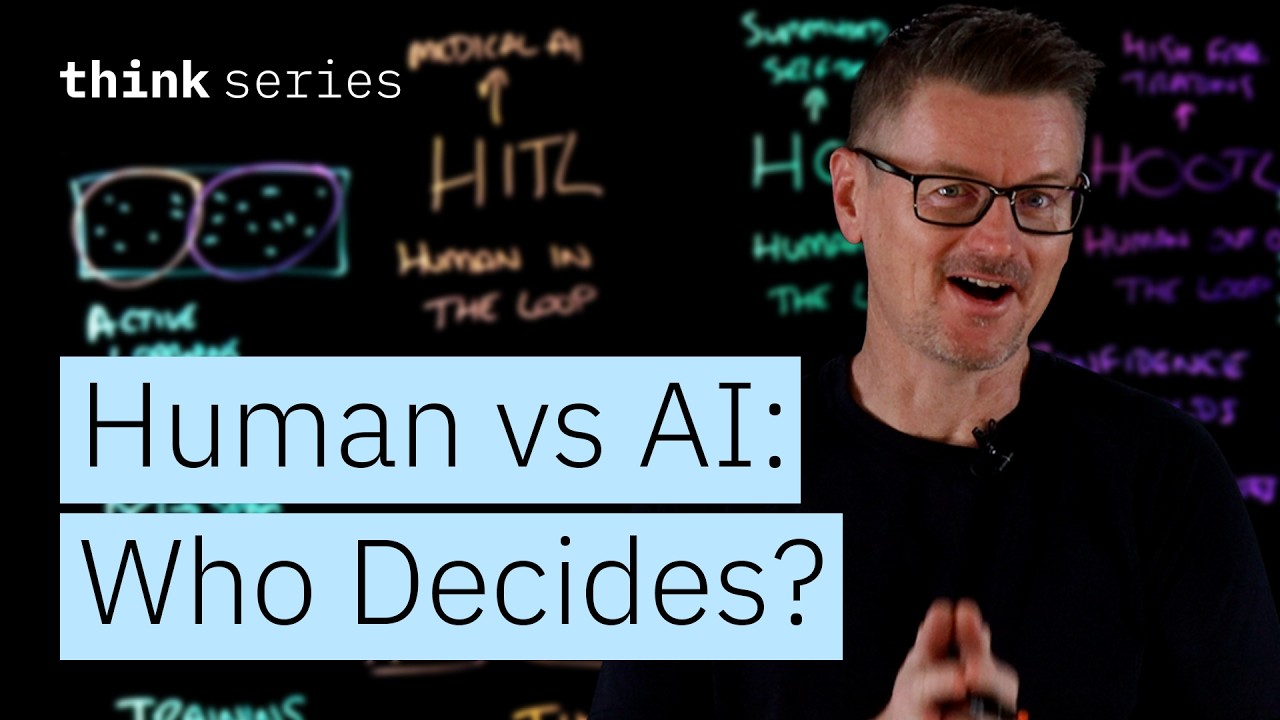
1. Human-in-the-loop (HITL) is a concept in AI that addresses the question of whether AI systems should operate autonomously or require human involvement. As AI becomes more capable and autonomous, deciding the level of human oversight becomes crucial. HITL represents a spectrum: at one end, strict HITL systems require human approval before proceeding; in the middle, “human-on-the-loop” systems allow humans to monitor and intervene if necessary; and at the other end, “human-out-of-the-loop” systems operate fully autonomously without human intervention.
2. Examples illustrate these levels of involvement: In medical AI, HITL is used when an AI flags potential issues (like tumors), but a human expert makes the final decision. Human-on-the-loop is exemplified by supervised self-driving cars, where the AI drives but a human must be ready to take over. Human-out-of-the-loop is seen in high-frequency trading, where AI systems act so quickly that human intervention is impractical. The choice of where to involve humans depends on the stakes, speed, and reliability required by the application.
3. Human involvement in AI can occur at three main stages: training, tuning, and inference. During training, humans label data to provide ground truth for supervised learning, which is essential but labor-intensive and costly, especially in specialized fields. Active learning can make this process more efficient by having humans label only the most challenging cases. This ensures that human effort is focused where it is most needed.
4. In the tuning phase, humans help refine AI behavior through techniques like Reinforcement Learning from Human Feedback (RLHF). Here, humans compare AI-generated responses and indicate preferences, which are used to train a reward model that guides the AI toward more desirable outputs. At inference (runtime), humans can be involved through mechanisms like confidence thresholds (where uncertain cases are routed to humans), approval gates (requiring human sign-off for certain actions), and escalation queues (flagging edge cases for human review).
5. While HITL provides knowledge, judgment, and guardrails to AI systems, it also introduces trade-offs such as scalability and consistency. Human involvement can become a bottleneck in high-volume systems, and human subjectivity can lead to inconsistent results. The ultimate goal is not to keep humans in the loop indefinitely, but to gradually move toward greater autonomy as the AI system earns trust—progressing from HITL, to human-on-the-loop, and eventually to fully autonomous operation. This maturity curve is typical for AI deployment, ensuring safety and reliability as systems evolve.