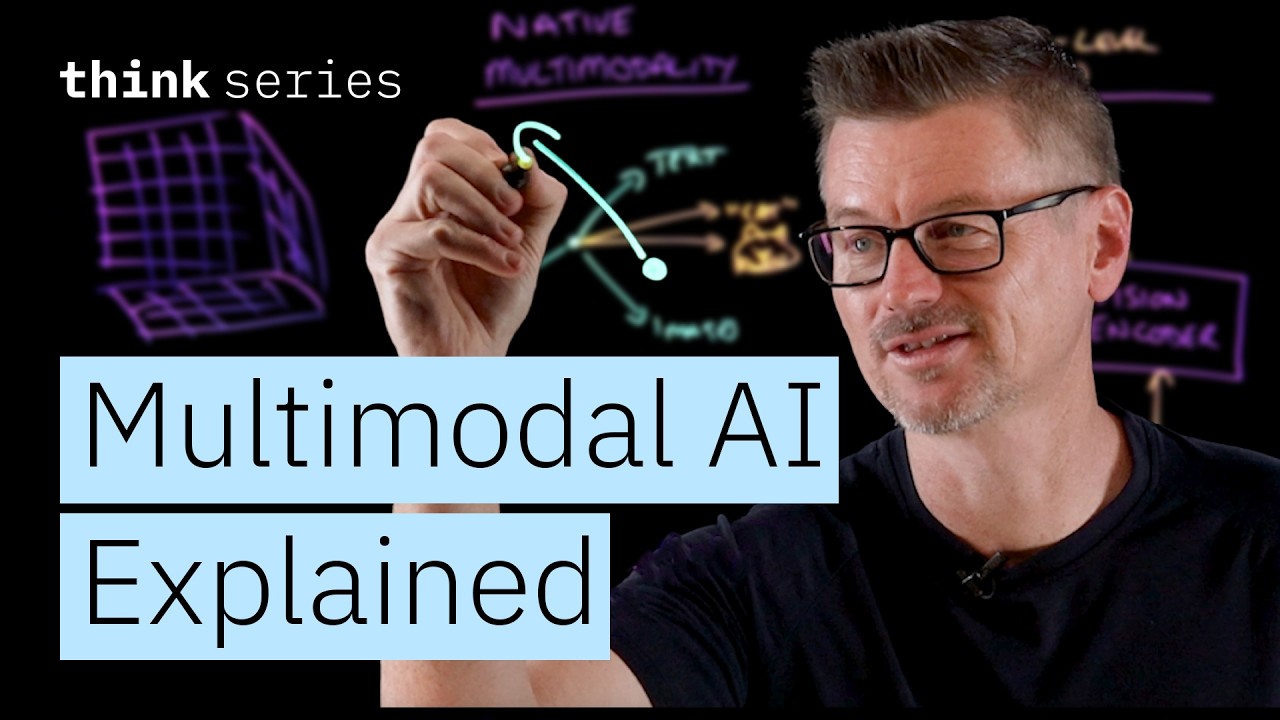
Multimodal AI refers to artificial intelligence models capable of processing and generating multiple types of data, or modalities, such as text, images, audio, and more. Traditionally, large language models (LLMs) have been single modality, handling only text input and output. However, when incorporating other modalities like images, a multimodal AI model is required to understand and integrate these diverse data types. This capability allows users to provide mixed inputs, such as text combined with images, enabling richer and more versatile interactions.
Early multimodal AI systems often used a modular feature-level fusion approach, where separate models handled different modalities. For example, a vision encoder would process images into numerical feature vectors, which were then passed to a text-based LLM. While this method allowed integration of multiple data types, it had limitations, such as potential information loss during the transfer of features between models. Despite these drawbacks, feature-level fusion remains useful for specialized tasks due to its cost-effectiveness and modularity.
A more advanced approach is native multimodality, where different modalities are processed within a shared vector space. In this system, text, images, audio, and other data types are tokenized and embedded into the same high-dimensional space, allowing the model to reason about them simultaneously. For instance, image patches and words like “cat” would be represented as points close to each other in this space, reflecting their semantic similarity. This shared representation enables the model to attend to relevant details across modalities in real-time, improving accuracy and coherence.
When it comes to video, multimodal AI must handle the temporal dimension, as video data involves sequences of frames over time. Early models sampled individual frames for processing, which could miss important motion information. Native multimodal models address this by embedding video as spatial-temporal patches—3D cubes that capture both spatial and temporal information. This allows the model to understand motion and changes over time directly within the tokens, enhancing its ability to interpret and generate video content.
Finally, multimodal AI models are not limited to ingesting multiple modalities; they can also generate outputs across different types. Because all modalities share the same vector space, these models support any-to-any generation, meaning they can take in any combination of modalities and produce outputs in any combination as well. For example, a model could explain how to tie a tie using text instructions and simultaneously generate a short video demonstrating the process. This seamless integration of seeing, reading, hearing, and responding exemplifies the current state of multimodal AI technology.