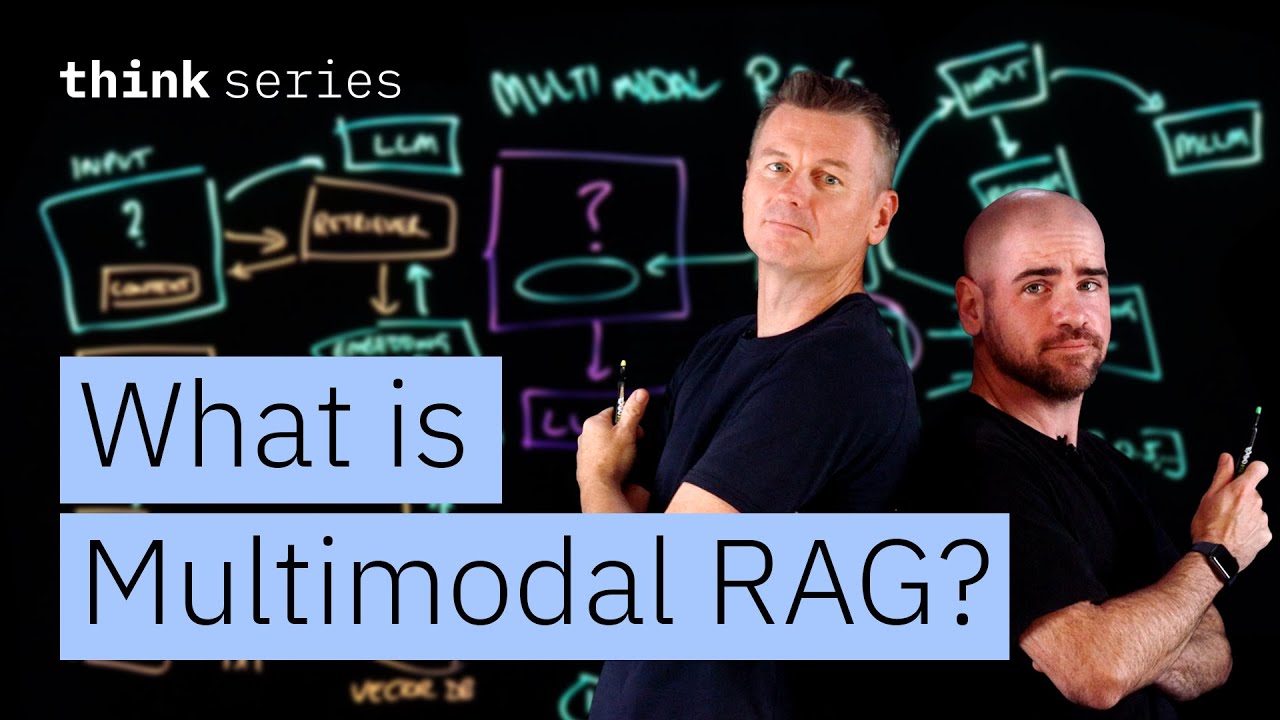
The video explains the concept of Retrieval Augmented Generation (RAG), a technique that allows large language models (LLMs) to access and use external information, such as up-to-date documents or search results, to answer user queries more accurately. In a typical RAG setup, documents are processed offline by an embedding model, which converts chunks of text into vectors that capture their meaning. These vectors are stored in a vector database. When a user asks a question, the query is also embedded as a vector, and the system retrieves the most relevant document chunks from the database to provide context for the LLM’s response.
However, real-world data is often not limited to text; it can include images, diagrams, videos, and audio files. To handle this, the video introduces the concept of multimodal RAG, which enables the retrieval and understanding of information across multiple data types, not just text. Each modality—text, images, audio, video—requires its own preprocessing and embedding approach to ensure that relevant information can be retrieved and aligned with the user’s query.
The first approach discussed is “text-ify everything RAG,” where all non-text data is converted into text. Images are run through captioning models to generate descriptions, and audio or video is transcribed into text. These textual representations are then processed just like any other text document in the RAG pipeline. While this method is simple and leverages existing text-based retrieval systems, it can lose important visual or contextual information, especially when captions or transcripts fail to capture the nuances of the original data.
The second approach is “hybrid multimodal RAG.” Here, retrieval still happens over text—using captions and transcripts—but the system keeps pointers to the original non-text data. When relevant information is retrieved, both the text and the associated images, audio, or video are passed to a multimodal LLM capable of reasoning over multiple data types. This allows the model to access the full richness of the original data when generating answers, but the quality of retrieval still depends on the quality of the textual representations.
The most advanced approach is “full multimodal RAG,” which uses a multimodal embedding stack to encode text, images, audio, and other modalities into a shared vector space. This enables the system to perform similarity searches across all data types directly, without relying solely on text-based proxies. As a result, both retrieval and generation are fully multimodal, allowing the LLM to ground its answers in the most relevant information, regardless of format. This approach is more complex and computationally demanding but provides the most comprehensive and accurate results. The video concludes by summarizing these three approaches and highlighting their respective trade-offs.