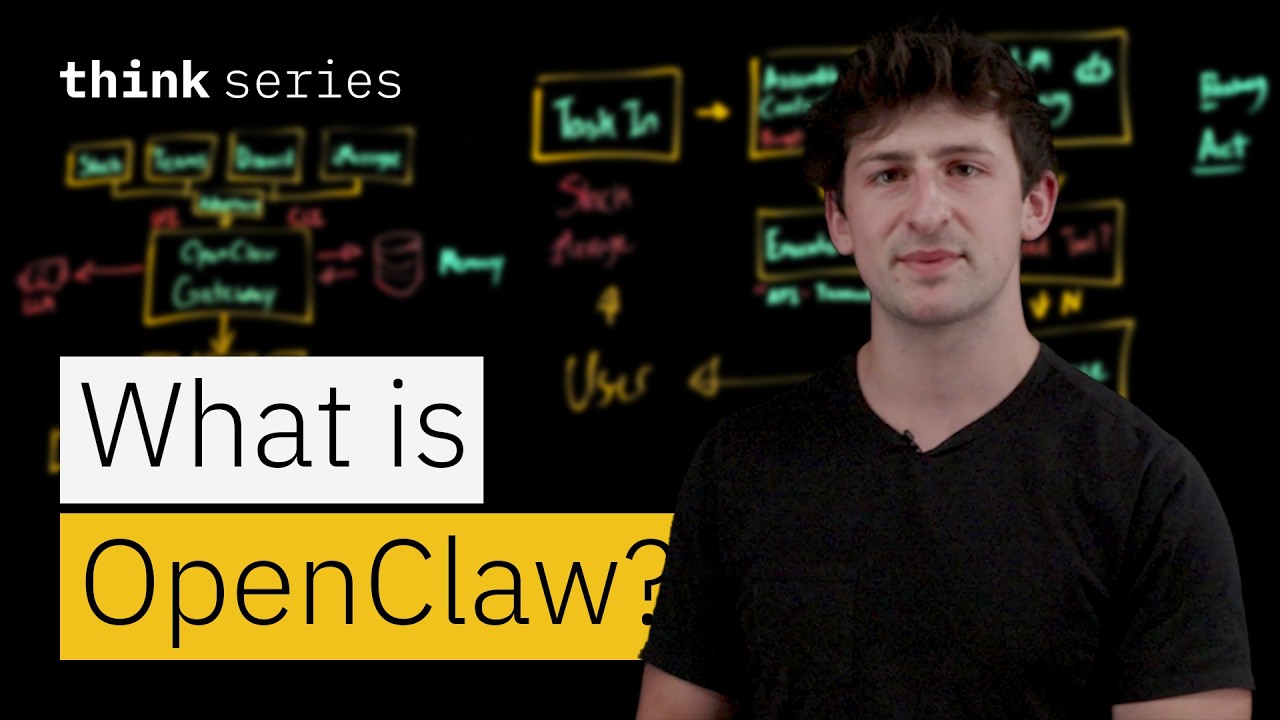
The video introduces the concept of AI agents, highlighting the gap between traditional AI chatbots and autonomous task execution. While large language models (LLMs) like GPT or Claude can generate responses to user queries, they typically require human intervention to perform actions such as scheduling meetings or managing emails. AI agents bridge this gap by integrating LLMs with tools that enable them to autonomously carry out tasks, eliminating the need for users to manually transfer information or operate different applications. This shift from simply “knowing” to actively “doing” is central to the discussion, with OpenClaw presented as a leading example of such an AI agent.
OpenClaw operates through an agentic loop, a continuous cycle of reasoning, acting, and observing until a task is completed. When a task is received—whether via Slack, iMessage, or other communication platforms—the agent compiles relevant context including conversation history, long-term memory, system instructions, and available tools. This context is sent to the LLM, which decides whether to use tools like web browsers, terminal commands, or APIs to gather additional information. The results from these tools are fed back into the context, allowing the agent to refine its response and actions iteratively until the task is resolved and the final output is delivered back to the user.
Technically, OpenClaw runs as a local Node.js service on devices ranging from laptops to Raspberry Pis, following a hub-and-spoke architecture centered around a gateway. This gateway manages message routing, session control, and tool usage, and supports multiple communication adapters to unify inputs from various platforms. The LLM can be hosted locally or accessed via APIs, and it leverages stored data such as long-term memory and prompt templates to enhance its reasoning. OpenClaw’s extensibility comes from its “skills”—modular folders containing markdown files that teach the agent how to perform specific tasks, from managing Trello boards and Google Calendars to running Docker commands or interacting with CRMs and GitHub.
Security is a critical consideration with OpenClaw due to its powerful access to local systems and integrations. Misconfigurations can expose users to significant risks, including unauthorized remote access and execution of malicious code embedded in skills or input data. The video emphasizes the importance of running OpenClaw in isolated environments, carefully reviewing code, encrypting credentials, and guarding against prompt injection attacks where malicious instructions might be hidden in untrusted inputs. Responsible deployment and governance practices are essential to safely harness the capabilities of AI agents like OpenClaw.
In conclusion, the video frames OpenClaw as a pioneering open-source AI agent that exemplifies the transition from conversational AI to autonomous task execution. It highlights the agentic loop as a fundamental pattern for AI agents and showcases OpenClaw’s architecture, capabilities, and extensibility. While acknowledging the existence of other frameworks, the video underscores OpenClaw’s growing popularity and practical utility. Viewers are encouraged to engage with the topic responsibly, considering security and governance, and to participate in ongoing discussions about the future of AI agents.