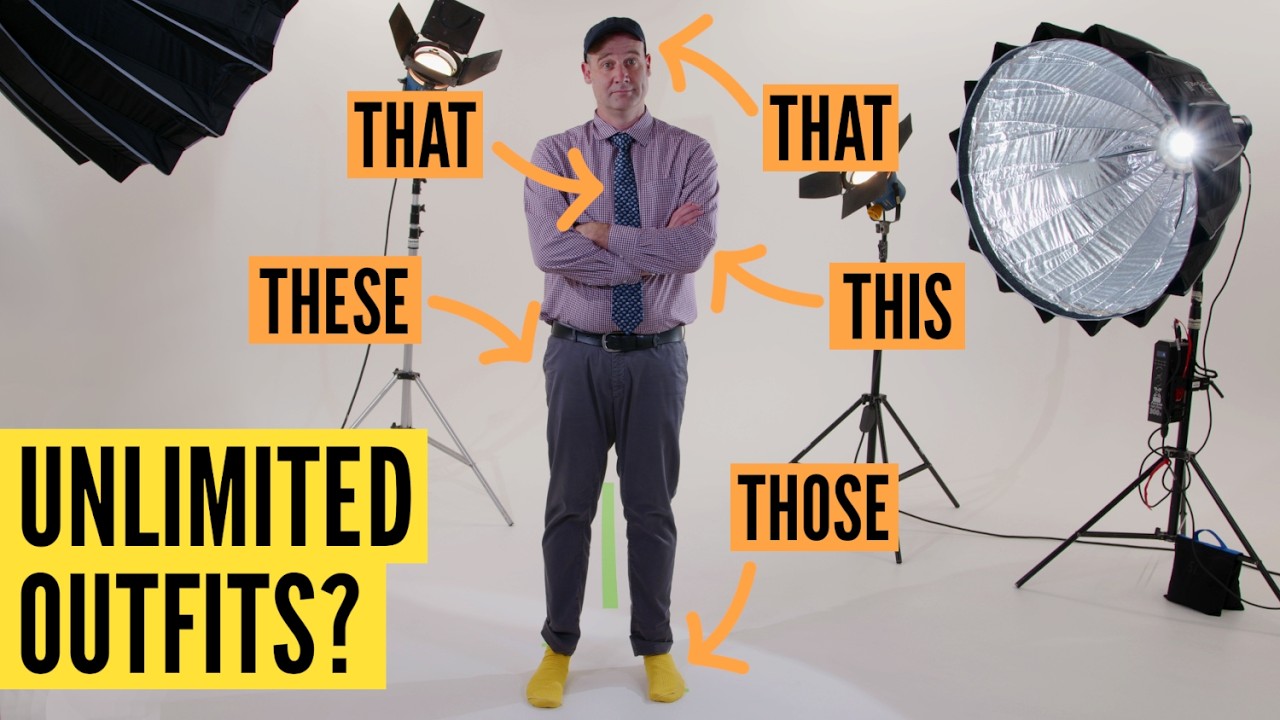
The video explores the mathematical question of how few items of clothing one would need to own to avoid repeating an outfit for an entire year. The presenter begins by considering the total number of unique outfits needed—365 for a non-leap year—and breaks down this number into its prime factors (73 and 5). This factorization suggests that owning 73 items in one category (like shirts) and 5 items in another (like trousers) would yield exactly 365 unique outfit combinations. For a leap year with 366 days, the prime factors are 2, 3, and 61, meaning owning items in three categories with those quantities would suffice. The presenter also discusses the concept of “null” items—choosing not to wear something in a category—which can increase outfit combinations.
The focus then shifts to efficiency, aiming to minimize the total number of clothing items rather than just hitting the exact number of outfits needed. By analyzing prime factorizations of numbers greater than 366, the presenter finds that some combinations require fewer total items while still exceeding the number of days in a year. For example, having 31 ties and 12 shirts yields 372 outfits with only 43 items, which is fewer than the 78 items needed for the exact 365 outfit solution. The presenter also considers minimizing the number of categories to reduce the complexity of changing multiple clothing types daily, highlighting combinations like 5 by 7 by 11, which require only 23 items across three categories.
To test the practicality of these mathematical solutions, the presenter goes shopping on Oxford Street, aiming to buy a year’s worth of outfits at minimal cost while considering style and ethical factors. They find that some clothing items, like hoodies or trousers, are expensive, while smaller items like socks offer a cost-effective way to increase outfit combinations. The presenter ultimately chooses a “math teacher” style wardrobe consisting of five ties, five shirts, five pairs of socks, and two hats, totaling 375 unique outfits. This selection balances cost, style, and the mathematical goal of maximizing outfit combinations with a manageable number of items.
The video also showcases the challenge of physically wearing and displaying all 375 outfits, including a stop-motion catwalk sequence filmed in a studio. Despite running out of time and being kicked out of the studio, the presenter humorously reflects on the effort involved and the fun of never repeating an outfit. They invite viewers to spot a missing outfit in the footage as a fun challenge. The conclusion emphasizes that the absolute minimum number of clothing items needed to never repeat an outfit for a year is nine, assuming you can treat each item as a binary choice (wear or not wear), yielding 512 possible combinations.
Finally, the presenter discusses the broader implications of this combinatorial approach to clothing, noting that owning 29 items arranged in nine categories with three options each could provide over 39,000 unique outfits—enough to last more than a century. They acknowledge practical considerations like cost and style preferences, suggesting that a wardrobe of 17 to 18 items is more realistic for most people. The video ends with an offer to sell the clothes used in the experiment for charity and a thank you to viewers, encouraging them to consider the fascinating intersection of mathematics and everyday life through clothing combinations.