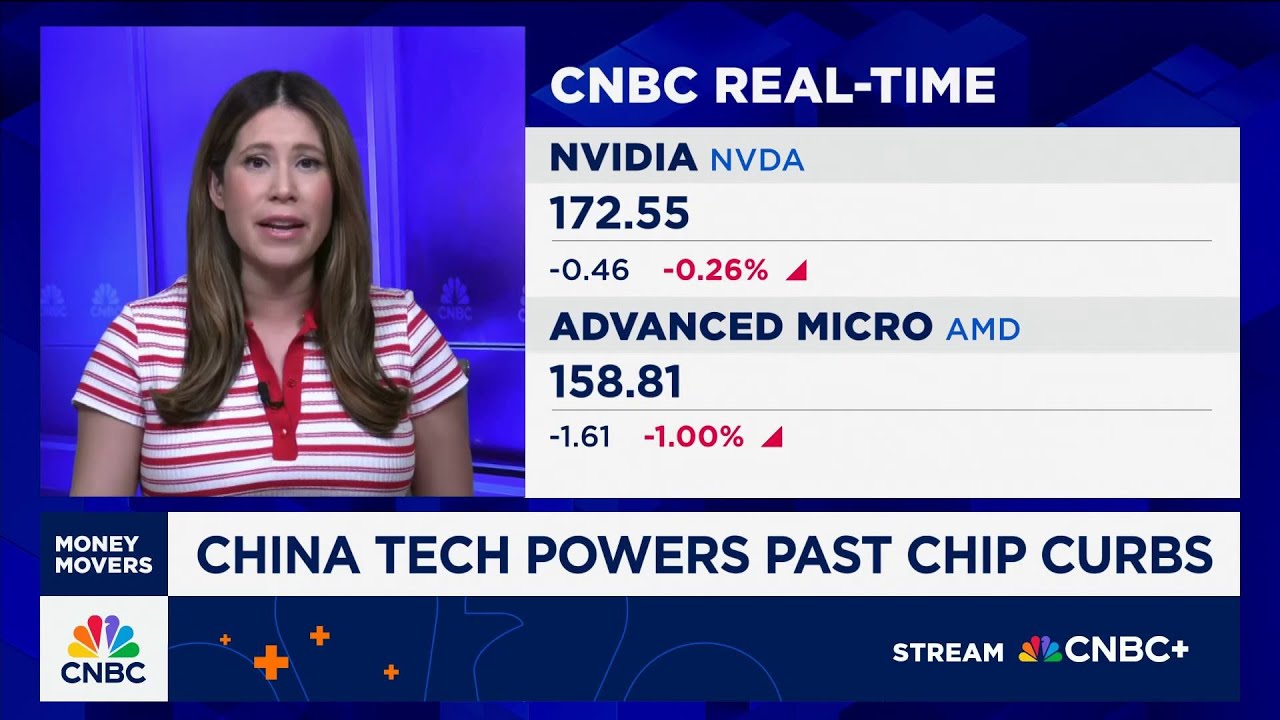
Nvidia’s resumption of H20 AI chip sales to China, along with the development of China-compliant hardware by Nvidia and AMD, supports China’s AI ambitions while keeping it reliant on U.S. technology and software ecosystems. Despite export restrictions, Chinese AI labs are advancing through optimized models and growing investor confidence, though political opposition in the U.S. could impact future trade policies and China’s path to technological independence.
The recent announcement that Nvidia expects to resume selling its H20 AI chips in China has led to a roughly 5% increase in Nvidia’s shares, signaling renewed momentum for China’s AI ambitions. This development means that Nvidia will continue to play a central role in powering Chinese AI efforts, not only through its advanced hardware but also via its proprietary Cuda software, which effectively locks developers into Nvidia’s ecosystem. This ongoing reliance ensures that much of China’s AI progress remains tied to American technology and infrastructure.
However, Chinese AI labs have been making significant strides in optimizing AI models to run efficiently on less powerful hardware. Examples include Deep Seek’s Original R1 and the newer Kimmy K2 model from Alibaba-backed startup Moonshot. These models demonstrate that China can advance its AI capabilities even under hardware constraints imposed by export bans. Chinese AI models have been climbing global rankings, with Kimmy K2 recently securing fifth place on the Marina AI leaderboard, surpassing notable non-Chinese open-source models like Mistral and Meta’s Llama, which has dropped significantly in rank.
On the hardware front, Nvidia is preparing to launch the B30 chip, designed to comply with export regulations and intended specifically for the Chinese market, with shipments expected soon. AMD is also developing a China-compliant version of its MI300X chip. These moves indicate that rather than completely cutting off China’s access to advanced AI hardware, U.S. policy is creating a parallel supply channel tailored to regulatory compliance. This approach aligns with the intentions of policymakers like AI expert David Sachs, aiming to manage the AI race through innovation and execution rather than outright restrictions.
Financially, this evolving dynamic is reflected in market performance. While the Nasdaq has seen steady gains, the Chinese tech index, which includes giants like Alibaba, Baidu, and Tencent, has quietly outperformed with a 25% increase year-to-date compared to the Nasdaq’s 8%. This suggests growing investor confidence in China’s tech sector despite geopolitical tensions and export controls. The competition in AI is becoming more about who can innovate faster and execute better rather than simply who can restrict access to technology.
Looking ahead, there is a strategic trade-off for China. Increased access to U.S. AI chips may reduce the urgency for China to develop its own indigenous hardware, potentially slowing its path to technological independence and limiting the rise of domestic champions like Huawei. However, this situation remains fluid, as political opposition within the U.S. persists. For instance, the top Republican chairing the House China Committee recently objected to the resumption of chip shipments, highlighting that trade policies and the AI landscape could shift rapidly in response to political pressures.