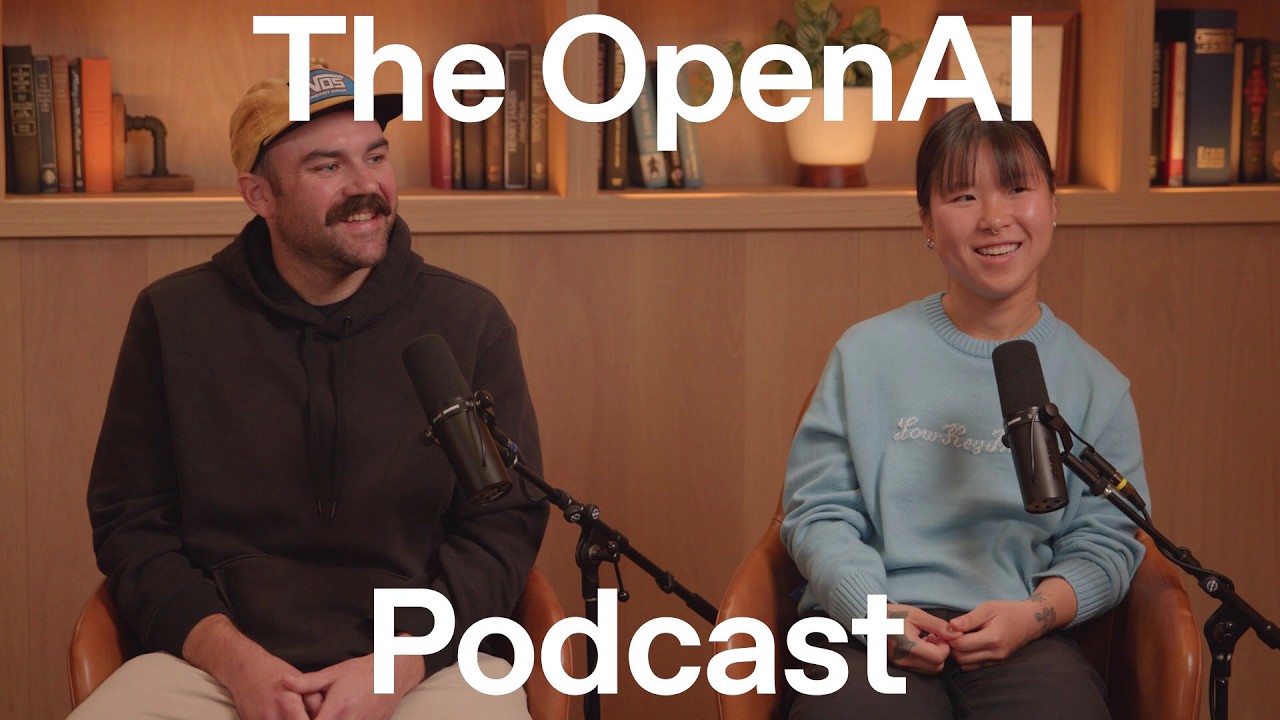
In this episode of the OpenAI Podcast, host Andrew Mayne interviews OpenAI researcher Joyce Ruffell and Chase Holden, co-founder of RaceTek Systems, about their experiences integrating AI into motorsports. Joyce discusses her work with Chip Ganassi Racing, focusing on leveraging AI to process vast amounts of high-bandwidth, time-series data from various racing series to improve logistics, driver performance, and strategic decision-making. The collaboration aims to make data more accessible and actionable in real-time, enabling teams to conduct more experiments and fine-tune their approaches before races, qualifying sessions, and practices.
Chase shares his journey into motorsports, which began with a childhood fascination with racing and evolved through media and podcasting into building a racing intelligence company using AI tools like ChatGPT and Codex. He emphasizes how AI has allowed smaller and mid-level teams to access sophisticated engineering insights and data analysis that were previously limited to larger teams with extensive resources. By organizing and simplifying complex data, AI helps teams make faster, more informed decisions, bridging communication gaps between engineers, crew chiefs, and drivers.
Both Joyce and Chase highlight the importance of education and understanding when working with AI in racing. Joyce notes that demystifying AI and teaching teams about prompt engineering helps them better utilize the technology, while Chase points out that AI can translate complex data into digestible insights for drivers, enhancing their performance. They also discuss the challenges of working with traditional data formats like spreadsheets and the need to convert these into AI-friendly formats to maximize efficiency and accuracy.
The conversation touches on the broader implications of AI in motorsports, emphasizing that AI is a tool to augment human expertise rather than replace it. Both guests agree that the future of racing will continue to be human-centric, with AI serving as a powerful assistant that speeds up workflows, reduces errors, and frees up time for creative problem-solving. They foresee a competitive landscape where success depends on how well teams and individuals can collaborate with AI, leveraging it to gain marginal gains that make a significant difference on the track.
Finally, Chase offers practical advice for those interested in exploring AI, encouraging curiosity and hands-on experimentation with tools like ChatGPT and Codex. He shares how AI supports not only technical aspects of racing but also organizational tasks such as scheduling and sponsorship management. The episode concludes with a lighthearted note on favorite racing movies, underscoring the passion and human element that drive the sport and its ongoing evolution alongside AI technology.