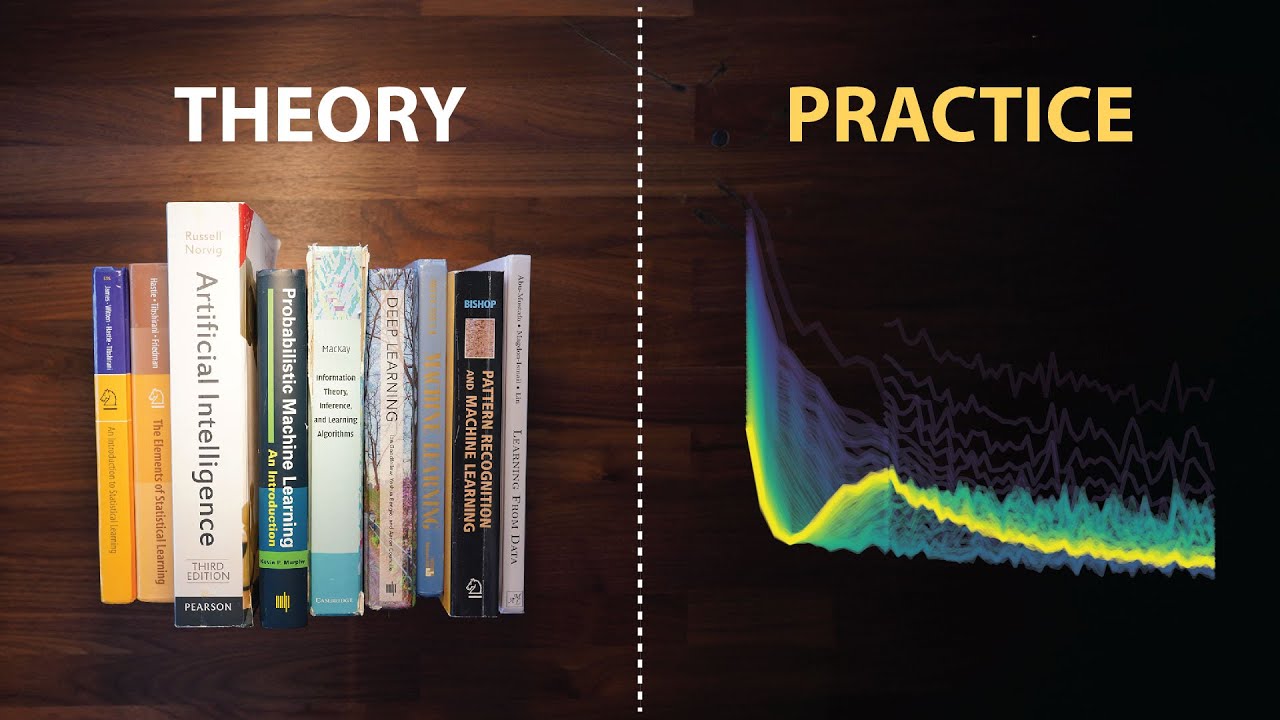
The video challenges the traditional understanding of the bias-variance trade-off in machine learning, which is commonly presented in textbooks as a U-shaped curve relating model size to test error. According to this classical view, as model complexity increases, test error initially decreases but then rises due to overfitting, where the model memorizes training data noise rather than learning generalizable patterns. This concept was illustrated using polynomial curve fitting, showing how higher-degree polynomials fit training data perfectly but perform poorly on unseen data. The takeaway from this theory has long been that model complexity must be carefully controlled to avoid overfitting and ensure good generalization.
However, the video highlights that this traditional view is incomplete, especially in the context of modern deep learning. The breakthrough AlexNet model in 2012 demonstrated that large neural networks could generalize well despite their size, using regularization techniques like data augmentation, dropout, and weight decay to combat overfitting. Yet, subsequent research from Google Brain in 2016 showed that deep models could perfectly memorize random labels, indicating that regularization does not fully prevent overfitting. Surprisingly, these models still generalized well on correctly labeled data, and removing regularization only modestly affected test performance, challenging the classical bias-variance trade-off’s assumptions.
The phenomenon of “double descent” was introduced as a more accurate description of model behavior beyond the interpolation threshold—the point where a model can perfectly fit training data. Researchers found that as model size or training duration increases past this threshold, test error, after initially rising, can decrease again, forming a second descent in the error curve. This was demonstrated not only in neural networks but also in polynomial curve fitting when using minimum norm solutions. The key insight is that overparameterized models have many solutions that fit the training data, and training algorithms like stochastic gradient descent tend to find smoother, lower-norm solutions that generalize better, explaining the improved test performance despite perfect training fit.
The video also discusses how the bias-variance trade-off can still be decomposed mathematically but is no longer the dominant factor driving test error beyond the interpolation threshold. Instead, the measure of model complexity or flexibility needs reconsideration, as traditional metrics like polynomial degree do not capture the nuances of overparameterized models. The updated understanding acknowledges that while the classical U-shaped curve is a useful conceptual tool, it does not fully describe the behavior of modern machine learning models, especially deep neural networks, which exhibit more complex generalization dynamics.
Finally, the video promotes the creator’s new book on AI, which delves deeper into these topics with rich visuals, exercises, and code examples to provide a hands-on understanding of modern AI concepts. The book aims to bridge the gap between classical theory and contemporary practice, offering insights into neural scaling laws, interpretability, and generative models. The video concludes by emphasizing that while traditional machine learning books remain valuable, the field is evolving rapidly, and new theories like double descent are reshaping our understanding of how AI models learn and generalize.