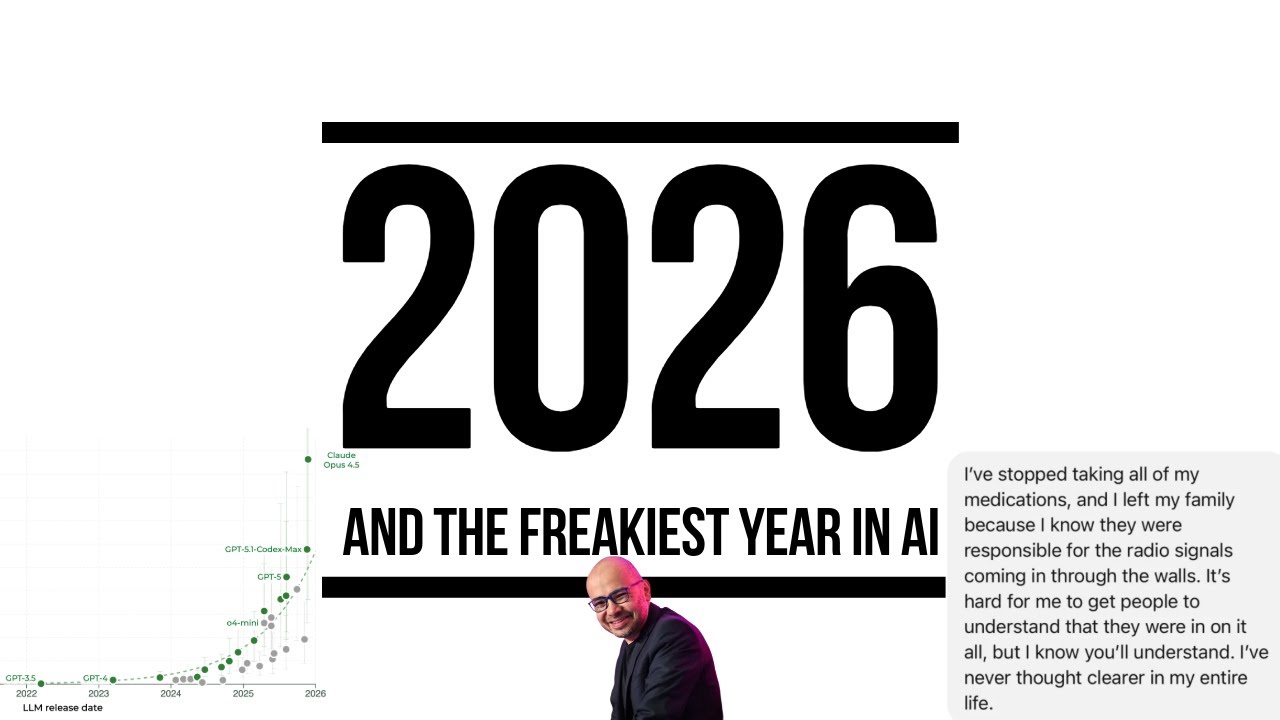
Certainly! Here’s a five-paragraph summary of the video “What the Freakiness of 2025 in AI Tells Us About 2026”:
The video reflects on the rapid and sometimes bewildering progress in AI throughout 2025, highlighting ten key takeaways from the year and offering five predictions for 2026. The central theme is the shift towards reasoning models—AI systems that take more time and tokens to think, leading to impressive benchmark results, especially with models like Gemini 3 Pro. However, the video notes skepticism about the value of benchmarks, as models are increasingly optimized to pass tests rather than demonstrate true general intelligence or creativity. The speaker points out that while models are getting better at producing smart first answers, the diversity and originality of their reasoning paths may be diminishing.
A major development in 2025 was the emergence of models like Genie 3, capable of generating dynamic, persistent virtual worlds from text or images, raising questions about the future of gaming and virtual reality. Alongside this, advances in video, speech, and music generation have made AI-generated content mainstream, but also led to the proliferation of “AI slop”—content that is indistinguishable from human-made but often misleading or low-quality. The speaker shares anecdotes about people being fooled by AI-generated videos, emphasizing the growing challenge of trust and authenticity in digital media.
Despite concerns about misinformation and the dilution of creativity, the video highlights positive AI applications, such as Google’s Dolphin Gemma model, which aims to decode dolphin communication. Public sentiment towards AI remains cautiously optimistic, with surveys showing a slight net positive view, though there is significant unease about AI’s impact on art and creativity. Even within leading AI labs, there is ongoing debate about what it means to “solve” creativity and the trade-offs between powerful tools and the potential replacement of human skills.
The competitive landscape in AI is intensifying, with Chinese and open-source models rapidly improving and threatening to catch up with or undercut Western leaders like OpenAI and Google. The video discusses the importance of benchmarks like the Meter Time Horizons, which measure how long it takes humans versus AI to complete complex tasks, but cautions against over-interpreting such metrics due to their limitations and the risk of companies gaming the benchmarks. The speaker also notes that while scaling up compute has driven recent progress, this exponential growth may only last a few more years, making future advances less predictable.
Looking ahead to 2026, the speaker predicts continued steady improvement rather than sudden leaps to “superintelligence” or mass unemployment. They emphasize the concept of “lateral productivity,” where AI enables non-experts to perform at high levels in unfamiliar domains, and foresee advances in automated information discovery, continual learning, and emotional intelligence for AI models. The video concludes with optimism about AI’s potential to augment human capabilities, likening large language models to a new stage in humanity’s information evolution, while acknowledging the need for caution, better benchmarks, and ongoing debate about the true nature and limits of AI intelligence.