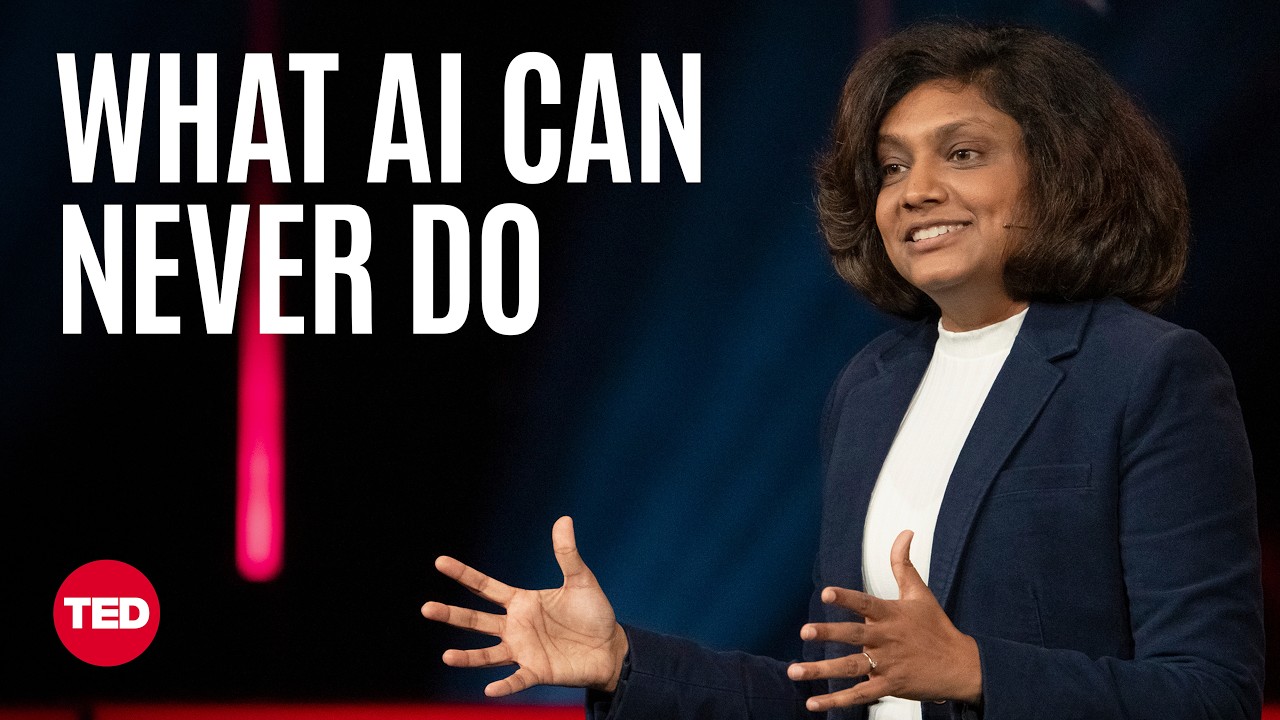
Priyanka Vergadia emphasizes that while AI excels at pattern recognition and data analysis, it lacks the human ability to understand context, emotions, and deeper meanings behind data, making human insight essential for interpreting and acting on AI findings. Through real-world examples, she illustrates that successful collaboration between humans and AI—leveraging empathy, intuition, and critical thinking—is crucial for thriving in an AI-driven future.
In her TED talk, Priyanka Vergadia addresses the widespread anxiety around AI and job losses, emphasizing a fundamental truth: while AI excels at identifying patterns and analyzing data, humans uniquely understand the deeper meaning behind those patterns. She highlights that AI cannot replicate the nuanced human experiences such as context, intent, emotions, and cultural subtleties, which are essential for interpreting data in real-world scenarios. This distinction underscores the importance of humans working alongside AI rather than competing with it.
Priyanka shares three stories from her professional experience to illustrate this point. The first story involves Sarah, a product manager who used AI analytics to discover that most users only engaged with basic features of a product. Instead of accepting this at face value, Sarah reached out to top clients and uncovered that users wanted to use advanced features but couldn’t find them due to poor design and unclear documentation. This human insight led to a redesign that significantly increased feature adoption, demonstrating how AI identifies symptoms while humans diagnose underlying causes.
The second story features Marcus, who used AI tools to predict the likelihood of closing a major sales deal. Although the AI indicated a high probability of success based on engagement data, Marcus noticed inconsistencies in the human interactions, such as changing stakeholders and vague communication. By investigating further, he discovered internal restructuring at the client’s company that threatened the deal. This example highlights the necessity of reading social cues and understanding the human dynamics behind data, something AI cannot do.
In the third example, Priyanka recounts working with Priya, who used AI to optimize social media content for follower growth. While the AI-driven strategy increased engagement, it attracted the wrong audience—bargain hunters rather than customers willing to pay for ethically made products. Priya shifted the focus to storytelling about artisans and sustainability, which built a loyal community and boosted sales. This story illustrates the importance of questioning AI’s metrics and aligning strategies with authentic human values and business goals.
Ultimately, Priyanka concludes that the future belongs to humans who collaborate with AI while maintaining their irreplaceable human qualities such as empathy, emotional intelligence, and contextual understanding. She encourages viewers to embrace AI as a tool that identifies patterns but reminds them that only humans can interpret the stories behind the data. This partnership, she argues, is key to thriving in an AI-driven world and alleviating fears about job displacement.