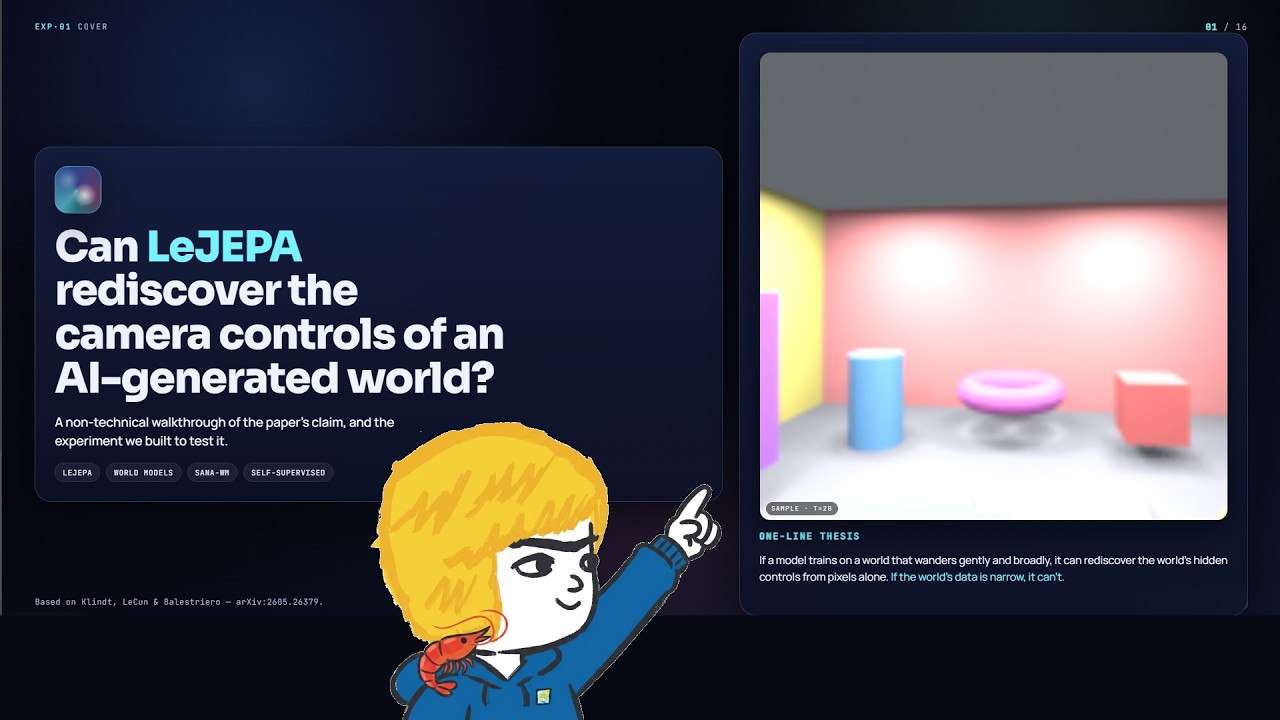
The video begins with an introduction to the concept of LeJEPA models and the recent paper titled “When Does LeJEPA Learn a World Model?” by David Clint, Jan LeCun, and Randall Balestriero. The presenter expresses interest in the topic and outlines the plan to break down the paper in simple terms and then conduct an experiment to validate some of its claims. The core question addressed is whether LeJEPA can rediscover the camera controls of an AI-generated world solely from pixel data, with the paper suggesting it can, but only under specific conditions.
The paper’s main idea revolves around the concept of latent variables, or “hidden sliders,” which represent underlying factors like camera position, lighting, and object colors that generate the pixels the model sees. The goal of LeJEPA is to learn an embedding of these hidden sliders that is linearly identifiable, meaning a simple linear regression can recover the original latent variables from the model’s internal representation. The paper shows that this is possible when two forces are applied during training: alignment (encouraging embeddings of temporally close frames to be close) and Gaussian regularization (keeping the embedding distribution round and well-spread). Together, these forces ensure the model learns a stable, rotated copy of the true latent space.
A critical insight from the paper is that the latent variables must follow a Gaussian distribution and the world must change smoothly over time (a smooth drift) for LeJEPA to succeed. If the data distribution is biased or the world jumps randomly between states, the model cannot recover the latent variables accurately. The paper demonstrates this with experiments on a simulated robot arm, showing that good exploration of the latent space is necessary alongside the right training objective. Without broad exploration, the learned representation is less accurate.
The presenter then describes their own experiment designed to test the paper’s claims in a richer, fully rendered 3D environment created in Blender. They control the camera’s six degrees of freedom precisely and generate datasets with different exploration regimes: broad Gaussian exploration, biased cinematic camera paths, and a restricted yaw-only rotation. The same encoder and loss are used across regimes, and the models are evaluated on a held-out canonical test set to fairly compare how well each can recover the camera’s true controls from pixels alone. The experiment is run using a co-working approach with two AI coding assistants, Claude and Codex, to design, audit, and implement the experiment.
The results from two runs of the experiment support the paper’s claims: broad Gaussian exploration leads to better recovery of the camera’s latent controls than biased or restricted exploration. The first run showed a significant gap but had issues with the yaw dimension due to scene design, while a smaller scoped experiment confirmed the recoverability of a simplified latent state and showed a smaller but clear advantage for broad exploration. Overall, the experiment validates the importance of exploration distribution in learning world models with LeJEPA, and the presenter expresses interest in continuing to explore this approach in future work.