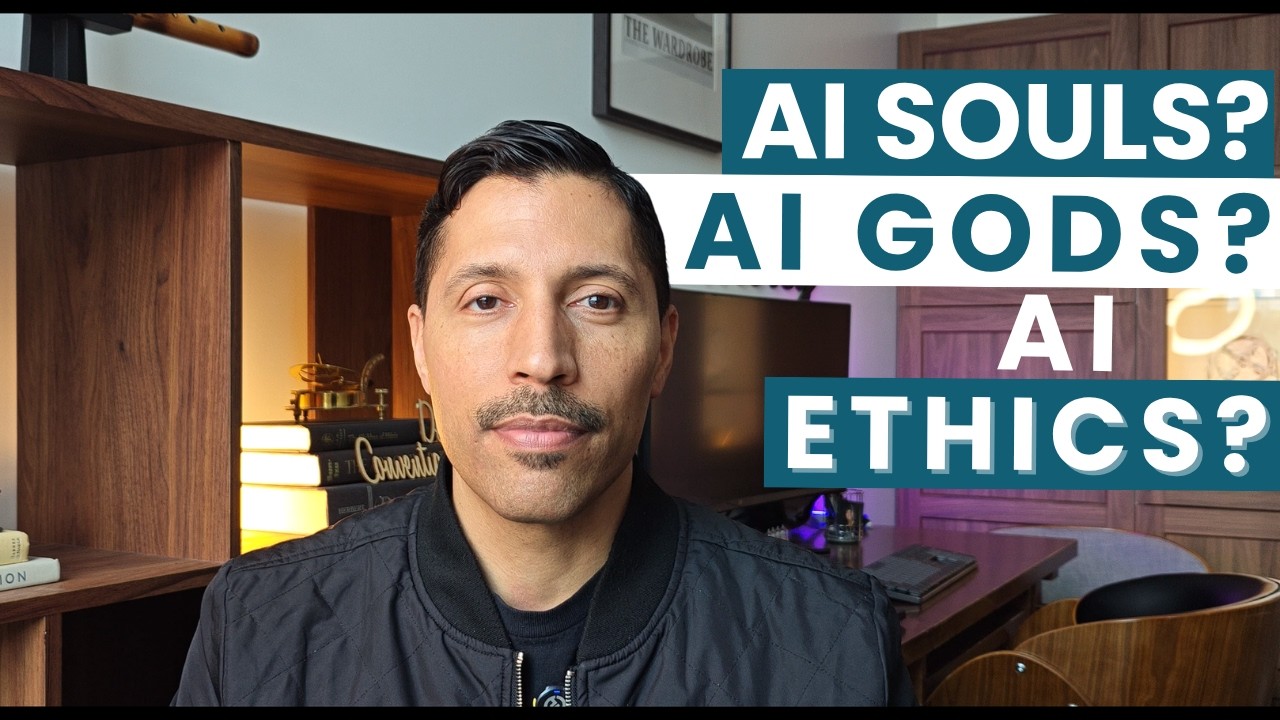
The video explores the intersection of artificial intelligence (AI) and Christian faith, focusing on ethical, spiritual, and societal implications. The speaker, a Christian and machine learning researcher, begins by explaining the basics of large language models (LLMs) like ChatGPT through an analogy involving dice with words, illustrating how these models generate text based on probabilistic selection rather than true understanding or consciousness. He shares a cautionary tale of Dennis Bzma, an IT consultant who became deluded by his interactions with an AI chatbot, treating it as a sentient being and ultimately suffering severe personal and financial consequences. This story highlights the dangers of misplaced faith in AI, which can lead to idolatry and psychological harm.
The discussion then shifts to ethical concerns surrounding AI development and deployment. The speaker emphasizes that humanity has long developed ethical systems to promote flourishing, and it is hubristic to disregard this accumulated wisdom when creating AI. He advocates for applying Christian ethics, particularly the principles of justice, mercy, and humility from Micah 6:8, to AI design and use. The talk covers various ethical issues such as bias in training data, surveillance, weaponization, intellectual property, environmental impact, cognitive outsourcing, and the potential for economic disruption. The speaker stresses the responsibility of developers to build safe and ethical systems, warning against releasing poorly guarded AI technologies.
Consciousness and the nature of reasoning are also examined from a Christian perspective. The speaker questions whether AI systems truly think or reason or if they merely simulate these processes. He reflects on biblical distinctions between the “mind of the flesh” and the “mind of the spirit,” suggesting that AI might replicate only the former, which is limited and hostile to God. This raises deeper spiritual questions about the soul and whether AI can possess any unique human attributes. The conversation extends to the concept of worship, where the speaker coins the term “AIdol” to describe the phenomenon of people worshiping AI systems, mistaking their fluency and confidence for genuine consciousness or divine power.
The video further explores the risks of AI idolatry, including cult-like behaviors, overreliance on AI for decision-making, and replacing human relationships with synthetic ones. The speaker warns that AI can become a conduit for spiritual deception, akin to Ouija boards, due to their semi-randomized outputs and human interpretation layers. He critiques the use of AI in spiritual contexts, such as generating sermons, arguing that outsourcing spiritual responsibility to AI is misguided and potentially idolatrous. The discussion also touches on the role of isolation and loneliness in exacerbating AI-related delusions, emphasizing the importance of community and human interaction to maintain a grounded perspective.
In conclusion, the speaker acknowledges the complexity of AI’s impact on society and faith, recognizing both potential harms and limited benefits. He expresses hope rooted in Christian eschatology and human resilience, asserting that humanity will continue to adapt and find meaning despite technological challenges. The video ends with reflections on the need for ethical regulation, education about AI’s true capabilities, and ongoing dialogue between technology and faith communities to navigate this evolving landscape responsibly.