The video presents a project called the “on-chain agent,” a custom AI agent designed specifically for trading meme coins, particularly on the Solana blockchain. Unlike traditional deterministic bots, this agent leverages large language models (LLMs) to interact using natural language, allowing users to ask questions like “What’s going on with JOSHUA today?” The agent integrates multiple data sources, including on-chain data and social media trends, and features a custom knowledge base tailored to meme coin mechanics and liquidity pools. It supports advanced functionalities such as setting cron jobs for alerts on wallet activity, price changes, and liquidity shifts, making it a versatile tool for meme coin traders.
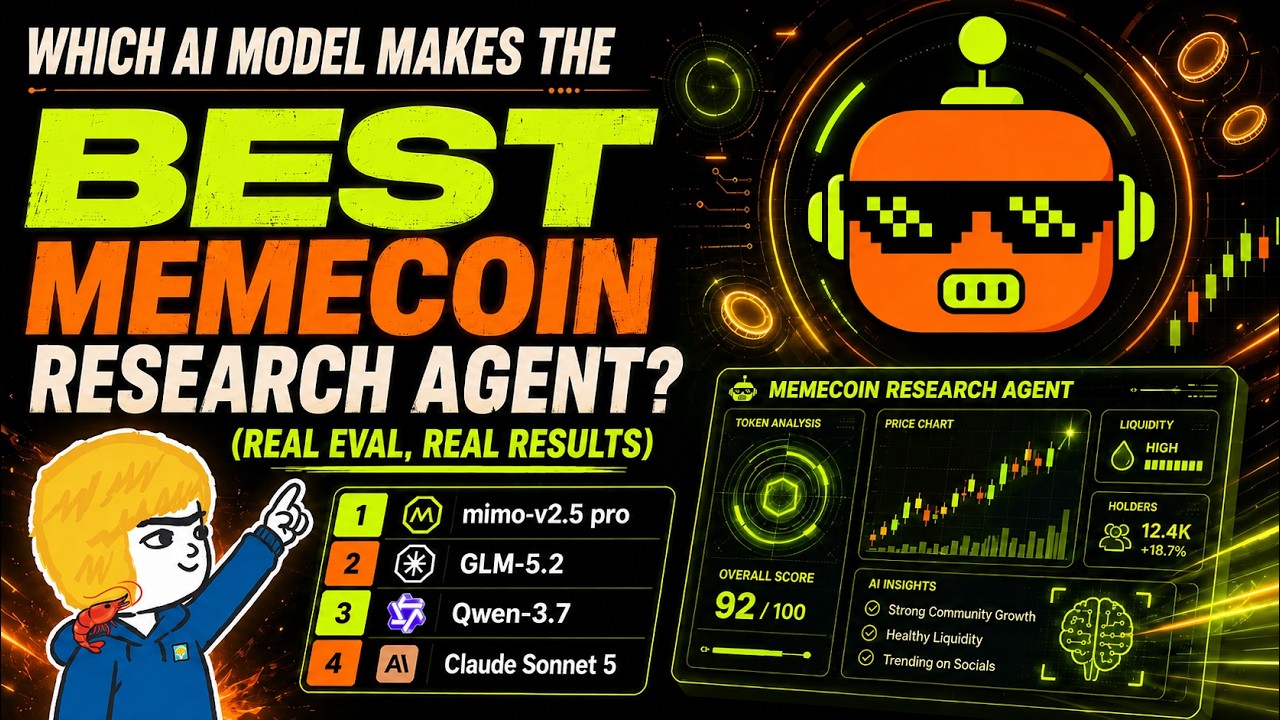
The creator conducted a comprehensive test to determine which AI models perform best as meme coin research agents. The evaluation focused on criteria such as tool use reliability, instruction adherence, reasoning ability, and role play or voice personality. The agent was tested with nine different models, ranging from high-end closed models like Claude Sonnet 5 to more affordable open-weight models like Mimo and MiniMax. The test involved real tool calls to APIs, answering 12 questions twice per model, and blind judging of the transcripts to assess accuracy, honesty, and voice quality.
Results showed that Claude Sonnet 5 delivered the highest overall quality, excelling in advice refusal, honesty, voice, and accuracy, but it was also the most expensive. The Mimo model stood out for its speed, low cost, and strong technical performance, making it the recommended default model for the agent. Other models like Kimi K2.6 and Qwen 3.7 also performed well in quality but were slower. Some models, including Grok and GLM 5.2, were disqualified due to fabricating data or providing inaccurate information, highlighting the importance of precise numerical handling in this use case.
The evaluation also revealed areas for improvement in the agent’s design, such as refining the system prompts to prevent unit distortions and enhancing the token resolver to better handle ambiguous tickers. These insights will help improve the agent’s reliability and user experience. The creator emphasized the importance of balancing speed, accuracy, and personality in selecting the best model for this specialized application, with Mimo version 2.5 emerging as the optimal choice for most users, while Claude Sonnet 5 remains a premium option.
In conclusion, the project demonstrates a novel approach to meme coin trading by combining AI language models with on-chain and social data, offering a conversational and customizable research tool. The testing process not only identified the best-performing models but also guided improvements in the agent’s functionality. The on-chain agent is expected to launch soon in beta, and the creator invites feedback and suggestions from the community to further refine the tool. Interested users can follow updates on Twitter and sign up for a newsletter to stay informed about the project’s progress.