In his talk, Derek Meegan from Browserbase discusses the challenges and solutions involved in deploying browser agents at scale. He begins by explaining how browser agents interact with the web, describing the browser as a complex system with multiple layers such as the DOM, accessibility tree, and dynamic code execution environments. He outlines three main strategies for interfacing agents with browsers: creating textual representations of the page, using screenshots, and enabling agents to write arbitrary code dynamically. Meegan emphasizes focusing on transactional workflows, where agents complete end-to-end tasks repeatedly, as these are most common in production environments.
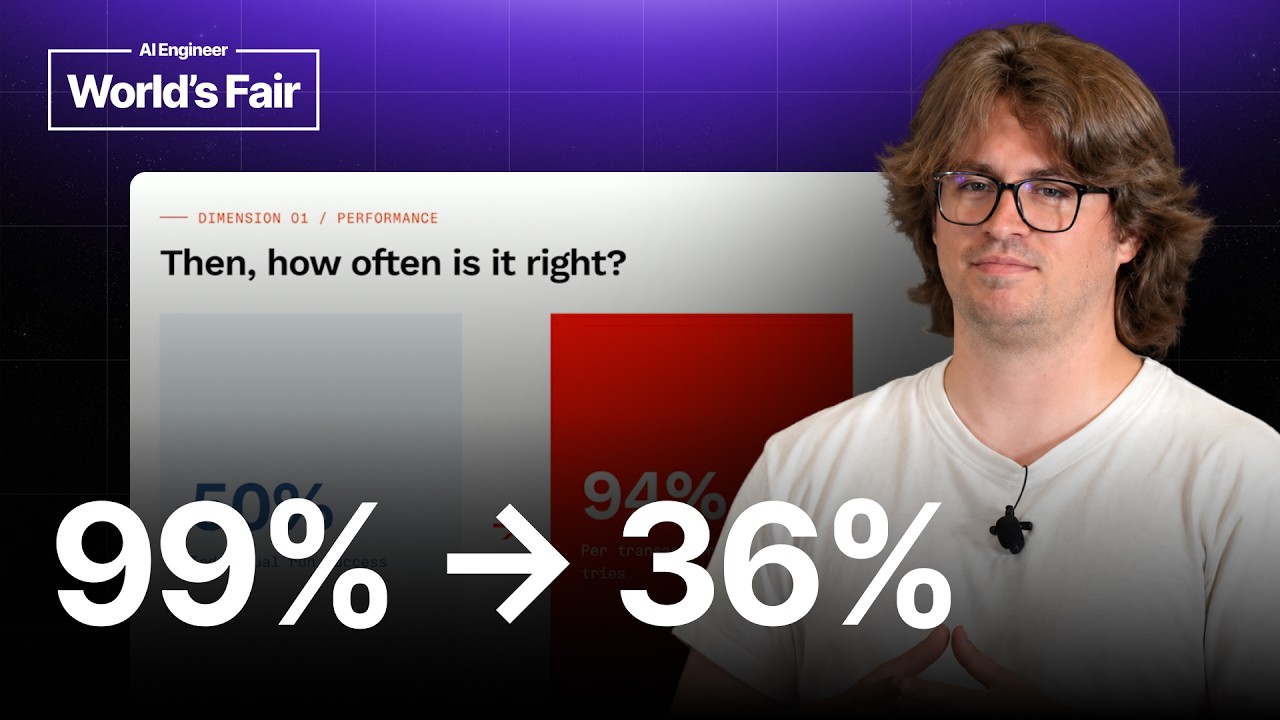
Meegan highlights the core difficulty in production: the continuous accumulation of cost and risk with each step in a browser agent’s trajectory, while value is only realized upon full task completion. He illustrates this with a thought experiment showing that even a 99% success rate per step can result in a low overall success rate for long workflows, making reliability a significant challenge. Despite this, he argues that the math alone should not discourage the use of browser agents, as their value extends beyond raw success rates.
To better understand the value browser agents provide, Meegan frames the problem in terms of profit—revenue minus costs—and stresses that agents must deliver more value than they consume. He identifies three key dimensions to focus on: performance, cost, and maintainability. Performance is paramount, measured by the agent’s ability to reliably complete tasks, ideally verified through concrete artifacts like confirmation emails or order IDs. He also advocates measuring success on a per-transaction basis, allowing retries to improve overall reliability from the customer’s perspective.
Cost considerations include model inference expenses, infrastructure, and integration tooling, with the expectation that model costs will decrease over time due to advances in open-source technologies. Maintainability involves investing in observability, developer time for troubleshooting and updates, and ongoing re-evaluation as websites and tasks evolve. Meegan also discusses risks such as anti-bot measures, task changes, emergence of better methods like APIs, and the inherent indeterminism of models that can cause agents to stray from intended paths.
Finally, Meegan presents a practical architecture for deploying browser agents in production, using the example of automating a health insurance portal. He describes progressively refining the system by encapsulating complex operations into deterministic tools, adding verification steps, separating stable authentication logic from the agent’s responsibilities, and providing the agent with a clear “skill” or standard operating procedure to reduce ambiguity. This approach reduces the number of decisions the agent must make, improving performance, lowering costs, and enhancing maintainability. The result is a robust, scalable system that overcomes the typical challenges of browser agents and delivers reliable value in production.
Useful Links