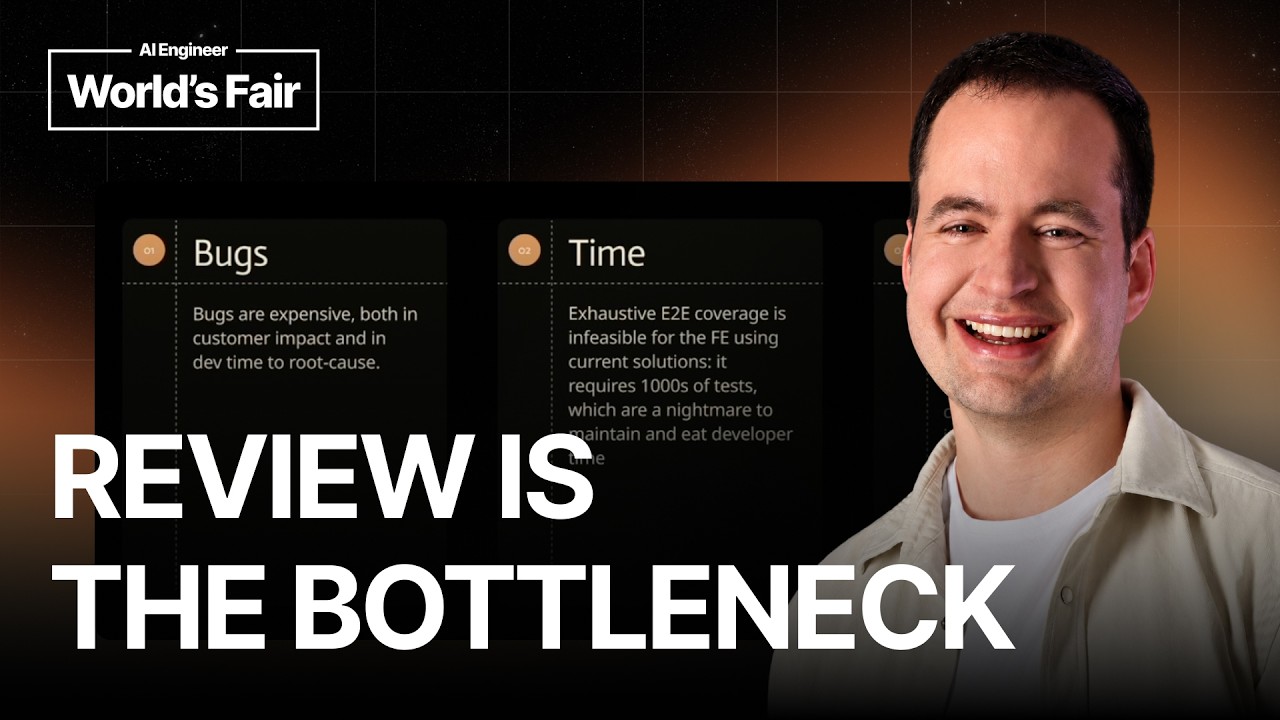
Gabriel Spencer-Harper, co-founder and CEO of Meticulus, presents a talk focused on the verification of front-end code and how exhaustive verification can impact software shipping velocity. He explains that while AI can write code faster than humans, the bottleneck has shifted to code review and verification. Without exhaustive verification, organizations face a trade-off between shipping speed and the risk of bugs or regressions, which can negatively affect user experience and business outcomes.
Meticulus offers a solution by providing near-exhaustive verification of front-end codebases with zero developer effort. The tool is widely adopted by major companies such as Discord, Dropbox, and Notion. It works by injecting a single line of JavaScript into non-production environments to record thousands of user workflows. When a pull request is opened, Meticulus replays a subset of these workflows on the updated code, capturing screenshots at every step to compare the before and after states, highlighting any differences for developers to review.
Unlike traditional assertion-based testing, which requires upfront definition of expected behavior and often misses edge cases, Meticulus shows developers exactly what changes would occur if the code were merged. This approach allows developers to use their judgment during review rather than relying solely on predefined assertions. The tool’s ability to detect even minor visual differences across various configurations and user roles helps ensure comprehensive coverage and reduces the risk of regressions.
Three key technologies underpin Meticulus’s effectiveness: first, network requests are fully mocked to ensure tests are idempotent and isolated, enabling reliable and parallel test execution. Second, the browser environment is augmented to be deterministic, drastically reducing flaky tests caused by randomness in animations or timing. Third, Meticulus uses a sophisticated code coverage algorithm that maps workflows to executed lines of code, selecting a subset of workflows that maximize coverage and ensure exhaustive verification.
Overall, Meticulus enables engineering teams to confidently ship code changes, including AI-generated ones, by providing a scalable, reliable, and comprehensive verification process. This capability allows organizations to perform sweeping refactors, dependency updates, and feature changes without fear of introducing bugs. The talk concludes with positive customer feedback and an invitation to learn more at the company’s booth.
Useful Links