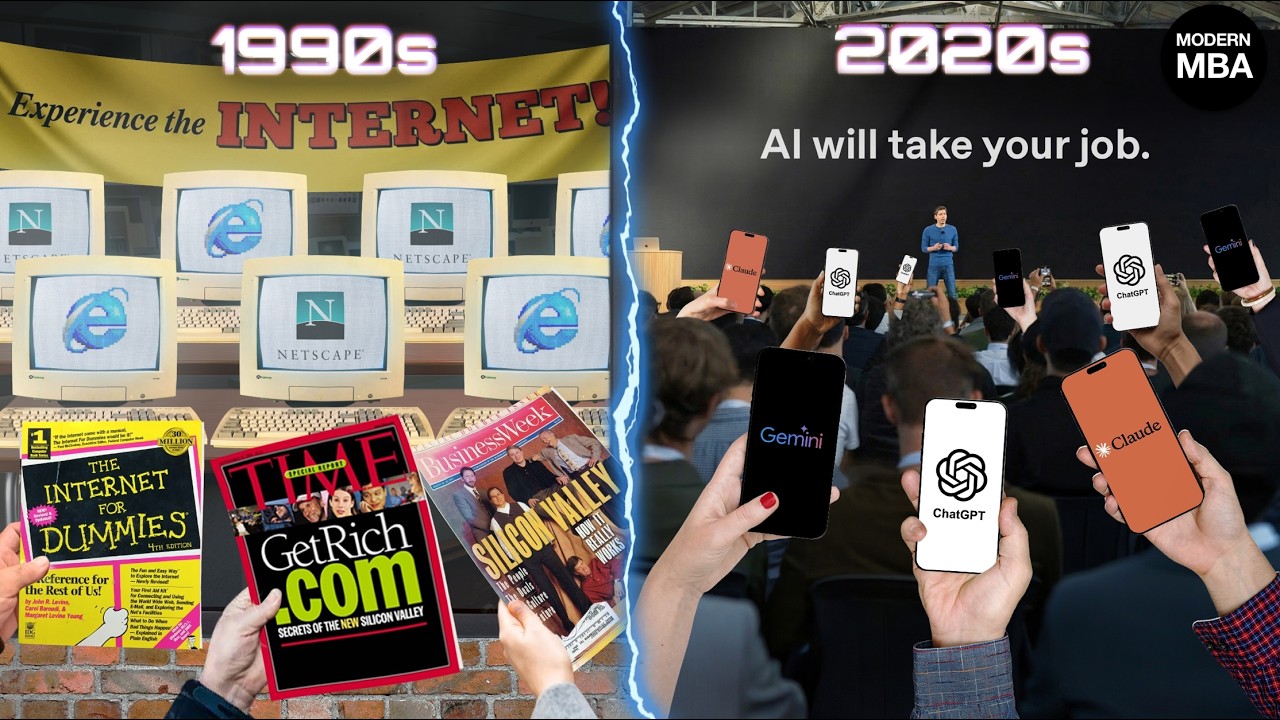
The video argues that the current artificial intelligence (AI) boom closely mirrors the dot-com bubble of the late 1990s and early 2000s, highlighting how tech companies and investors are aggressively pushing AI as an essential technology, often with exaggerated claims and little regard for genuine consumer demand. Tech leaders and politicians are hyping AI as a revolutionary force, comparing it to the discovery of fire or electricity, and warning that those who don’t adopt it will be left behind. This narrative is being used to justify massive public and private investment, with AI positioned as a necessity for economic and military supremacy, despite the technology still searching for its true form and practical value.
The video breaks down the AI ecosystem into layers, drawing direct parallels to the dot-com era. At the top are consumer-facing AI startups, which generate hype and burn through cash to maintain high valuations, but are highly dependent on the underlying platforms and infrastructure. These startups, much like Webvan and Pets.com during the dot-com bubble, are vulnerable to commoditization and platform changes, and are likely to be the first to collapse when the bubble bursts. Below them are the software gateways, such as OpenAI’s ChatGPT, which serve as entry points to AI but are themselves dependent on distribution channels controlled by tech giants like Apple, Google, and Microsoft.
The hardware and infrastructure layers are dominated by companies like Nvidia, which supplies the GPUs essential for training large language models, echoing the role of Sun Microsystems and Cisco during the dot-com boom. Cloud providers such as Amazon AWS, Microsoft Azure, and Google Cloud act as landlords, renting out computing power to AI startups, creating a cycle where venture capital is funneled into infrastructure for demand that may never materialize. The foundational bottleneck has shifted from bandwidth in the 1990s to energy today, with AI data centers consuming enormous amounts of power and prompting tech companies to invest in nuclear energy to meet their needs.
The video also critiques the financial and business practices fueling the AI bubble. Venture capitalists now keep startups private longer, inflating valuations through successive funding rounds and orchestrating media hype, only to offload the risk onto the public when these companies eventually go public. This has led to a bloated and saturated market, with thousands of lookalike AI startups chasing the same opportunities, and differentiation reduced to marginal improvements in benchmarks. The big tech companies, wary of being disrupted, are integrating AI into every product and service, subsidizing adoption to maintain their dominance and prevent new entrants from gaining a foothold.
Ultimately, the video concludes that while AI may indeed be transformative in the long run, the current frenzy is a speculative bubble driven by hype, self-interest, and circular financing. The risks are being socialized while the potential gains are privatized by a small circle of tech elites and political actors. When the bubble bursts, it will be the public that bears the cost, just as with previous tech bubbles. The true AI revolution, if it comes, will take decades and require breakthroughs beyond the reach of any single company or hype cycle.