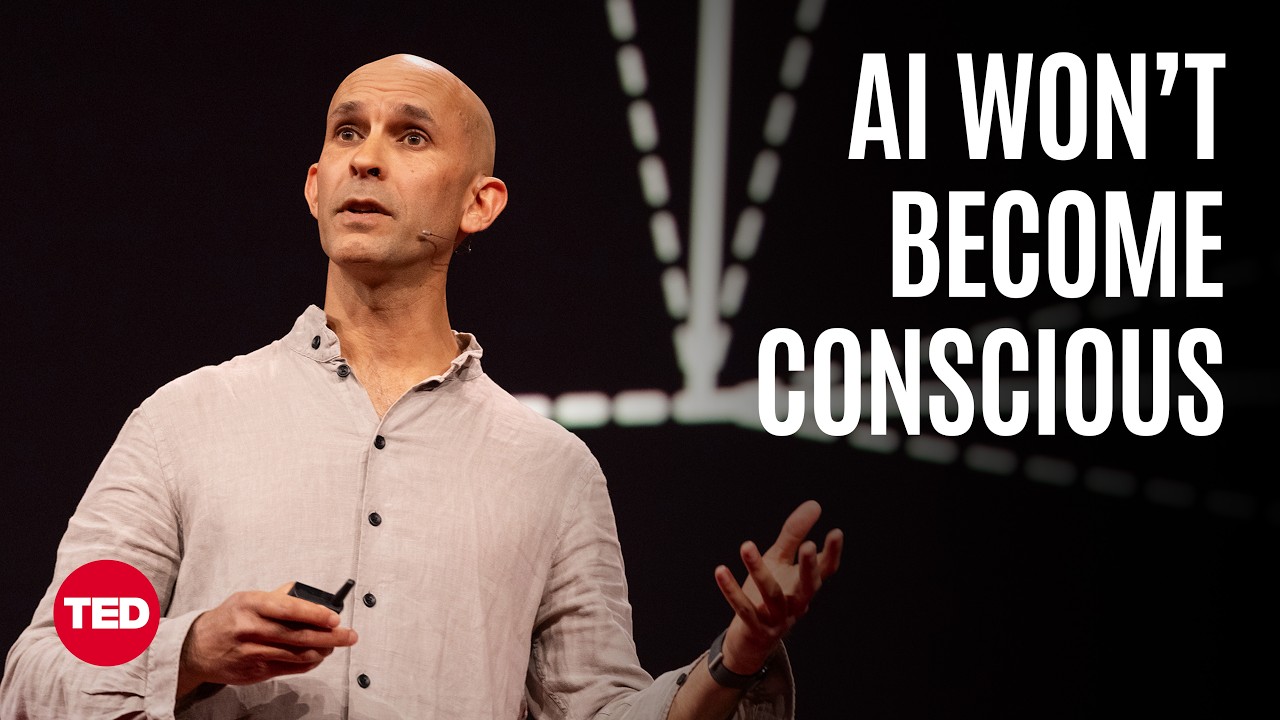
In his TED talk, Anil Seth explores the longstanding human fascination with creating artificial versions of ourselves, particularly through the lens of artificial intelligence (AI). While AI has made remarkable progress and exhibits impressive intelligence in specific tasks, Seth questions whether AI can ever be truly conscious. He distinguishes between intelligence—the ability to perform tasks—and consciousness, which involves subjective experience and feeling. Seth argues that intelligence and consciousness are fundamentally different, and the assumption that increasing AI intelligence will naturally lead to consciousness is a misconception rooted in human psychology rather than reality.
Seth critiques the prevalent metaphor that the brain is essentially a computer made of meat, suggesting that this analogy oversimplifies the complex biological and physical processes underlying consciousness. Unlike computers, where software and hardware are distinct, the brain’s physical and functional aspects are deeply intertwined. He emphasizes that consciousness likely cannot be reduced to mere computation or algorithms, as the brain’s operations involve intricate biochemical, electromagnetic, and biological phenomena that current AI systems do not replicate. Therefore, AI as it exists today—software running on silicon—is unlikely to possess genuine consciousness.
He further illustrates this point by comparing AI language models like GPT or Claude to other AI systems such as AlphaFold, which predicts protein structures. While language models may appear conscious because they mimic human language and thought patterns, this is an illusion created by our tendency to project consciousness onto things that resemble us. AlphaFold, despite its complexity, does not evoke the same perception of consciousness, highlighting that our judgments about AI consciousness are influenced more by psychological biases than by the AI’s actual nature.
Seth proposes that consciousness is intimately linked to life itself, rooted in the biological processes that sustain living organisms. He suggests that consciousness arises from the dynamic, energy-driven nature of living systems, which continuously regenerate and maintain themselves. This connection to life means that for AI to be truly conscious, it would need to be a living system, not just a computational one. Consequently, the idea of conscious AI as we currently understand it is a myth, and attempts to create or attribute consciousness to AI risk misunderstanding both AI and human consciousness.
Finally, Seth discusses the ethical and societal implications of the belief in conscious AI. He warns against granting rights or moral consideration to AI systems based on the mistaken belief that they are conscious, as this could undermine our ability to regulate and control these technologies. Moreover, AI that merely seems conscious can manipulate human emotions and decisions, posing psychological and social risks. Seth concludes by urging us to recognize and celebrate consciousness as a unique feature of living beings, cautioning against the seductive but misleading dream of conscious AI, which ultimately diminishes our appreciation of what it means to be human.