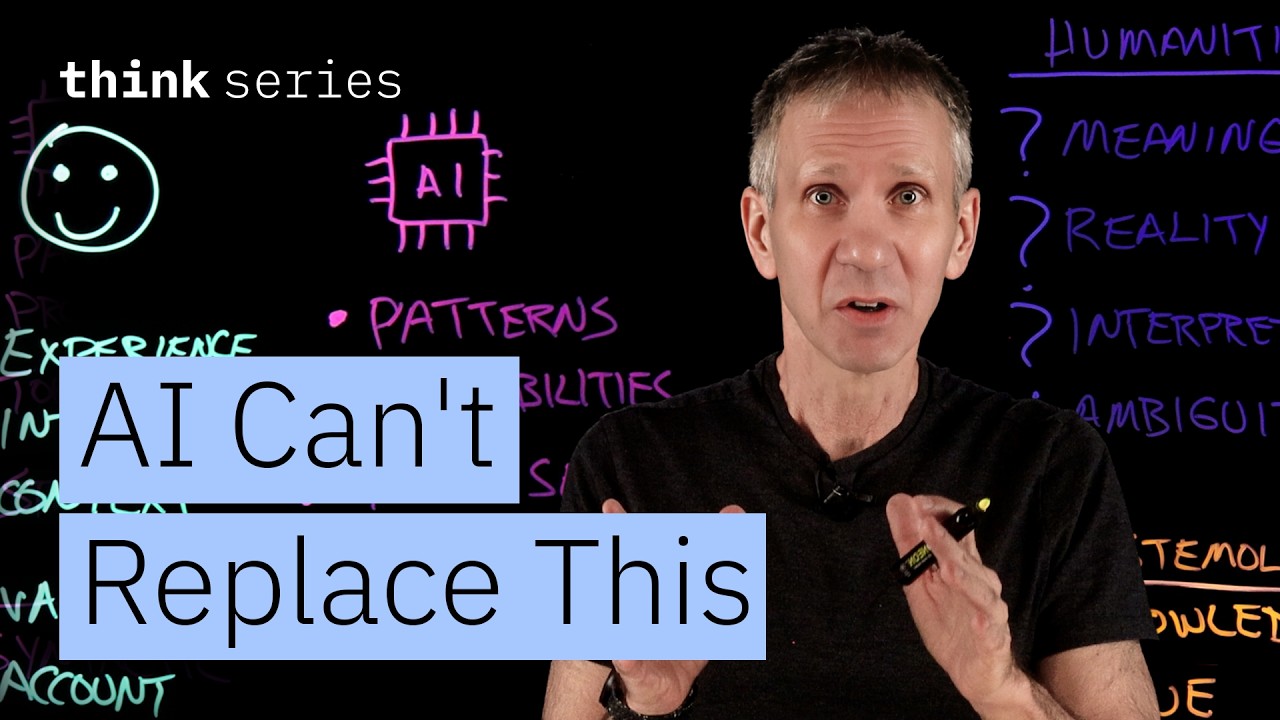
The video emphasizes that while AI systems have become remarkably proficient at generating language and producing outputs that appear to demonstrate understanding, they fundamentally lack true comprehension and judgment. AI operates through statistical pattern recognition and syntactic manipulation rather than semantic understanding, meaning it predicts likely sequences of words without grasping the deeper meaning, intent, or values behind them. This distinction highlights a critical gap: AI can generate answers, but it cannot decide which questions are meaningful or ethical, underscoring the need for human guidance in interpreting and applying AI outputs responsibly.
The humanities—disciplines such as literature, history, philosophy, and art—play an essential role in addressing these gaps. Unlike STEM fields, which explain how things work, the humanities explore why we do things, what values we hold, and how to interpret meaning and context. They teach us about ambiguity, interpretation, and the ethical consequences of our actions, all of which are crucial when dealing with AI-generated information that can be misleading, incomplete, or biased. The study of epistemology, for example, helps us question what knowledge is and how to discern truth, which is vital given AI’s tendency to confidently produce inaccurate or fabricated information.
The video also discusses the ethical and societal dimensions of AI, noting that AI systems are not neutral despite their mathematical foundations. The design, training data, user intent, and societal context all influence AI outputs, embedding assumptions and potential biases. Humanities disciplines such as ethics, political theory, and sociology help us critically examine who benefits from AI, what harms might arise, and how to navigate these complex issues. Importantly, AI shifts the burden of interpretation onto humans, making skills in critical reading, hermeneutics, and cultural literacy more important than ever to detect bias, ambiguity, and distortion in AI-generated content.
Communication skills rooted in the humanities, such as rhetoric and discourse analysis, are also vital in the AI era. Crafting effective prompts for AI requires clarity, precision, and an understanding of context and intent—skills traditionally developed through writing and composition studies. Small changes in how we frame questions can significantly affect AI responses, making human interpretive skill a form of system control. This shift means that rather than reducing the need for human judgment, AI actually increases the importance of critical thinking, ethical reasoning, and cultural awareness in guiding AI’s use and outputs.
In conclusion, the video argues that as AI technology advances and automates many routine tasks, the humanities become more crucial for grounding our understanding of meaning, ethics, and human values. The timeless lessons from literature and philosophy about human nature, society, and morality provide the framework needed to responsibly harness AI’s capabilities. Far from diminishing the role of human judgment, AI amplifies the need for it, making critical thinking and interpretive skills indispensable in navigating an AI-rich world. Ultimately, the humanities help ensure that technology serves human purposes and values, reminding us that while AI can generate answers, humans must decide which questions and answers truly matter.