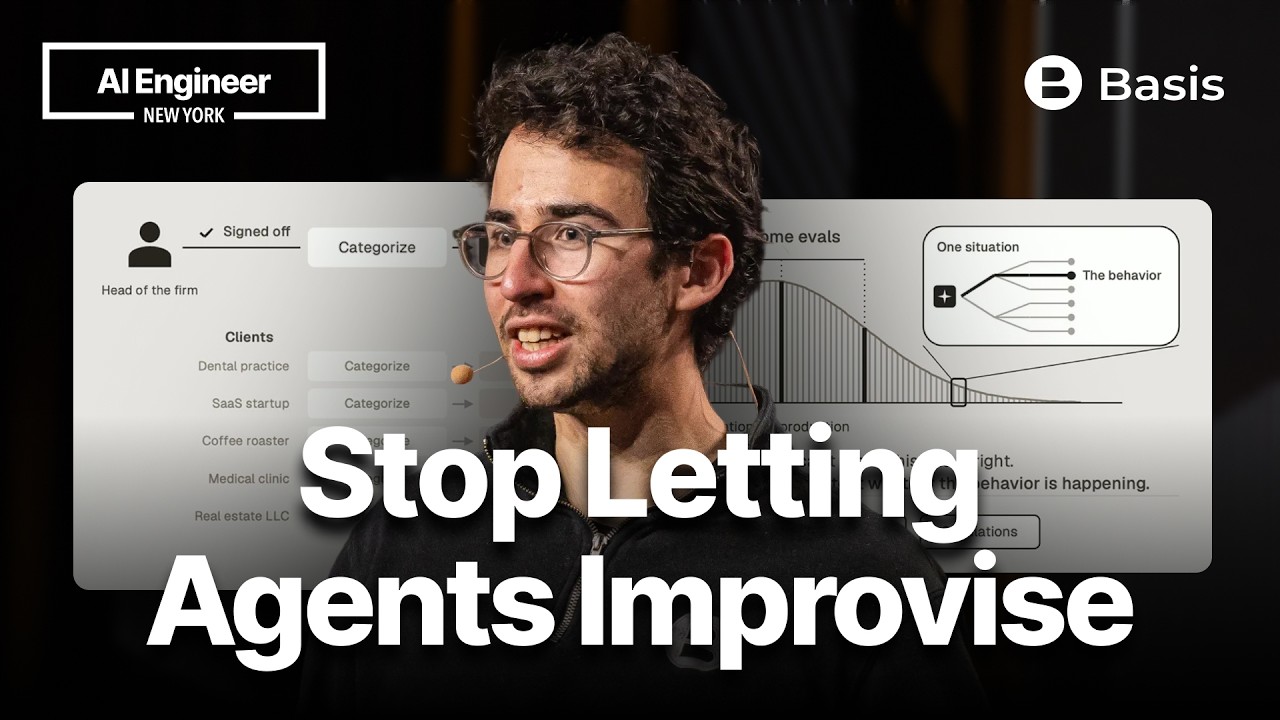
Mitchell Troyanovsky, co-founder of Basis, discusses why artificial intelligence (AI) significantly boosts individual productivity but does not translate into a proportional increase in company-wide productivity. He explains that while individuals using AI tools like ChatGPT or Codex may experience a 100x productivity increase, organizations do not see this scale of improvement because companies rely on structured processes and trust in consistent outcomes rather than on individual improvisation. Companies scale productivity by implementing reliable processes that ensure consistent results, even though the people executing these processes are non-deterministic and intelligent.
Troyanovsky identifies two main challenges with current AI agents: the competency gap and the process gap. The competency gap arises because users must manage the complexity of interacting with AI agents themselves, which is difficult for most knowledge workers. The process gap occurs because organizations need standardized processes dictated by leadership, but current AI tools often leave the process customization to individual users, undermining organizational consistency. To overcome these gaps, AI agents must be simple to use—almost like working with a human co-worker—and must operate reliably and consistently according to predefined processes.
To achieve reliability and simplicity, Troyanovsky emphasizes the importance of making AI agents opinionated. This means the agents should follow specific, consistent methods for tasks rather than using arbitrary or variable approaches. For example, when extracting data from PDFs, an opinionated agent would use a fixed, well-defined method rather than experimenting with multiple techniques. These opinions are based on expert intuition and practical experience, focusing not only on accuracy but also on factors like latency and reliability. By embedding these opinions into the agent’s behavior, organizations can ensure consistent and trustworthy outputs.
Troyanovsky introduces tools and concepts to manage and improve AI agent behavior in production. One is the behavior specification, which acts like a product spec for AI agents, defining key behavioral expectations to align teams and evaluate agent performance beyond simple outcome-based metrics. Another tool is forking, which allows developers to create copies of agent states to investigate and improve behaviors when failures occur. Additionally, simulations enable rapid, cost-effective testing of agent responses in hypothetical scenarios, helping refine agent behavior without the overhead of full environment replication.
In conclusion, Troyanovsky argues that for AI agents to be widely adopted and trusted in organizations, they must be both simple and reliable. This requires developing clear opinions on how agents should behave and using those opinions to generate meaningful signals that help improve agents continuously. Unlike the idea that agents should autonomously find better ways to work, organizations prioritize consistent, scalable, and trustworthy performance. By focusing on opinionated, process-driven AI agents, companies can better integrate AI into their workflows and realize productivity gains at scale.