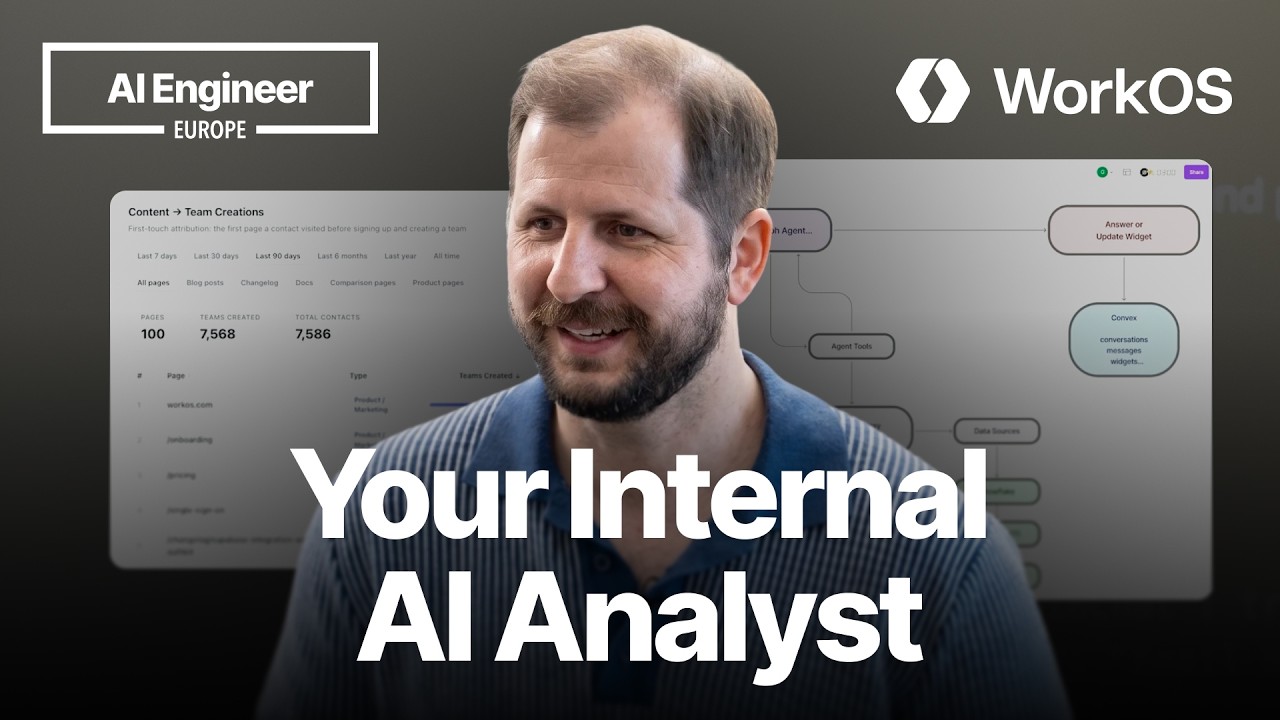
Garrett Galow from WorkOS introduces Studio, an internal tool that empowers non-technical teams to independently answer complex business questions by building custom apps and dashboards that integrate multiple data sources using a large language model and intelligent agents. Studio ensures accuracy through dynamic context injection, validation processes, and secure governance, ultimately reducing reliance on specialized data teams while maintaining performance and cost efficiency.
Garrett Galow from WorkOS presents a unique internal tool called Studio designed to improve productivity by enabling teams to answer business-related questions independently. He explains the common challenge many companies face: employees often have questions about customer behavior or product usage but lack the technical skills or data access to find answers themselves. Traditionally, this leads to a slow, back-and-forth process involving data teams or engineers running specific queries or building dashboards. Studio addresses this by providing an internal workspace where users can build custom apps or dashboards to answer their questions directly, reducing dependency on specialized teams.
Studio integrates with various internal data sources such as Snowflake, Linear, and Notion, allowing it to query and combine data from multiple tools. When a user submits a question, Studio uses a combination of a large language model (LLM) called Opus and an agent called Lane Graph to interpret the query, access the relevant data, and generate answers or interactive widgets. These widgets are reusable, live tools that can be shared across teams and used in meetings, providing dynamic insights such as tracking which marketing content drives new customer sign-ups or investigating security events in their Radar product.
The system relies on a sophisticated approach to ensure accuracy and reliability. It uses sequencing to run pre-flight checks, verify tool connections, and gather necessary context before querying data. Contextual information about database schemas and business logic is injected dynamically to guide the LLM in generating correct SQL queries. Studio also validates queries by running them and checking for meaningful results before finalizing widgets. This layered approach helps mitigate common issues like outdated model knowledge or incomplete data filtering, ensuring that the outputs are trustworthy and useful.
Garrett also discusses governance and security aspects, noting that while there is some inherent trust in the system, they embed rules and context to prevent common data errors. The widgets generated are actual code (JavaScript) that makes API calls directly to data sources, so once created, they operate reliably without involving the LLM repeatedly. User access is currently managed on a per-user basis for integrations, but WorkOS is developing an organizational permissioning layer to streamline access control and improve usability. This will allow centralized connection management and role-based access to data.
Finally, Garrett addresses concerns about cost and performance. Although running LLM queries can be expensive, WorkOS prioritizes quality and uses a high-performing model (Opus) to justify the expense. Since the widgets themselves are declarative code that runs independently after creation, ongoing costs are minimized. Overall, Studio represents a powerful internal solution that empowers non-technical teams to answer complex business questions quickly and accurately, improving operational efficiency and reducing reliance on specialized data teams.