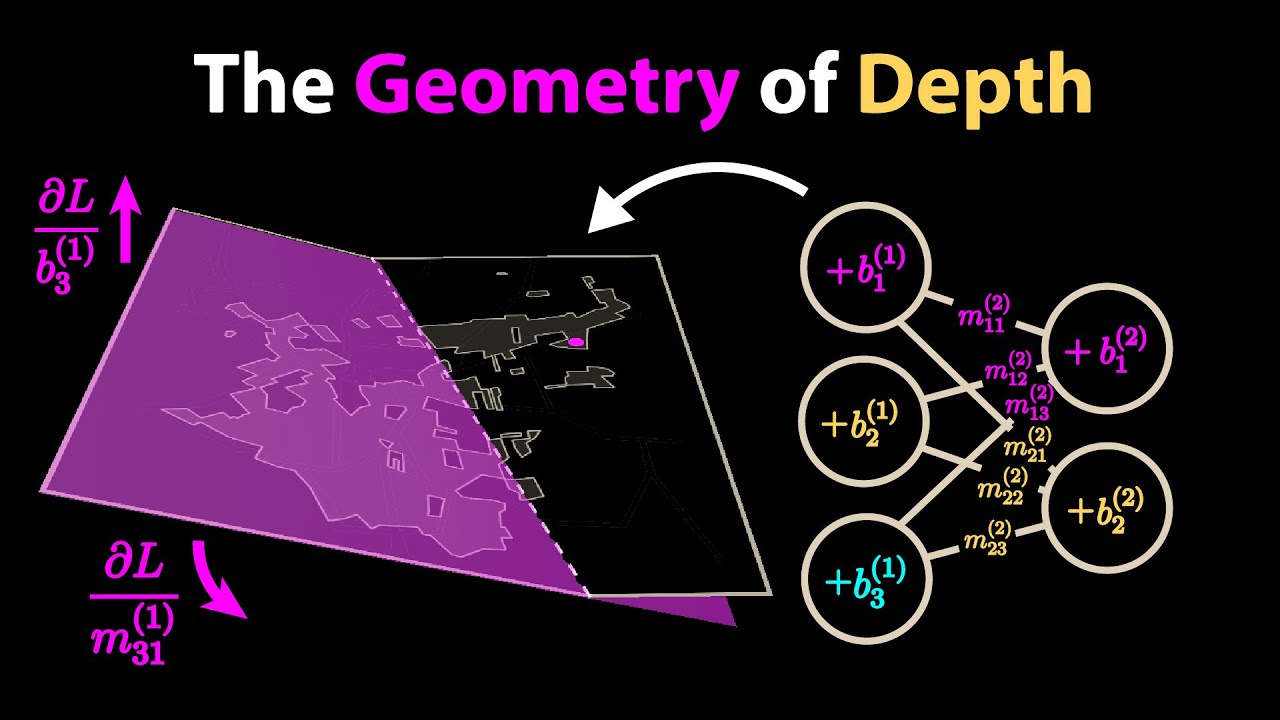
The video explains that deep learning’s exceptional performance stems from the exponential increase in representational complexity achieved by stacking multiple layers, allowing deep neural networks to efficiently model intricate functions and decision boundaries that shallow wide networks struggle to learn. It highlights the limitations of the universal approximation theorem in practice and emphasizes the importance of depth and compositional geometry for effective training and function approximation.
The video explores why deep learning models, particularly deep neural networks, perform exceptionally well in approximating complex functions and decision boundaries. It begins by discussing the universal approximation theorem, which states that a sufficiently wide two-layer neural network can approximate any continuous function to arbitrary precision. Using the example of a complex geographic border between Belgium and the Netherlands, the video illustrates how neurons with rectified linear unit (ReLU) activation functions fold and bend input spaces to create piecewise linear surfaces that represent classification confidence. However, even extremely wide two-layer networks with tens of thousands of neurons struggle to perfectly learn the border, highlighting practical limitations of the theorem.
A key insight is that simply increasing the width of a shallow network does not guarantee finding an optimal solution due to challenges in training with gradient descent and backpropagation. The video shows that random initialization can lead to suboptimal configurations where gradient signals vanish, preventing the model from improving. Moreover, the universal approximation theorem does not specify how many neurons are needed or how to efficiently train the network. This explains why very wide shallow networks may fail to learn complex patterns despite their theoretical capacity.
The video then contrasts shallow wide networks with deeper networks that stack multiple layers of neurons. Each layer applies folding, scaling, and combining operations, but when composed across layers, these operations compound to create exponentially more complex partitions of the input space. This exponential growth in the number of linear regions allows deep networks to represent intricate decision boundaries with far fewer neurons than shallow networks. Visualizations demonstrate how adding layers increases the number of fold lines and regions, enabling the model to capture fine details of the geographic border more effectively.
Mathematically, the maximum number of linear regions a ReLU network can create grows exponentially with the number of layers but only polynomially with the number of neurons in a single layer. This theoretical advantage explains why deep architectures are more powerful and efficient at learning complex functions. However, the video also notes that these theoretical bounds are loose and that practical networks do not always achieve the maximum possible complexity. Nonetheless, deep networks trained with gradient descent can learn highly detailed decision boundaries that shallow networks cannot match, as shown by training animations and region visualizations.
In conclusion, the video emphasizes that the power of deep learning arises from the compositional geometry created by stacking layers, which enables efficient representation and learning of complex functions. It also reflects on the challenges of training wide shallow networks and the importance of depth for practical success. The creator shares personal insights about the evolution of neural network understanding over the past decade and encourages further exploration and experimentation. The video ends with a call for support to continue educational content creation, highlighting the ongoing journey to demystify deep learning.