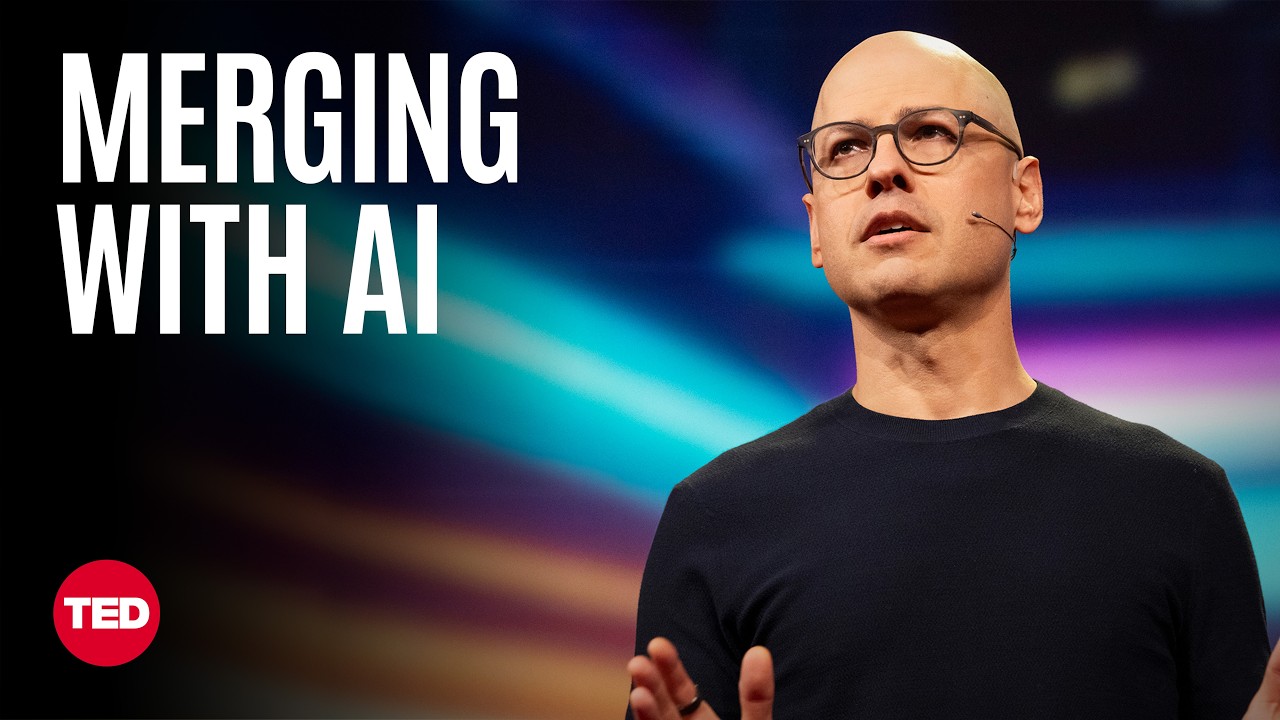
D. Scott Phoenix argues that humanity is on the verge of a major evolutionary transition through merging with AI, similar to how ancient single-celled organisms combined to form complex life, and that this integration offers immense benefits but requires collective unity and responsibility. He emphasizes that embracing this merger thoughtfully is crucial to ensuring a thriving future where humans and AI coexist and enhance one another rather than compete.
In his TED talk, D. Scott Phoenix reflects on the rapid changes brought by AI and the uncertainty they create about the future. Drawing a parallel to a pivotal moment two billion years ago when single-celled organisms merged to form complex cells, he highlights how such major transitions in evolution have always involved mergers that create new, more powerful wholes. This ancient merger, which led to the mitochondria becoming part of cells, enabled the development of larger bodies and brains, ultimately leading to human life as we know it.
Phoenix argues that humanity is now on the brink of another major transition: the merger of humans and AI. He acknowledges the fears surrounding AI, including the risk of it becoming a rival that could replace humans. Many AI experts themselves worry about the potential dangers, but the competitive race to develop AI makes slowing down difficult. He emphasizes that if AI remains separate from us, it will not be a tool but a competitor, potentially leading to humanity’s displacement.
However, Phoenix offers a hopeful perspective by pointing out that this merger is already underway. He illustrates how technology has progressively integrated into our lives, moving closer to our minds—from mainframes to smartphones to neural implants. These advancements are beginning to blur the line between human thought and machine intelligence, with brain-computer interfaces restoring lost abilities and potentially enabling new cognitive enhancements, such as rapid learning and shared memories.
The speaker stresses that this integration will become increasingly seamless, making it difficult to distinguish where human cognition ends and AI begins. He warns that while merging with AI offers tremendous benefits, it also requires a collective commitment to remember that we are parts of a larger whole. Drawing an analogy to cancer, he explains that when parts forget their role in the whole, the system fails. Similarly, society must hold together to successfully navigate this transition without fracturing.
In conclusion, Phoenix calls for unity and cooperation as humanity faces the challenges of AI integration. He reminds us that major evolutionary transitions succeed only when the parts remain connected and work together. The future depends on our ability to hold together as a society, adapt to change, and embrace the merger with AI. His message is a plea for collective responsibility to ensure that this transition leads to a thriving future for all, including the next generations.