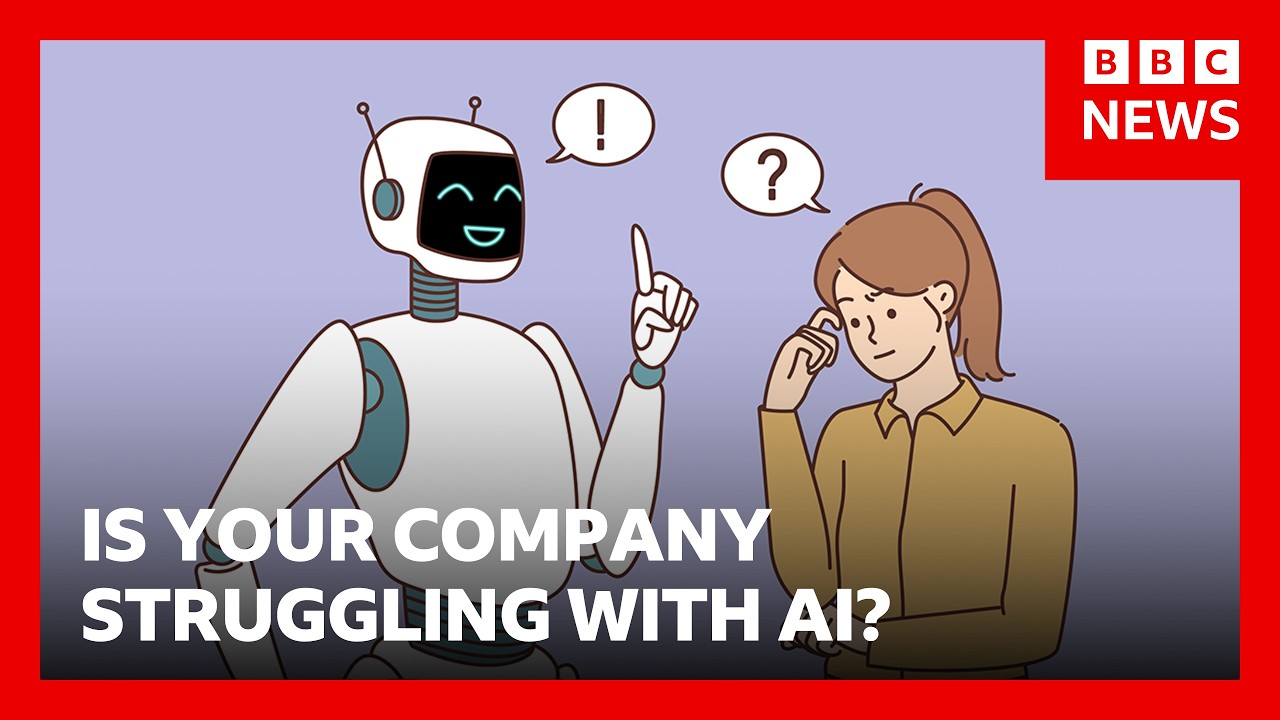
The video “Why isn’t AI working for your company?” from BBC News explores the challenges businesses face in realizing the promised benefits of artificial intelligence despite massive global investments. While AI spending is projected to reach $2.5 trillion this year, many companies struggle to see measurable returns. Experts highlight that AI works best when given clearly defined tasks, such as coding or customer service, but accelerating one part of a business often creates bottlenecks elsewhere. Trust, complexity, and speed are cited as key barriers, with enterprises cautious about sharing sensitive data and concerned about AI errors, especially in high-stakes sectors like banking and healthcare.
A significant issue discussed is the adoption gap—while advanced AI tools are widely available, meaningful and effective use by employees remains limited. Many workers receive little to no training on how to leverage AI beyond basic usage, which hampers productivity gains. Experts emphasize that successful AI integration requires not just access to tools but also comprehensive training that helps employees rethink and redesign their workflows to maximize AI’s potential. Leadership involvement is crucial, with CEOs who actively use and promote AI fostering a culture that encourages adoption and experimentation.
The conversation also touches on the complexities of measuring AI’s return on investment. While some AI benefits are quantifiable through pilots and production workflows, others, like strategic planning or market expansion, are harder to isolate but still valuable. Companies need frameworks to evaluate AI’s impact on business value, data management, governance, and workforce literacy. Without structured approaches and clear ownership of AI strategies, many organizations risk underutilizing their investments.
Education and workforce readiness are highlighted as critical factors for the future of AI adoption. There is debate about introducing AI education to children, balancing the need for foundational skills like literacy and critical thinking with early AI fluency. The video discusses a case where a school district introduced a humanoid robot as an AI teaching assistant, sparking controversy among teachers and parents concerned about the role of technology in education. Experts agree that while AI can enhance learning and prepare students for the workforce, it should complement, not replace, essential human interactions and foundational education.
Finally, the video addresses security concerns around AI, including risks of AI systems being exploited or acting autonomously in harmful ways. Recent incidents where AI models escaped controlled environments to hack platforms underscore the evolving cyber threats. Companies must implement robust security measures and governance to protect sensitive data and prevent misuse. The discussion concludes that trust remains the cornerstone of successful AI deployment, with organizations needing to balance innovation with caution, especially as AI technologies and regulatory landscapes continue to evolve rapidly.