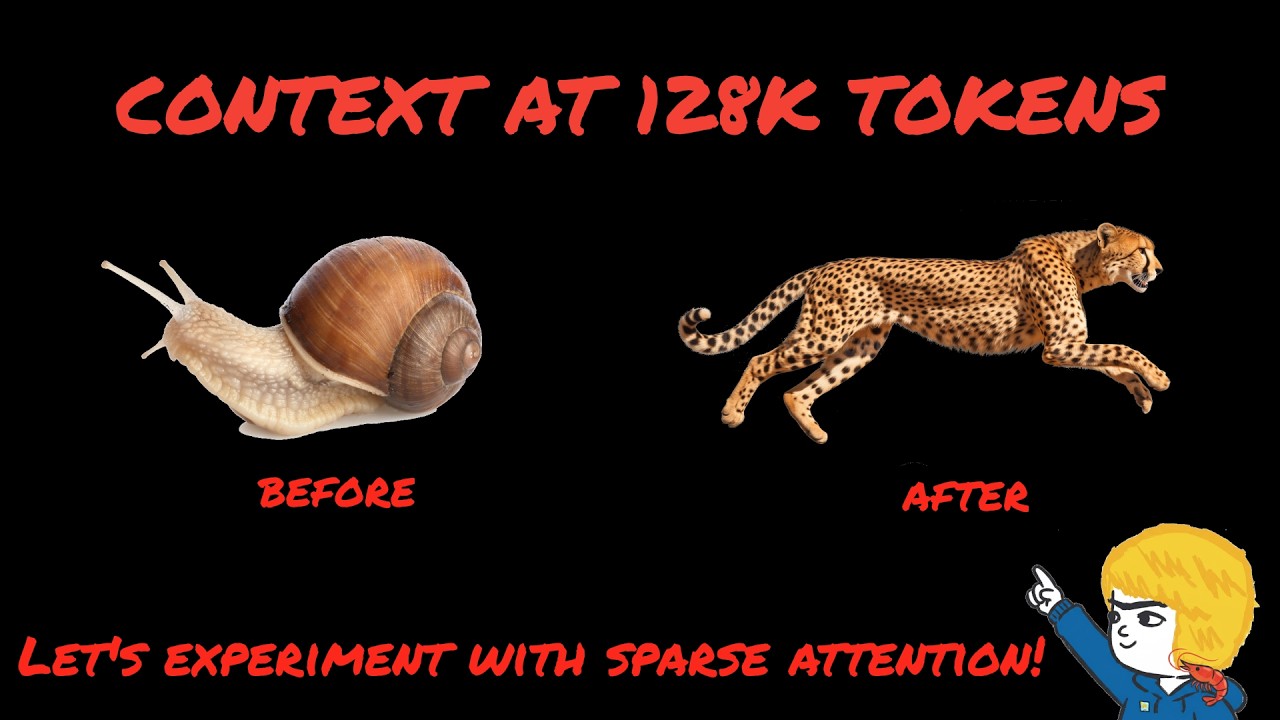
The video explores the challenge of slow performance in large language models (LLMs) when handling extremely long context windows, such as 128,000 tokens or more. The core issue lies in the attention mechanism, where each word in the input must attend to every other word, causing computational costs to grow quadratically with context length. This results in significant slowdowns and inefficiencies, especially in models with many layers. The presenter introduces the concept of attention in transformers, explaining how each token checks all previous tokens to determine relevance, which becomes impractical at very large scales.
To address this, the video reviews several existing attention optimizations. Multi-head attention (MHA) assigns separate memory to each attention head but is memory-intensive. Grouped Query Attention (GQA) reduces memory by sharing key-value memory among groups of heads, and Flash Attention optimizes speed without changing the architecture. However, none of these methods solve the fundamental quadratic scaling problem because every token still attends to every other token. The presenter then introduces DeepSeek Sparse Attention (DSA), which performs a quick scan to select relevant tokens before attending fully, reducing computation but still requiring a full scan of all tokens initially.
The main focus is on Hierarchical Indexed Sparse Attention (HISA), which improves upon DSA by organizing tokens into blocks and first selecting relevant blocks rather than individual tokens. This hierarchical approach drastically reduces the number of operations needed, as only a small subset of blocks and tokens within those blocks are fully attended to. HISA scales much better with increasing context length, maintaining near-constant computation time even as input size grows. The video references a research paper demonstrating that HISA achieves 2 to 4 times faster token selection with negligible quality loss and no retraining required.
The presenter then describes their own experiment implementing HISA on a consumer-grade GPU using PyTorch, applying it to the Qwen 2.5 and Llama 3.2 models. Despite initial challenges and bugs, the implementation showed significant speed improvements—up to 9.3 times faster at 8,000 tokens and enabling processing of longer contexts that the baseline model could not handle due to memory constraints. Quality tests using perplexity showed that HISA maintained comparable or slightly better prediction quality compared to dense attention, confirming that the speed gains did not come at the cost of model performance.
In conclusion, the video demonstrates that HISA is a promising method to overcome the quadratic bottleneck in long-context LLMs, enabling faster and more efficient attention computation without sacrificing quality. The presenter shares their open-source PyTorch plugin and encourages further experimentation and improvement by the community. They also discuss potential future directions, such as integrating fused GPU kernels, flash attention, and KV cache eviction, to further enhance speed and scalability. The video highlights the importance of such innovations for the future of large-context LLMs, especially for local deployments on consumer hardware.