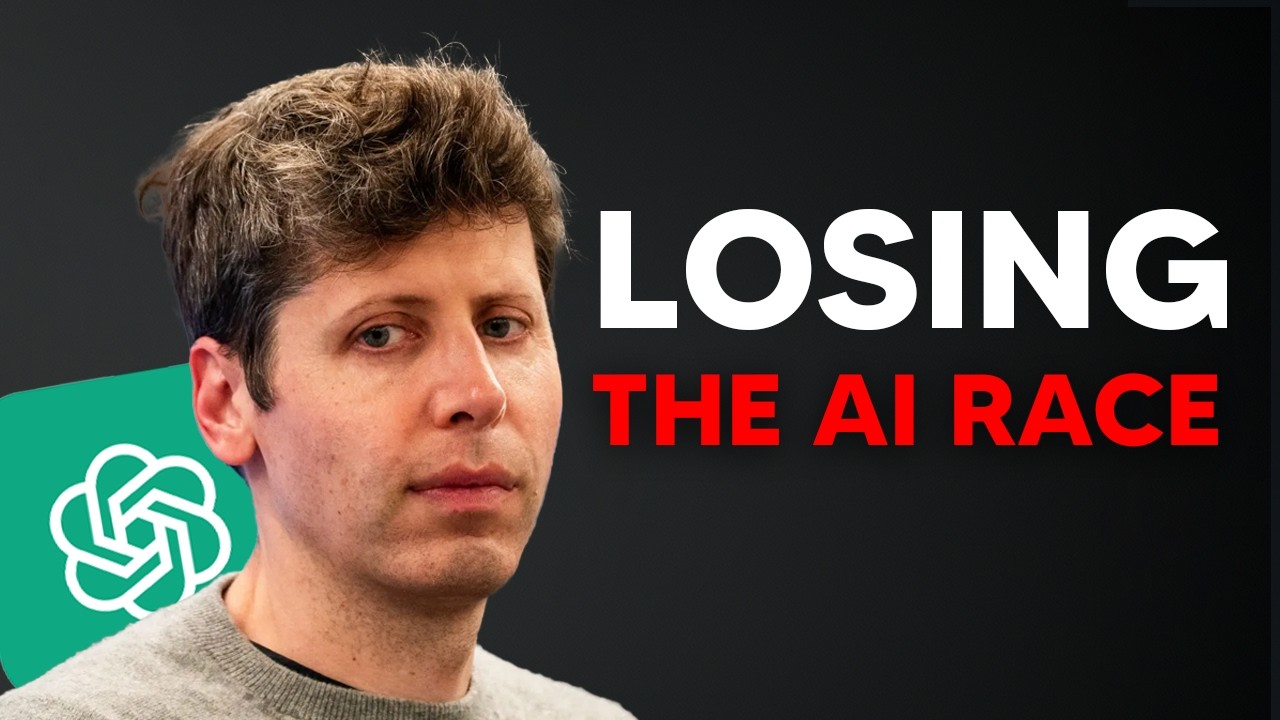
OpenAI, once the undisputed leader in AI with ChatGPT dominating the market, is now facing significant challenges that threaten its position. In December 2025, CEO Sam Altman issued a “code red” memo, halting various projects to focus solely on saving ChatGPT amid declining market share and mounting financial losses. While OpenAI still boasts around 800 million weekly users, only a small fraction pay for the service, making its free queries costly. The company is burning through billions, with projects like its video generation tool Sora proving economically unsustainable. Additionally, OpenAI is losing key talent and facing internal frustrations over shifting priorities from long-term research to immediate competitiveness.
A major factor in OpenAI’s struggles is its attempt to be everything at once—consumer app, API provider, video platform, search engine, and research lab—resulting in a lack of focus and dominance in any single area. Meanwhile, competitors Anthropic and Google have taken more strategic approaches. Anthropic concentrated on enterprise and coding solutions, achieving explosive revenue growth by delivering products tailored to paying customers and developers. Their Claude AI, with a large context window for coding tasks, has become a favorite among enterprises, securing contracts with major companies and rapidly expanding its market share.
Google, on the other hand, has pursued a multimodal AI strategy, integrating vision, audio, video, and text into unified models like Gemini. This approach has led to significant advancements in AI capabilities, including processing and understanding complex video content and embedding multimodal data into a single system. Google’s vast resources allow it to invest heavily without immediate profitability concerns, and its partnerships, such as embedding Gemini into Apple’s Siri, position it to reach billions of users, far surpassing OpenAI’s reach.
OpenAI’s reputation has also taken a hit, partly due to CEO Sam Altman’s public missteps and controversial statements, which have fueled criticism and eroded public trust. Product launches like GPT-5 and GPT-5.2 have been publicly acknowledged as flawed, further damaging user confidence. The company’s controversial Pentagon contract sparked widespread backlash, leading to user boycotts and subscription cancellations, while Anthropic’s refusal of similar deals boosted its standing and user base.
Looking ahead, OpenAI faces a daunting path to justify its high valuation and planned IPO, needing to dramatically increase revenue amid falling market share and rising costs. Its competitors’ focused and well-funded strategies contrast sharply with OpenAI’s scattered efforts and financial strain. The situation echoes past tech industry shifts where pioneers were overtaken by more strategically positioned players. Ultimately, the AI race is not about who started first but who builds the right product for the right customers, and currently, OpenAI is struggling to find that winning formula.