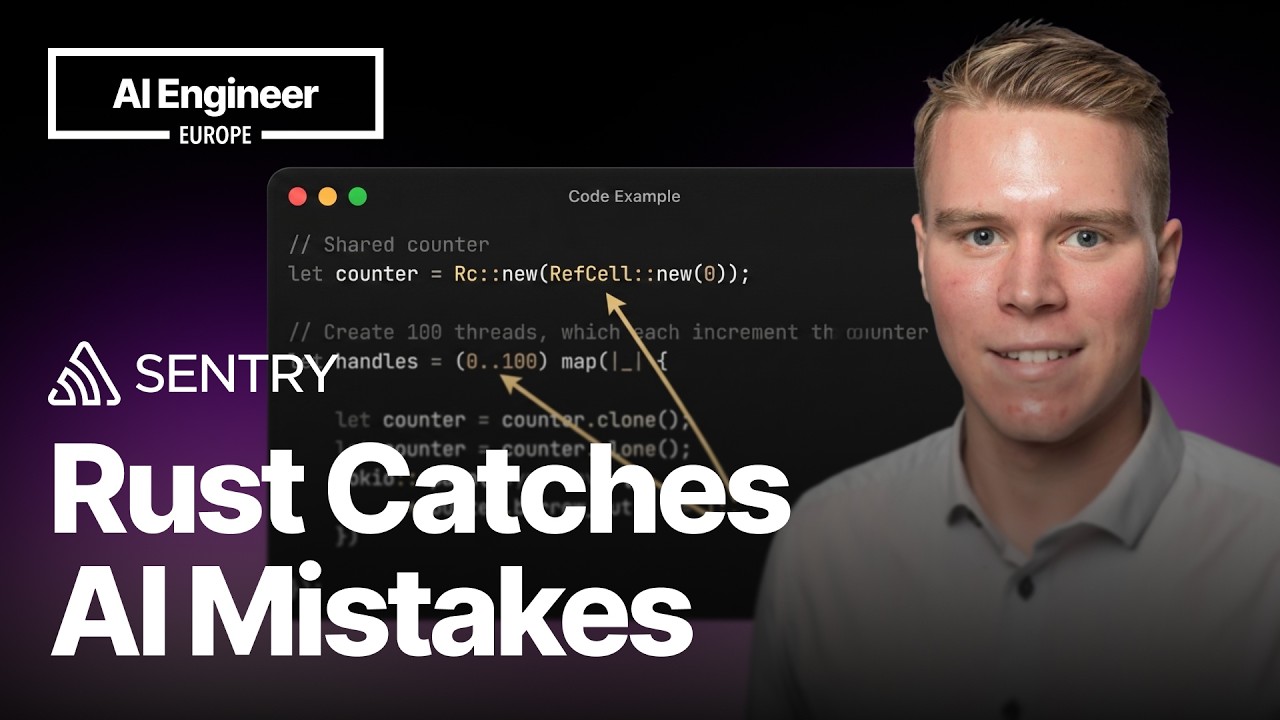
Daniel Szoke argues that despite the popularity of dynamic languages like Python and JavaScript for AI-assisted “vibe coding,” Rust’s strict compile-time safety guarantees and detailed compiler feedback make it a superior choice for reducing subtle bugs and improving code reliability in AI-generated code. He emphasizes that Rust’s deterministic guardrails, especially around concurrency, provide a valuable safety net that enables AI agents to iteratively produce higher-quality code, making Rust ideal for agentic programming.
Daniel Szoke, the Rust SDK maintainer at Sentry, discusses why Rust is the ideal language for “vibe coding” or agentic coding, a style of programming assisted by AI agents. He begins by acknowledging the conventional wisdom that Python, JavaScript, and TypeScript are the top languages for AI-assisted coding due to their familiarity, abundance of libraries, and ease of use for both humans and large language models (LLMs). These dynamic and interpreted languages allow for quick iteration and scaffolding, making them popular choices for developers leveraging AI tools.
However, Szoke challenges the assumption that ease of writing code by LLMs is always beneficial. He argues that the flexibility and dynamic nature of these languages often lead to subtle and obvious mistakes, which are difficult to catch solely through testing or code reviews. Since LLMs are inherently fallible and non-deterministic, relying on tests generated by AI or human reviewers is insufficient to guarantee bug-free code. He emphasizes the importance of deterministic guardrails to prevent errors, which are often lacking in these popular dynamic languages.
Szoke introduces Rust as a language designed with strict safety and performance guarantees, making it well-suited for AI-assisted development despite its complexity. Rust’s compiler enforces strong type safety, null safety, and fearless concurrency, which prevent many common bugs at compile time. He highlights how Rust’s strict compiler errors provide detailed feedback that AI agents can use to iteratively fix code, reducing the likelihood of runtime errors and improving overall code reliability.
A key example Szoke provides is Rust’s handling of concurrency issues. Unlike JavaScript or TypeScript, where data races might only be detected at runtime and can be difficult to debug, Rust’s compiler prevents unsafe multi-threaded code from compiling. This feature ensures that concurrency bugs are caught early, which is especially valuable when code is generated or modified autonomously by AI agents. Although Rust is harder for LLMs to write correctly on the first try, its compile-time checks serve as a powerful safety net.
In conclusion, Szoke argues that the trade-off of Rust’s complexity is worthwhile because AI agents can leverage its strict compiler feedback to improve code quality autonomously. He suggests that Rust’s deterministic guardrails make it an ideal language for vibe coding, reducing the risk of subtle bugs that dynamic languages are prone to. He ends by inviting viewers to explore Sentry’s monitoring tools for AI-assisted development and offers a promotional free trial for their business plan.