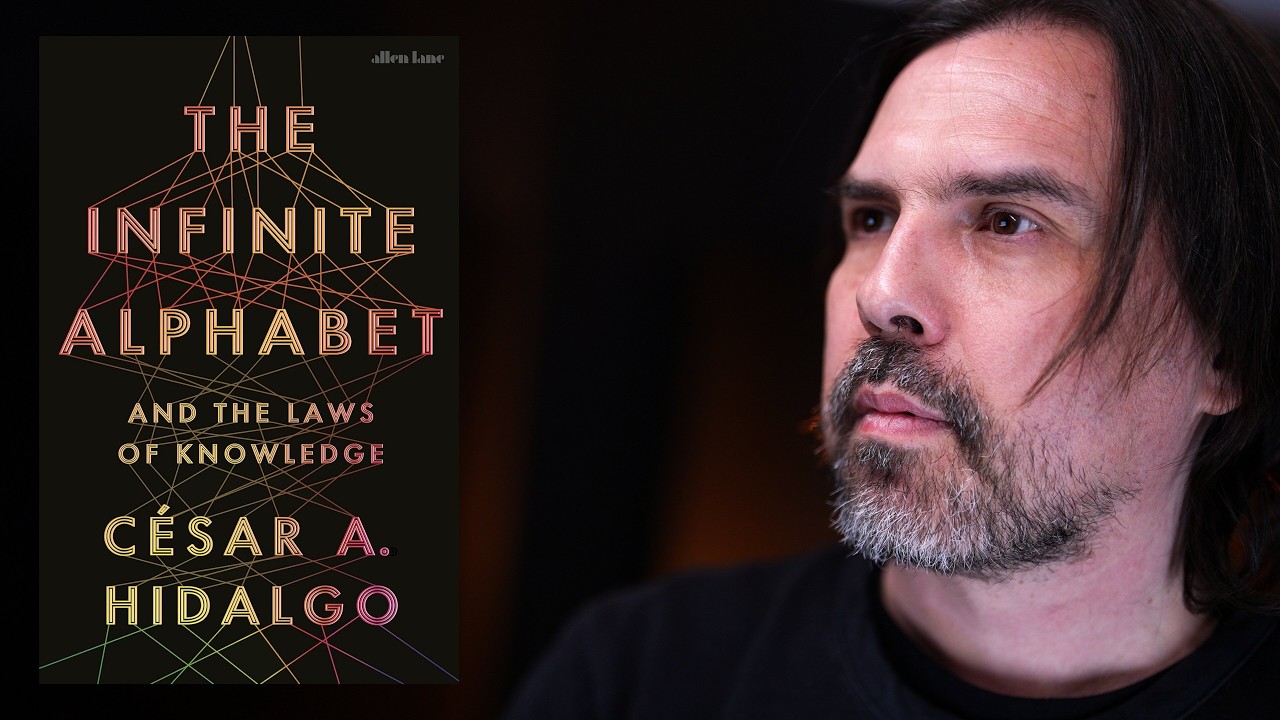
César Hidalgo, director of the Center for Collective Learning, discusses the core ideas from his book The Infinite Alphabet and the Loss of Knowledge. He introduces three fundamental laws governing knowledge: how it grows over time, how it diffuses across space and activities, and how its value can be estimated. Hidalgo emphasizes that knowledge is not just an abstract, easily transferable commodity; it is non-fungible and deeply embedded in individuals, teams, and organizations. He argues that many failed development projects stem from misunderstanding the true nature of knowledge, likening such efforts to building rockets without understanding gravity or chemistry.
A key theme is the distinction between different types of knowledge: factual, conceptual, and procedural. Hidalgo illustrates that while factual knowledge is easy to transmit, procedural and conceptual knowledge are much harder to transfer and often require direct experience and collective embodiment. He uses historical examples, such as the story of Samuel Slater bringing water-powered cotton spinning to the United States, to show how critical hands-on, situated knowledge is for technological progress. Books and manuals alone are insufficient; knowledge must be embodied in people and their interactions.
The conversation explores how knowledge decays rapidly if not actively maintained and practiced. The story of the Polaroid camera factory in the Netherlands exemplifies this: even with access to original equipment and experienced staff, the knowledge required to produce high-quality instant film was largely lost after production ceased, and it took years to recover. This highlights the fragility of collective knowledge and the importance of continuous practice and transmission across generations, as seen in the Japanese temple rebuilt every 20 years to preserve construction skills.
Hidalgo also delves into the dynamics of innovation and economic growth, explaining how knowledge diffusion is constrained by both geography and the structure of knowledge itself. He uses the analogy of monkeys jumping between trees in a forest to describe how countries and organizations move into new industries based on their existing capabilities. Migrants play a crucial role in enabling jumps to more distant “trees,” fostering diversity and innovation. However, simply injecting financial resources or copying institutions is insufficient for development if the underlying knowledge base is lacking.
Finally, the discussion touches on the measurement of knowledge and its implications for economic potential. Hidalgo introduces the concept of the “infinite alphabet,” where the diversity and specificity of knowledge components in an economy predict its future growth. He argues that complexity and diversity—measured by the range of unique “letters” or capabilities—are better predictors of economic success than income alone. The conversation concludes with reflections on the collective nature of knowledge, the limitations of large language models, and the importance of nuanced, story-driven communication to convey the richness and specificity of real-world knowledge.