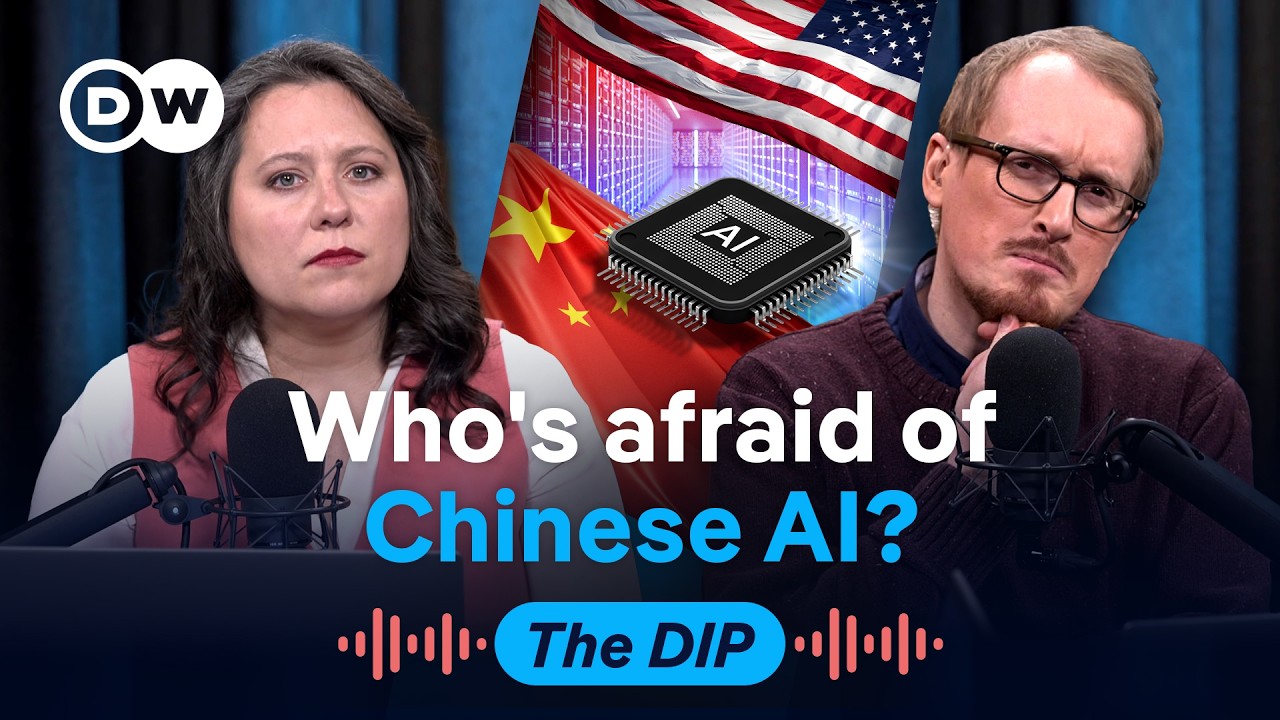
The podcast episode explores the intensifying AI race between the US and China, focusing on the recent breakthroughs by Chinese AI company DeepSeek. DeepSeek disrupted the industry by demonstrating that top-tier AI performance could be achieved on less powerful, more affordable hardware, challenging the prevailing belief that only the biggest and newest models would dominate. Their upcoming DeepSeek V4, a coding-focused model, claims to outperform ChatGPT at a fraction of the cost, raising concerns among US companies like OpenAI. The discussion highlights how the gap between leading Chinese and US AI models has narrowed significantly, with Chinese models now only a few months behind their American counterparts and sometimes outperforming them on certain benchmarks.
The conversation moves beyond the simple “race” metaphor, emphasizing that both countries are pursuing multiple strategies and verticals within AI. In China, companies like Alibaba are integrating AI into their existing ecosystems, while startups such as Moonshot and Jup are targeting specific sectors. The US, meanwhile, sees fierce competition among its own tech giants, with Google and OpenAI pushing the frontier. The podcast notes that while China has made impressive technical advances, its models have not yet achieved the same level of global recognition or adoption as DeepSeek did, partly due to psychological and sociological factors in the West.
Deployment strategies also differ: the US relies on private sector innovation and expects the market to find applications for powerful models, whereas China pursues a more centralized, government-driven approach to boost AI adoption across its economy and internationally, especially in Asia-Pacific and Africa. The US continues to outspend China on data centers and chips, but China is betting on efficiency, developing models that run well on less advanced hardware and focusing on specific use cases. This divergence could lead to different AI ecosystems, with each country excelling in areas aligned with their respective strengths and strategies.
The podcast also addresses concerns about the sustainability of current AI investment levels, questioning whether the sector is in a bubble and if returns will justify the massive spending on infrastructure. The hosts discuss foundational challenges, such as chip supply and energy needs, noting that while the US leads in compute capacity and investment, China’s rapid expansion in renewable energy and focus on efficiency could give it an edge in the long run. The open-source nature of many Chinese models, which are often released with open weights, also poses a challenge to the subscription-based business models favored by US companies.
Finally, the episode considers the global implications of the US-China AI rivalry. While both countries dominate the AI landscape, other nations are developing their own models or adapting existing ones to local needs. The future may not be a binary contest but rather a fragmented ecosystem with different models serving different markets and use cases. The hosts predict that 2026 will be pivotal, especially with the rise of AI agents capable of performing real-world tasks, and stress the importance of trust and adoption rates in shaping the trajectory of AI worldwide. They also highlight the need for new educational approaches to keep pace with rapid technological change and suggest that international collaboration on AI governance and safety remains crucial despite growing competition.