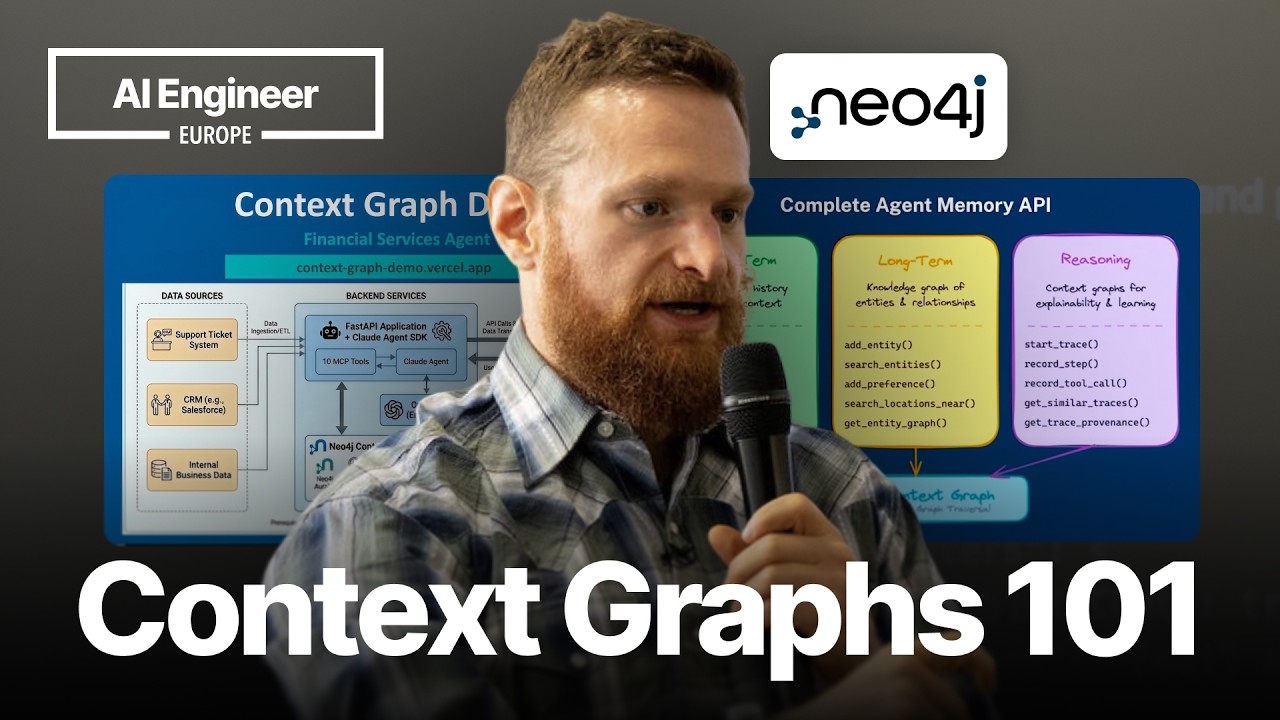
Zach Blumenfeld from Neo4j, a graph intelligence company, presented on the concept of context graphs and their importance for AI agents. He explained that while traditional knowledge bases help agents answer questions accurately, context graphs go further by enabling agents to make better decisions. This is achieved by incorporating decision traces, precedents, and dynamic information about why past decisions were made, allowing agents to provide not only answers but also explanations and recommendations based on causal chains and historical context.
Zach demonstrated a financial analyst agent example where the agent uses a context graph to assess customer information, transactions, and policies, then references past decision traces to decide whether to accept or reject a request. The system combines semantic and structural similarity searches using graph embeddings, which embed connected nodes into vectors, enabling efficient retrieval of similar decision traces. This approach surpasses traditional document-based retrieval by leveraging the interconnected nature of graph data to provide richer, more explainable reasoning.
He introduced tools developed by Neo4j, including a recently released command-line utility that allows developers to quickly create full-stack context graph applications with a single command. This tool scaffolds the backend, frontend, and demo data, supporting multiple frameworks and domains such as healthcare and financial services. It also supports importing data from popular SaaS platforms like GitHub, Slack, and Notion, making it easier to build and experiment with context graphs in real-world scenarios.
Underpinning these tools is the Neo4j agent memory package, which manages short-term memory (conversation history), long-term memory (entities extracted and resolved over time), and reasoning (decision traces). The package includes sophisticated entity extraction pipelines that combine spaCy, gliner, and large language model fallbacks to convert raw text into structured graph data. This structured approach helps agents maintain context and reason over time, improving their ability to handle complex, multi-turn conversations and decision-making processes.
In closing, Zach shared resources including live demos, GitHub repositories, and documentation to help developers get started with context graphs. He emphasized that the project is open source and evolving, inviting contributions from the community. During the Q&A, he addressed questions about adding timestamps, automating ontology creation, and storing decision traces, acknowledging ongoing work to enhance these capabilities. Overall, the presentation highlighted how context graphs represent a significant advancement in making AI agents more accurate, explainable, and capable of sophisticated reasoning.