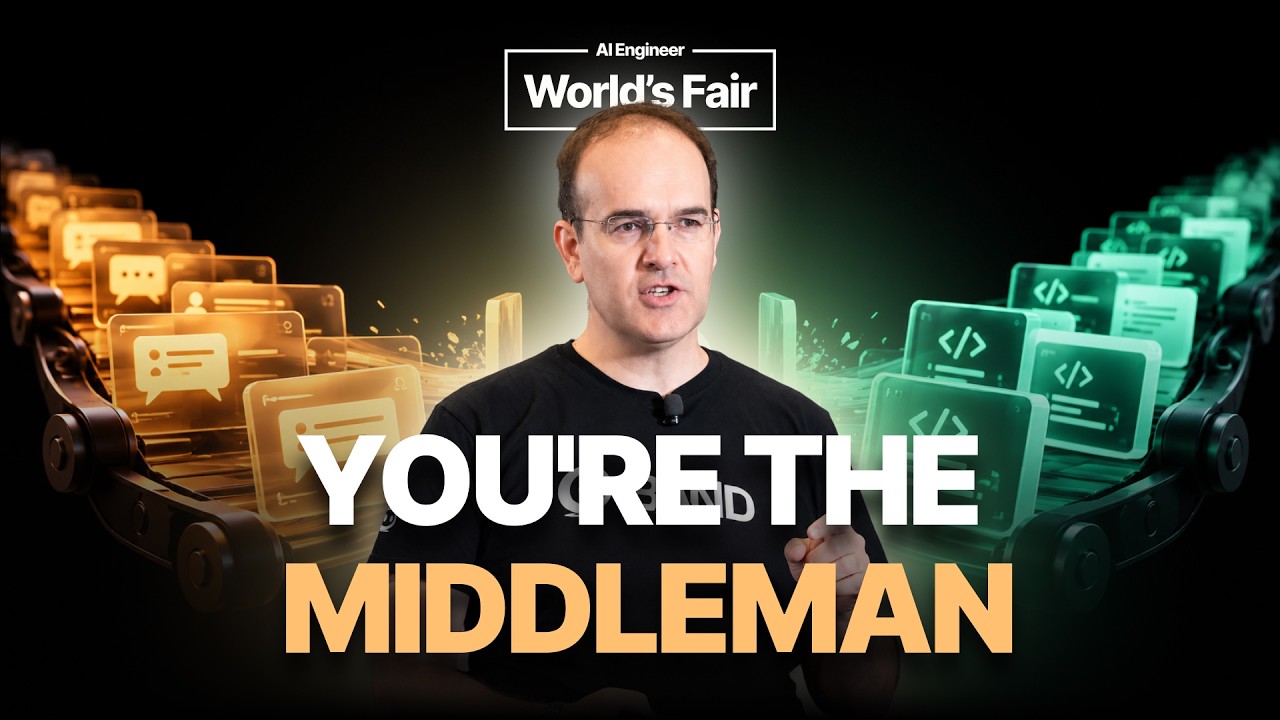
Vlad Luzin, co-founder and CTO of BAND, presented on the current challenges and future of AI-to-AI communication. He began by outlining the company’s thesis: the future of AI lies in autonomous agents communicating seamlessly within and between businesses and consumers to accomplish tasks on our behalf. Vlad illustrated this vision with a demo showing agents interacting in a conversational space, delegating tasks, searching for colleagues, and collaborating in real time. This sets the stage for understanding the importance of multi-agent systems in AI development.
He then discussed the evolution from competitive agents—where multiple AI sessions work on the same task independently—to loop engineering, which involves orchestrating multiple stateful agents through code to enable collaboration. Vlad highlighted the limitations of single-agent systems, such as confirmation bias and limited context handling, which make multi-agent approaches necessary. However, current solutions like messaging platforms (Slack, Discord, Telegram) are inadequate for agent-to-agent communication because they are designed for human interaction and require complex manual setup.
Vlad critiqued existing protocols like MCP and A2A, explaining that they are too low-level and stateless, lacking essential features such as session state, discovery, and bidirectional communication. Implementing these features individually leads to building complex infrastructure rather than focusing on multi-agent collaboration. He emphasized that connecting multiple agents is fundamentally a distributed systems challenge, requiring real-time, ordered message transport, persistence, runtime binding, and higher-level abstractions like conversations and channels tailored for agents.
To address these challenges, Vlad introduced BAND’s new platform, which simplifies multi-agent communication by providing a global interaction layer that supports any agent, platform, or language. The platform includes features like automatic agent discovery, persistence, security, observability, and message filtering, enabling agents to collaborate seamlessly while keeping humans in the loop. He demonstrated the platform with recorded demos showing agents owned by different users connecting, exchanging tasks, and working together in real time, highlighting the ease and transparency of the system.
In conclusion, Vlad stressed that while multi-agent systems are already in use, current tools and protocols fall short of enabling scalable, reliable AI-to-AI communication. BAND’s platform aims to solve these problems by abstracting away the complexities of distributed systems and providing a robust foundation for loop engineering and agent collaboration. He invited attendees to visit their booth for live demos and further engagement, signaling a significant step toward realizing the vision of autonomous AI agents working together efficiently.
Useful Links