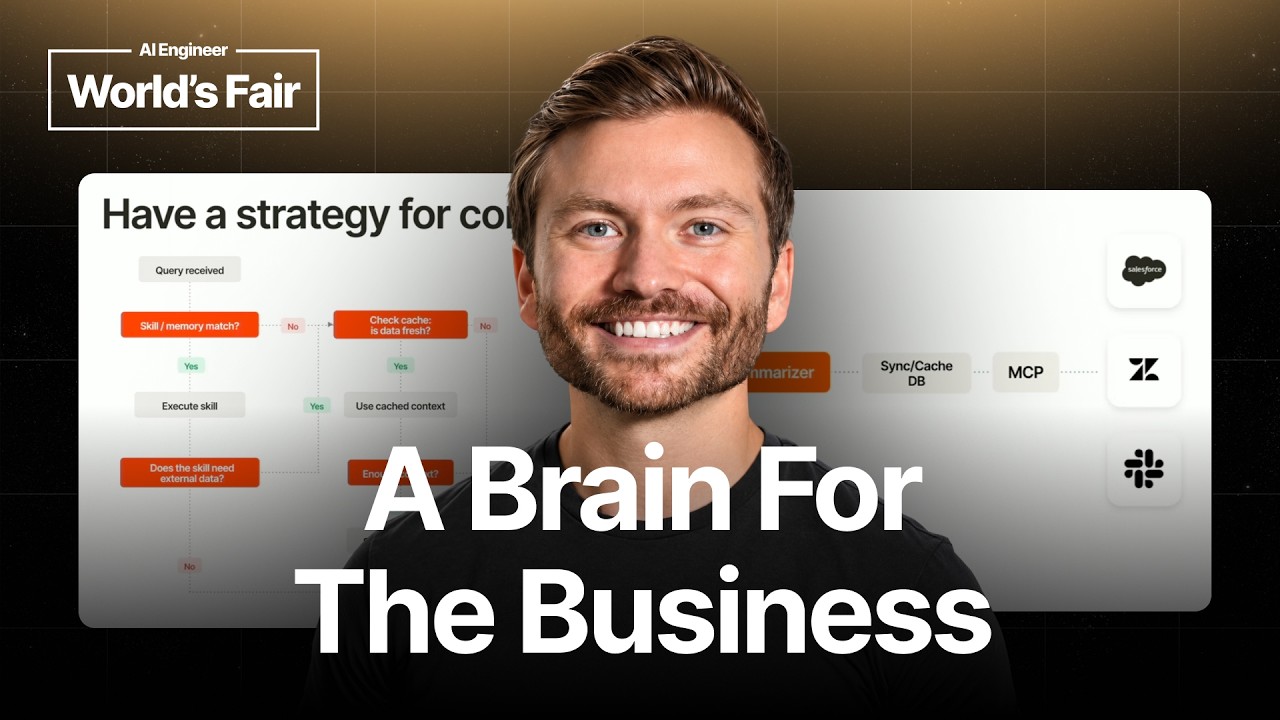
Gil Feig, co-founder and CTO of Merge, presents the importance of building a context graph for companies to effectively leverage AI. He explains that a context graph acts as a company’s brain, integrating various data sources such as third-party systems (e.g., NetSuite, Jira), structured data, memories formed during agent interactions, and company-specific skills. This comprehensive context layer enables AI agents to provide accurate and relevant responses by combining live lookups, cached data, and company-specific logic.
Feig illustrates the limitations of relying solely on live API calls (MCPs) for answering complex queries, such as identifying which customers were upset over a long period. Live lookups are often inefficient or unsupported for semantic queries across large datasets, necessitating a syncing layer that locally caches data in vector databases. This hybrid approach—combining live lookups for simple queries and cached data for deeper analysis—ensures timely and meaningful AI responses without overwhelming external systems or risking timeouts.
The context graph also incorporates a routing and summarization process. Incoming prompts are routed to the appropriate agent, which then checks for relevant memories or skills before querying the cached or live data sources. Summarizers condense the gathered information to provide concise answers. Skills are particularly crucial as they encode company-specific rules and processes, such as how to interpret customer satisfaction, ensuring that AI responses align with unique business contexts.
Feig outlines four tiers of context: prompt skills and memory, live API calls, cached (synced) data, and derived context created from processing raw data. Each tier plays a distinct role in delivering accurate and efficient AI-driven insights. He emphasizes the importance of traceability and provenance—tracking where data originates, when it was fetched, and how it was transformed—to maintain data freshness, ensure accountability, and support troubleshooting when AI decisions go wrong.
In conclusion, Feig stresses that tools alone do not constitute context; a context graph integrates data, processes, and skills to create a unified company brain. Quality and freshness of data are paramount, and every AI-generated answer must be traceable. Merge offers products like Gateway, Unified, and Agent Handler to help companies build and manage their context graphs, enabling seamless internal and customer-facing AI applications.
Useful Links
- Merge Agent Handler — Directly discussed as a component of the context graph architecture.
- Merge Gateway — Key product discussed for routing in the context graph system.