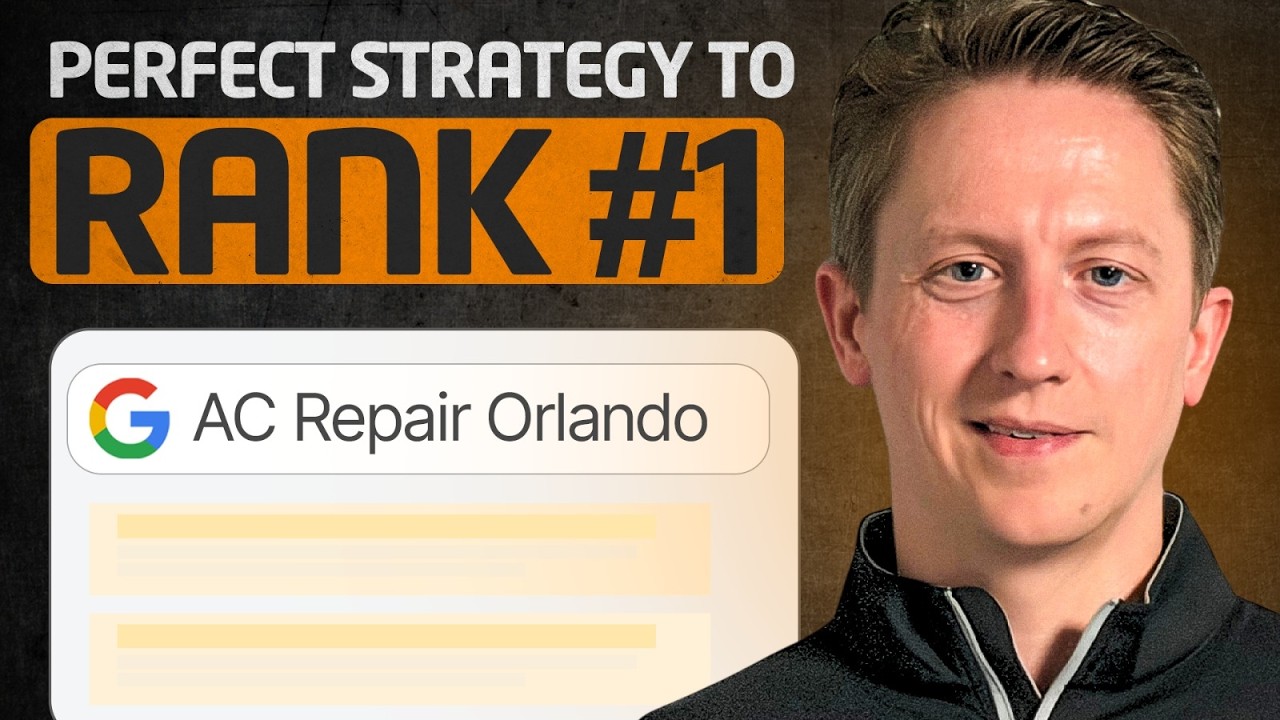
In this video, Caleb Allcoue, an SEO expert running a seven-figure agency, analyzes why certain local businesses rank higher on Google, using the example of AC repair companies in Orlando, Florida. He begins by searching “AC repair Orlando” and examines the top-ranking businesses in the Google map pack and organic results. Caleb emphasizes the importance of having the city name and search term in the title tag, noting that the top-ranked company, Our Place Home & Air Repair, nails this with “AC repair Orlando” in their title. He praises their website for clear, customer-focused content, strong social proof with numerous reviews, and user-friendly features like call buttons and chat options, although he suggests replacing their scrolling hero image with a fixed one to improve conversions.
Next, Caleb reviews the second and third-ranked companies, Mechanical One and another HVAC service, pointing out areas for improvement. Mechanical One’s title tag lacks the exact search term “AC repair,” and their website has too many buttons, which can overwhelm users. The third company uses keyword stuffing in their title and has poor design choices, such as illegible text and misplaced social proof, which likely hurt their conversion rates despite ranking well. Caleb highlights that these companies have fewer reviews than the top-ranked business, suggesting that review volume and quality play a significant role in rankings and user trust.
Caleb then critiques a lower-ranked company, Professional Inc., which fails to include the city name “Orlando” on their homepage or title tag, a critical SEO mistake that likely contributes to their poor ranking. He also notes the absence of local business schema markup, which helps search engines understand the website’s content and relevance. Their blog content is generic and not locally focused, and their internal linking is disorganized, reducing their site’s SEO effectiveness. Caleb stresses the importance of structuring a website to mirror the categories and services listed on the Google Business Profile (GBP) for better local relevance and rankings.
Further, Caleb examines another company with a high number of reviews but poor website design choices, such as multiple changing stock images and a large wall of text that deters users. Their content is generic and lacks compelling reasons for customers to choose them, and their FAQ section is weak. He also criticizes their attempt to build geographical relevance by listing many neighborhoods randomly, explaining that this outdated tactic no longer works since Google’s algorithm update in 2018. Instead, he recommends creating hyper-local content focused on specific landmarks or neighborhoods to build stronger local relevance and improve rankings.
In conclusion, Caleb summarizes that the key to ranking well in local search lies in combining strong on-page SEO elements—like including the city and search terms in titles, structured and relevant content, proper schema markup, and user-friendly design—with robust social proof such as numerous positive reviews. He highlights that businesses not ranking in the top three essentially do not exist to desperate customers searching for emergency services. These principles apply across all local niches, not just AC repair, and Caleb invites viewers to explore his other case studies, such as local food businesses, to see these strategies in action.