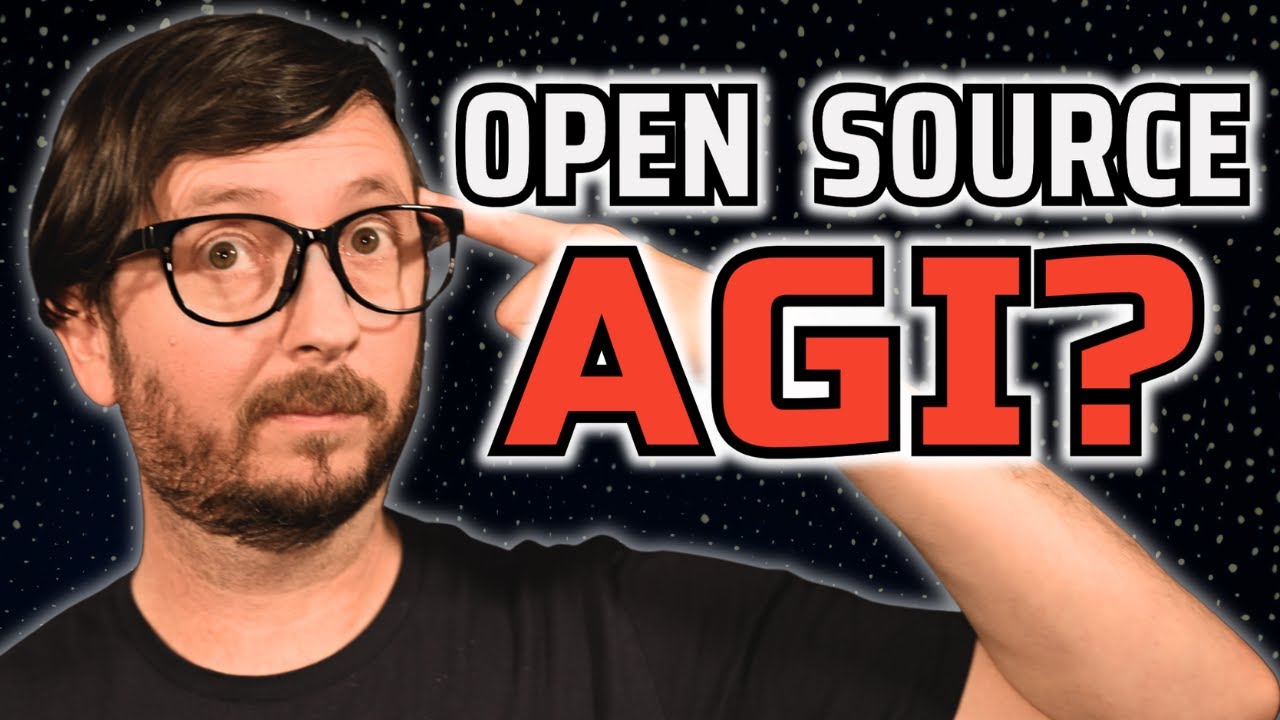
The video argues that while open-source AI initiatives drive much innovation, the first true AGI is unlikely to be released openly due to high hardware demands, proprietary control, and economic incentives favoring large corporations. It also highlights the ongoing challenges in AI development, including technical limitations, geopolitical factors, and the balance between open collaboration and corporate control, urging cautious optimism and community engagement in the evolving AI landscape.
The video explores the question of whether Artificial General Intelligence (AGI) will be open source, concluding that while open-source initiatives are driving much of AI development, the actual release of AGI as open source is unlikely. Companies tend to release some AI tools openly but keep their most advanced technologies proprietary to monetize them effectively. The timeline for achieving AGI is still several hardware generations away, primarily due to limitations in system bandwidth and the need for fundamentally new mathematical approaches. Although open source leads innovation, the first company to achieve AGI will likely keep it under tight control, making it inaccessible for individual or garage-level use.
The discussion highlights the significant hardware demands for AI development, especially in terms of VRAM and system bandwidth, which are currently only affordable for large corporations. The video notes that while local AI solutions and open-source projects like those from the Allen Institute and Chinese companies are advancing, they still lag behind the capabilities of proprietary systems. The speaker emphasizes the importance of maximizing current AI tools and prompting techniques to extract value during what appears to be a plateau phase in AI breakthroughs. The future may see a divergence between powerful cloud-based AI and more limited but accessible on-device AI.
Geopolitical and economic factors also play a role in the AGI race. Governments and corporations are likely to adopt a “winner takes all” mentality, but independent researchers and smaller players will continue to contribute to progress. The video stresses that AGI and superintelligence remain distant goals, with breakthroughs like DeepSeek R1 being rare and unpredictable. Financially, the speaker advises caution, recommending that individuals avoid debt when investing in AI hardware due to economic uncertainties and the rapid depreciation of expensive GPUs like the Nvidia 4090.
The video also touches on recent developments in AI voice technology, such as Microsoft’s Vibe Voice, which was initially released under an open-source license but then pulled back due to concerns about misuse. This incident illustrates the challenges corporations face in balancing innovation, open-source collaboration, and control over powerful AI tools. The speaker praises the quality of these voice AI tools and their potential for virtual production and home assistant applications but notes that corporate reactions to open-source successes can be confusing and sometimes counterproductive.
Finally, the video encourages viewers to engage in discussions about the future of AGI, open source, and AI hardware. It highlights the importance of community input and ongoing exploration of AI tools, including tutorials and builds. The speaker also acknowledges the support of channel members who help fund GPU purchases, which are essential for testing and advancing AI capabilities. Overall, the video provides a thoughtful and realistic perspective on the current state and future trajectory of AGI development, emphasizing both the technical and socio-economic challenges ahead.