The video addresses widespread concerns about AI causing mass unemployment, acknowledging that while AI is rapidly advancing and capable of automating many economically important tasks, the impact on jobs and wages is complex. Historically, automation has sometimes increased employment and wages by making workers more productive and shifting the value from automated skills to complementary ones. For example, the introduction of ATMs reduced clerical tasks but increased customer service roles, and AI has so far made radiologists and software engineers more productive rather than obsolete. However, as automation progresses, some jobs do decline, illustrating a pattern of initial employment growth followed by reduction.
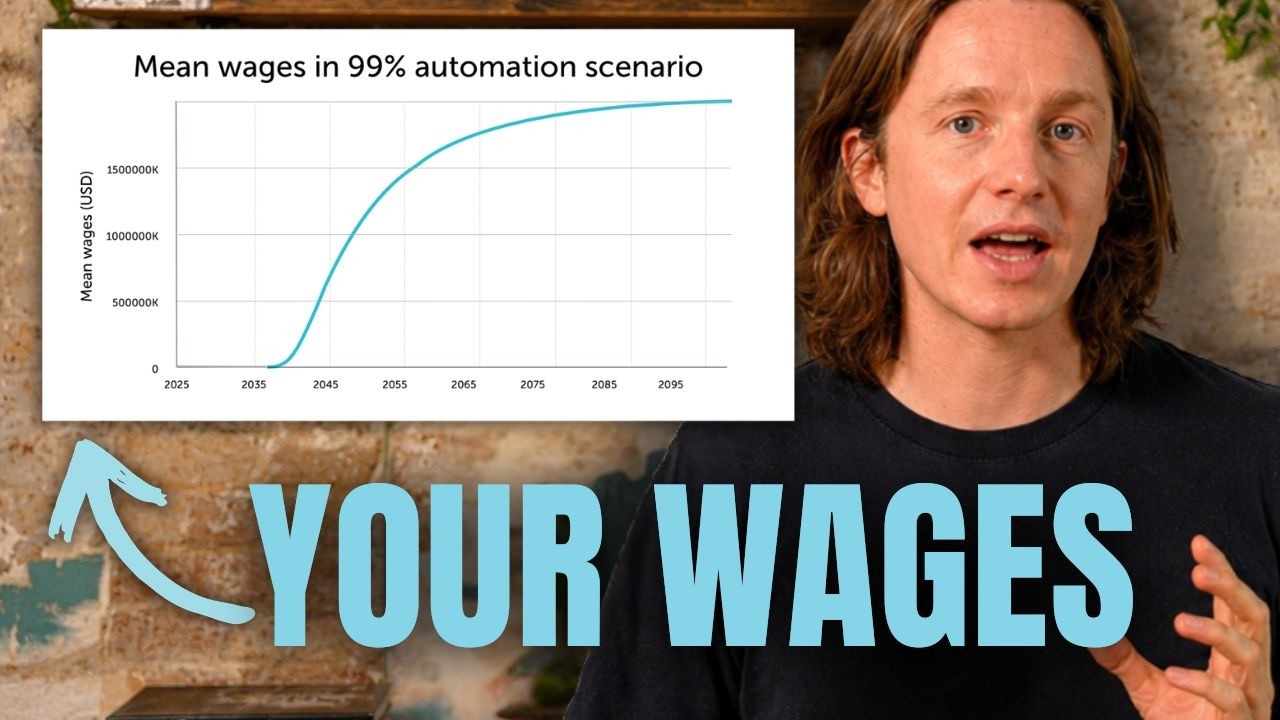
Looking ahead, economic models suggest two possible futures: one where wages rise significantly before collapsing if AI fully automates all tasks, and another where humans remain essential for a small fraction of tasks, leading to continuous wage growth and wealth creation. The key for workers is to focus on skills that AI cannot easily automate or that complement AI, maximizing their value during the transition. The video identifies four categories of skills likely to increase in value: those hard to automate, skills needed to deploy and manage AI, skills producing goods and services people will consume more of, and specialized skills that are difficult for others to learn.
Skills hard to automate often involve complex physical tasks, unpredictable environments, or long-term judgment and coordination, such as leadership, strategy, and managing AI teams. AI deployment skills include managing AI systems, designing projects, and understanding AI models’ strengths and weaknesses. Additionally, jobs that produce goods or services people will demand more of as they become cheaper—like healthcare or luxury experiences—are expected to grow. Specialized skills that take time to acquire and match unique strengths, such as electricians specializing in data centers, are also valuable.
The video emphasizes the importance of transferable and foundational skills that enhance effectiveness across many roles. These include learning to use AI tools effectively, maintaining personal well-being, improving productivity habits, decision-making and prioritization, social skills, and the ability to learn quickly. Leadership, operations management, policy, communications, and technical expertise in AI, cybersecurity, and international relations are highlighted as particularly impactful and in demand. The combination of technical and social skills is especially valuable, enabling individuals to bridge emerging technologies and real-world applications.
Ultimately, the video advises against seeking a single “future-proof” job and instead encourages adapting by moving into skills that rise in value as AI advances. It stresses that automation tends to decrease the value of some skills while increasing others, and success lies in riding this wave. For those interested in deeper guidance on choosing and learning these skills, the video references the book “80,000 Hours,” which offers research-based career advice tailored to the evolving job landscape shaped by AI.