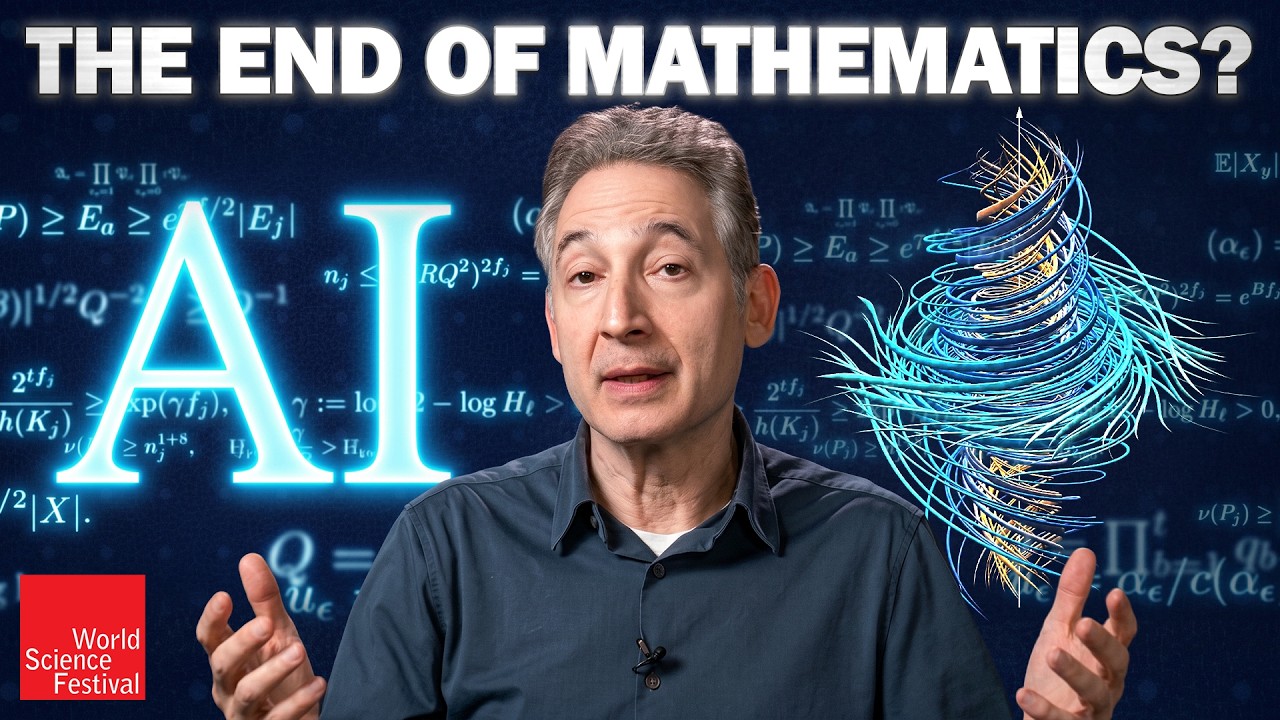
The video discusses the rapid advancements AI has made in solving longstanding mathematical problems, including tackling hundreds of unsolved problems in a very short time. This unprecedented progress raises questions about the future role of human mathematicians. While AI can provide solutions quickly, the speaker emphasizes the importance of the mathematical journey—the development of ideas and methods that enrich the field—which traditionally comes from human struggle and insight.
The speaker reflects on historical examples, such as the four color theorem, where computer-assisted proofs provided answers but left some mathematicians feeling a lack of deep understanding. This raises the question of whether AI-generated solutions will similarly lack the rich insights that human mathematicians develop. However, early indications suggest that AI’s reasoning might itself contain novel insights and methods, challenging the notion that only humans can provide meaningful mathematical journeys.
A key point is the distinction between AI’s ability to combine existing knowledge and the human capacity for creativity—those flashes of original, groundbreaking ideas exemplified by mathematicians like Cantor, Gödel, and Poincaré. While some hope that this uniquely human creativity will remain irreplaceable, the speaker is skeptical and suggests that AI might eventually match or surpass even the most brilliant human minds in mathematics, potentially transforming the field profoundly.
Looking ahead, the speaker envisions a future where some mathematicians continue traditional work, while others become adept at collaborating with AI, leveraging its power to explore new mathematical frontiers. If AI can generate original ideas and develop them fully, conventional mathematical practice might become obsolete for most, akin to living off the grid in a modern world. However, this would not mark the end of mathematics but rather a shift in human roles.
Ultimately, the speaker argues that humans will remain essential as curators, critics, and guides, deciding which mathematical questions matter and which AI-generated results are meaningful. Human discernment and taste will shape the direction of mathematical inquiry, preventing the field from becoming an overwhelming, unfocused mass of information. Thus, while AI will expand mathematical knowledge exponentially, human mathematicians will continue to play a vital role in steering and enriching the discipline in this new era.
Useful Links