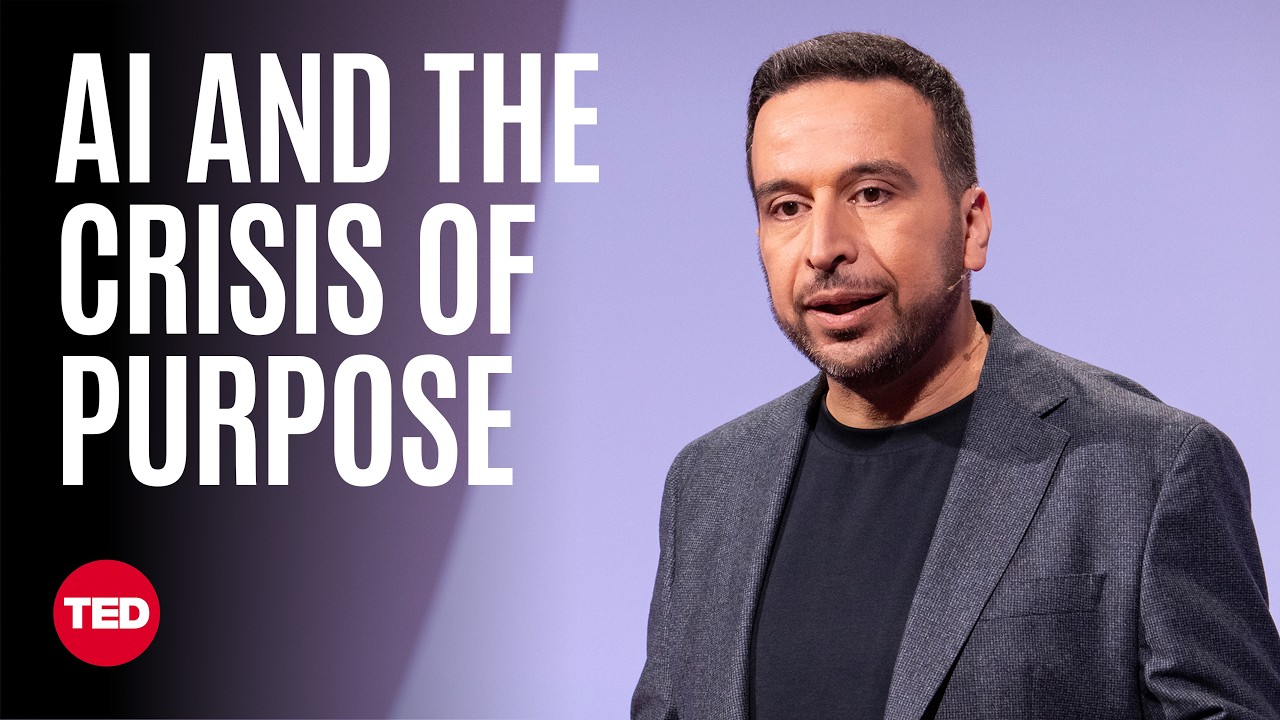
Akram Awad’s TED talk explores the profound impact artificial intelligence (AI) is having on human work, identity, and purpose. He begins by illustrating the anxiety many professionals, like Elena, a doctor in Dubai, feel as AI systems increasingly outperform humans in complex tasks, even in fields like medicine. This technological shift is not just a threat to jobs, but to the sense of meaning and dignity people derive from their work. Awad warns that society may be facing not only a job crisis but also a crisis of purpose, as traditional roles and sources of self-worth are disrupted.
Awad traces the evolution of how societies have defined identity. Before the Industrial Revolution, people’s sense of self was rooted in faith, family, and community, with work being just one aspect of life. Industrialization changed this, making work central to identity—“What do you do?” became synonymous with “Who are you?” Now, AI is dismantling this model by automating tasks across all sectors, from manufacturing to creative industries. The World Economic Forum predicts that by 2025, AI will perform more tasks than humans, putting hundreds of millions of jobs at risk.
To navigate this new reality, Awad introduces the “GAP circles” framework: Guardians, Adapters, and Pioneers. Guardians are those who focus on humanity’s survival, working in fields like medicine and climate science, but even their roles will be reshaped by AI. Pioneers are driven by curiosity—scientists, explorers, and philosophers who collaborate with AI to push the boundaries of knowledge. Adapters, the largest group, will find meaning not through traditional employment but through how they live, connect, and contribute to their communities, such as by caring for others or fostering creativity.
Awad argues that society must fundamentally rethink how it values and compensates contribution. As AI reduces the need for traditional work, new systems should ensure everyone has access to basic resources and recognize meaningful acts of contribution, like caregiving or community engagement. Education must also shift focus from purely technical skills to character development, emphasizing emotional intelligence, ethics, and resilience. Additionally, communities and spaces are needed to help people rediscover their identities as jobs disappear.
Ultimately, Awad calls for a cultural reset, urging society to move beyond equating productivity with purpose or income with contribution. He envisions a future where recognition and legacy, rather than wealth, become the new status symbols, and where daily life is enriched by small acts of connection and creativity. The age of AI, he concludes, is not just a test of technology but of human imagination. By redefining value and reclaiming purpose, humanity can build a future where work is no longer the center of identity, but where meaning is found in deeper, more human connections.