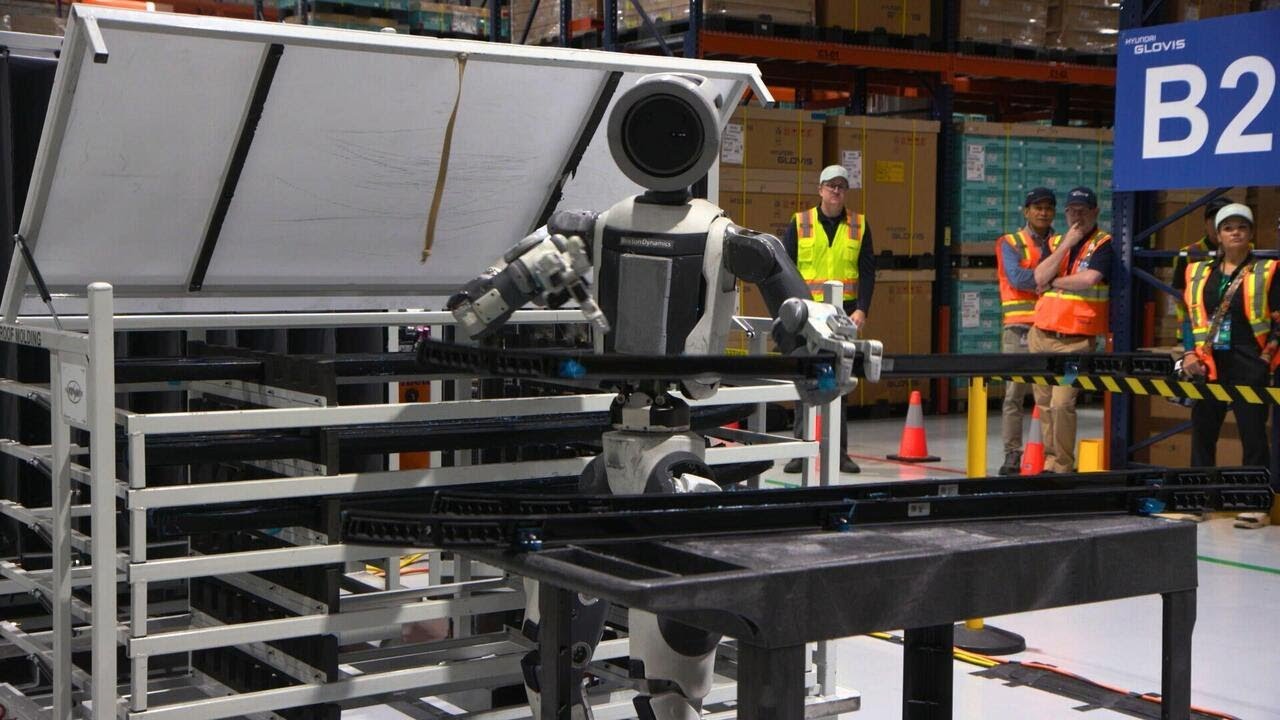
The 60 Minutes segment explores the rapid advancements in AI-powered humanoid robots, focusing on their transition from research labs to real-world workplaces. Companies like Tesla, Amazon- and Nvidia-backed startups, and Chinese firms are racing to develop robots capable of performing human jobs. Boston Dynamics, now majority-owned by Hyundai, is a frontrunner with its Atlas robot. The program visits Hyundai’s cutting-edge factory in Georgia, where over a thousand robots already work alongside humans, and witnesses Atlas’s first real-world test as it autonomously sorts parts for the assembly line.
Atlas represents a significant leap in robotics, featuring a sleek, all-electric design and an AI “brain” powered by Nvidia chips. Unlike earlier versions that relied on pre-programmed algorithms, the new Atlas learns through machine learning, demonstrations, and simulations. Engineers teach Atlas tasks by directly controlling it via virtual reality or by capturing human movements with motion sensors, then training thousands of digital Atlases in simulation to perfect new skills. Once a skill is learned, it can be uploaded to all Atlas robots, accelerating their collective progress.
Despite these advances, Atlas and other humanoids still face limitations. Everyday human tasks like dressing or carrying coffee remain too complex for robots to handle as smoothly as people do. However, researchers are optimistic that continued improvements in AI and machine learning will eventually enable robots to master such activities. The goal is to create general-purpose robots that can understand and adapt to new environments and instructions, much like humans.
Boston Dynamics’ journey began with its robotic dog, Spot, which is already deployed for industrial inspections and quality control at sites worldwide. The company envisions humanoid robots with superhuman capabilities—stronger, more resilient, and able to operate in hazardous environments. While some fear the rise of “rogue robots,” Boston Dynamics’ leaders emphasize the current challenges in robotics and dismiss concerns about sentient machines, focusing instead on practical applications and safety.
The segment also addresses concerns about job displacement, noting that robots will likely take over repetitive and physically demanding tasks, but will still require human oversight, maintenance, and training. The global race for humanoid robotics is intensifying, with Chinese companies investing heavily and threatening to outpace U.S. firms. Hyundai’s investment in Boston Dynamics is part of a broader strategy to stay ahead. While it may take several years before robots like Atlas are fully integrated into the workforce, the vision of robots working alongside humans is quickly becoming a reality.